Nonlinear Optimal Control and Filtering beyond the HJB Equation
A novel set of sufficient conditions - equivalent to the HJB equation for the solution of nonlinear optimal control problems.
Overview
Optimal control and filtering problems have a rich history that can be traced back to Queen Dido’s solution to the isoperimetric problem in 814 BC, the solution to the brachistochrone problem by Johann Bernoulli in 1696, and the introduction of the least-squares method by Legendre and Gauss in the late 18th and early 19th centuries.
Modern solutions exploit the calculus of variations and its control perspectives, Pontryagin’s Minimum Principle, Bellman’s Principle of Optimality, and the Wiener and Kalman filters.
While for linear systems all roads lead to the Algebraic Riccati Equation and its dual, we demonstrate that for nonlinear systems one can go well beyond the HJB equation by judiciously exploiting properties of the stable invariant manifold, the associated invariant distribution, and adapted coordinates for the underlying Hamiltonian system. These, in turn, yield PDEs that differ dramatically from the HJB equation and have a deep geometrical meaning.
Finally, we propose an ansatz for developing global solutions based on a fixed-point characterization of optimal feedback strategies and on a geometric relation between the tangent space to the stable manifold and the first order approximation of the Hamiltonian vector field away from its equilibrium.
This is joint work with Mario Sassano (University of Rome Tor Vergata).
Presenters
Brief Biography
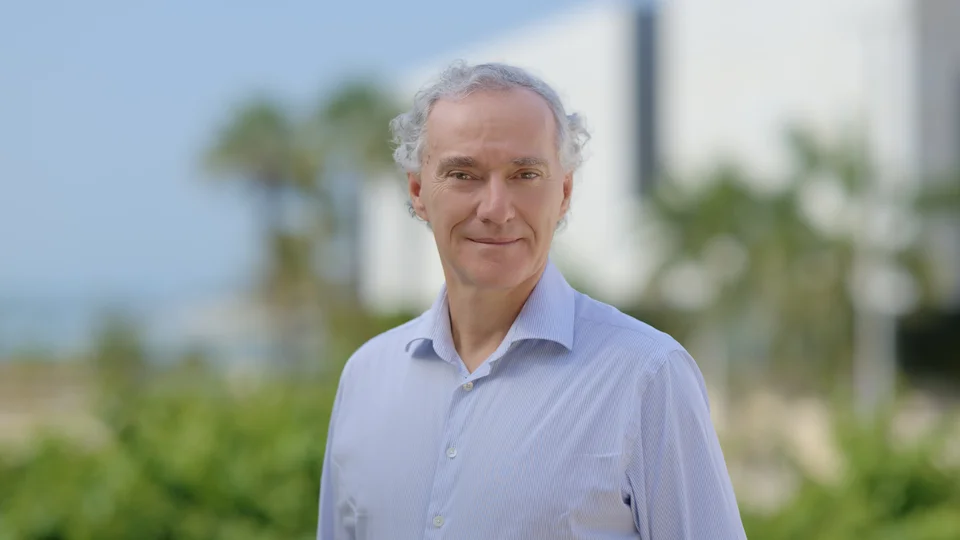
Alessandro Astolfi is professor of applied mathematics and computational science at KAUST and a leading scholar and pioneer in nonlinear systems and control. His research focuses on the analysis and design of advanced control strategies for complex, large-scale, and interconnected systems, with applications spanning robotics, power systems, aerospace, and social and biological systems.
Before joining KAUST, he was professor of nonlinear control theory at Imperial College London and also held professorial appointments at the University of Rome Tor Vergata and Politecnico di Milano.
Astolfi’s work delivers mathematically rigorous methods and algorithms that address engineering challenges. He collaborates closely with academic institutions and industry leaders worldwide, advancing technologies that support infrastructure, energy, and intelligent automation.
An accomplished educator and mentor, Astolfi is committed to developing the next generation of engineers and researchers. At KAUST, he leads interdisciplinary research initiatives and provides master’s and Ph.D. students with opportunities to engage in high-impact projects at the forefront of systems and control theory.