
Building bridges between mathematical statistics and real-world impact
A research journey that connects statistical theory with the complexity of real-world systems.
About
Like most things in life, the path to impactful research rarely follows a straight line. For KAUST Professor David Bolin, it began with an autonomous car in California and a problem with “noisy” LiDAR (light detection and ranging) data.
During a summer research project at Caltech, the young Swedish researcher developed sensor-fusion methods for a Defence Advanced Research Projects Agency (DARPA) autonomous-vehicle competition. Working with imperfect data from light-detection sensors, Bolin had a profound realization: deterministic approaches could only take his research so far. The noise in the data was not just an obstacle; it was information. What he needed were mathematical tools that could embrace uncertainty rather than try to eliminate it.
It was an insight that changed everything. Bolin pivoted from his planned focus on applied mathematics and automatic control to pursue probability and statistics. A subsequent course in statistical image analysis introduced him to random fields and computationally efficient methods in spatial statistics.
By the time he completed his master's thesis and began his Ph.D., he had found his calling: stochastic partial differential equations (PDEs), a research focus he has pursued ever since.
“Even though my work is largely methodological and theoretical, I have never been interested in doing theory just for the sake of theory. Whenever I work on a problem, I want to have a clear application in mind, even if the work is initially theoretical.”
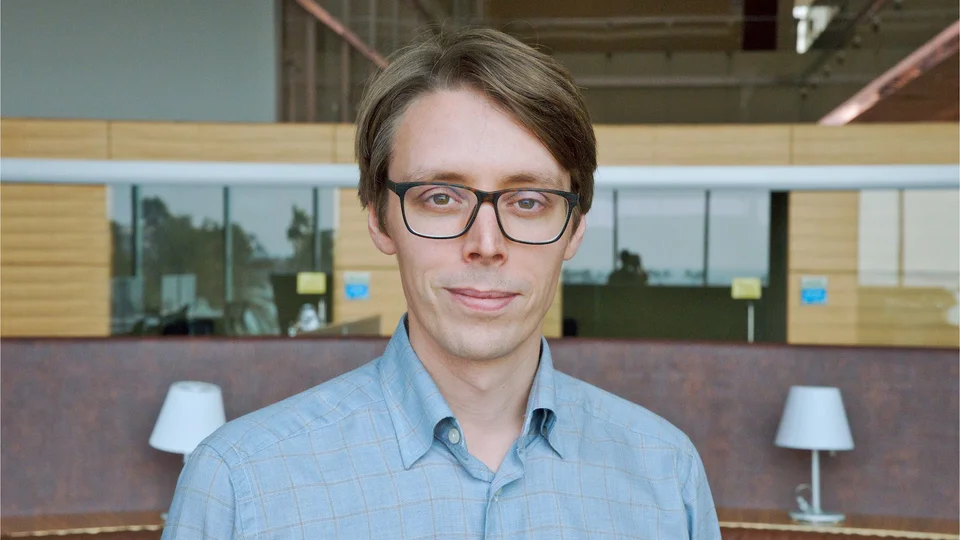
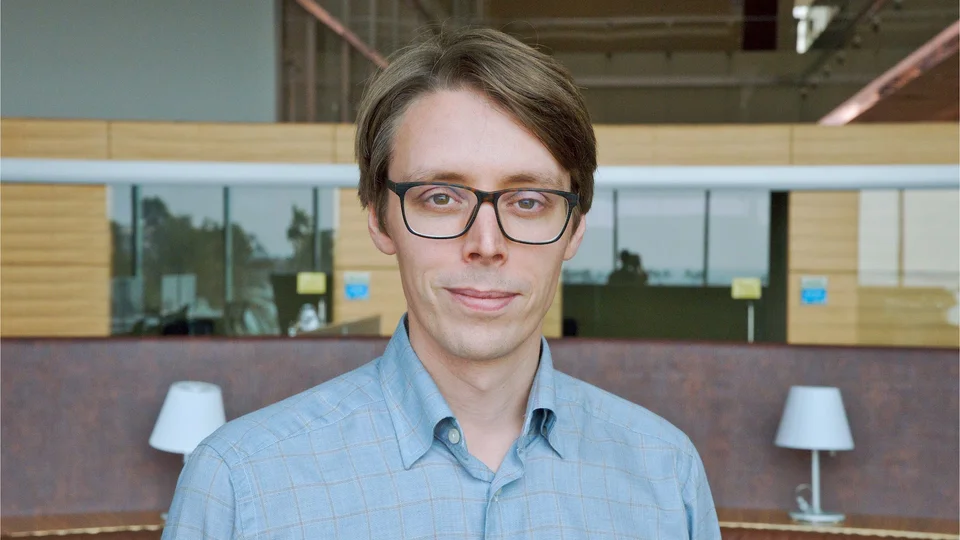
Today, as a professor of statistics at KAUST, Bolin works at one of the most exciting interfaces in modern mathematics, where statistical theory meets real-world complexity through the language of partial differential equations.
When data has a structure
Most statistical methods treat data points as independent observations floating in abstract space; however, much of the world's most important data doesn't work that way. Ocean temperatures influence neighboring measurements. Traffic accidents cluster along road networks. Brain activity ripples across neural pathways. These systems have structure, relationships, and physics.
This is where Bolin’s work becomes transformative. By building statistical models directly on the PDEs governing physical systems, his methods can capture spatial and spatiotemporal relationships that traditional statistics struggle to capture. The approach offers two crucial advantages: models become more physically realistic and flexible, and they can leverage efficient computational methods to handle the massive datasets that define modern research.
One of his recent research contributions focuses on statistical modeling for data defined on networks. Conventional statistical methods are ill-suited to these domains, where distance is determined by network connectivity rather than straight-line geometry. Bolin’s metric graph methods address this challenge by defining statistical models that explicitly respect network structure.
The work emerged from a collaboration with urban science researchers studying pedestrian movement patterns, illustrating how interdisciplinary partnerships shape and inform his theoretical research.
“One promising application is the use of metric graph methods in traffic safety, where I hope these methods will be adopted as standard tools to inform the design of traffic safety policies that could save lives.”
Fractional and non-Gaussian models for the Red Sea
Bolin’s Stochastic Processes and Mathematical Statistics (StochProc) research group also works on fractional stochastic PDEs, which capture irregular, rough patterns in data that traditional smooth models struggle to represent. By allowing smoothness properties to be estimated directly from data, these methods often deliver markedly improved predictive performance.
Particularly exciting is the group's work on non-Gaussian statistical models, an area where computationally efficient and flexible methods have been scarce. The team is developing new models and software with direct applications to environmental challenges, including interpolating Chlorophyll-a data in the Red Sea. Chlorophyll-a bloom can indicate ecological distress in marine systems, and early-warning models could help protect fragile ecosystems.
“Improved interpolation of remote sensing data leads to better climate models, more accurate predictions of extremes, and ultimately, more informed policy decisions,” he said.
For Bolin, the measure of methodological research isn't just published papers; it is adoption. That's why the StochProc group invests heavily in developing and maintaining software packages that make these sophisticated methods accessible to researchers across multiple fields.
The software enables applications in climate science, brain imaging, finance, and beyond. By removing computational barriers, the team ensures that their theoretical advances translate into practical tools.
“Even though our research can have direct impacts through the various applications, the most important impact is likely the fact that I am developing human capital by educating students in advanced statistical methods, which are essential for several areas of Saudi Vision 2030, including digital economies and sustainability.”
The data deluge
Looking ahead, Bolin observes that his field is maturing. Over the next five to 10 years, he plans to continue laying methodological foundations while expanding interdisciplinary collaborations to enhance impact. As the methods become more established, the focus shifts toward application and adoption.
"It is constantly getting easier to obtain various types of data in large amounts. Because of this, there is a need for more adequate, flexible and scalable statistical methods."
Bolin’s research approach, which spans topics from traffic safety to ocean health, highlights a fundamental truth about modern science: the most effective tools are often discovered at the intersections of disciplines. It’s an approach that honors the theoretical elegance of mathematics and the messy complexity of the world it describes.