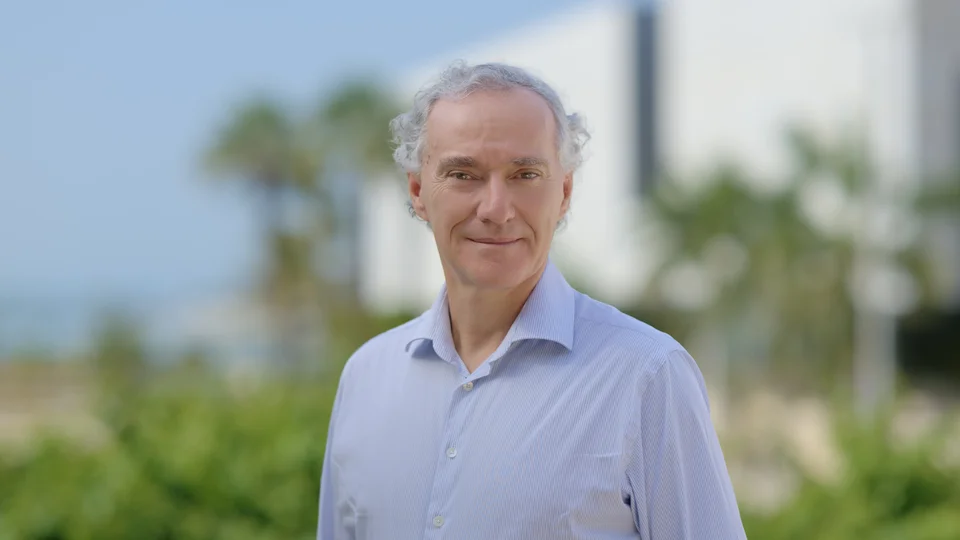
Alessandro Astolfi joins KAUST as professor of applied mathematics and computational science
Alessandro Astolfi arrives at KAUST with a body of work that has reshaped how engineers approach the analysis and control of nonlinear systems.
About
Alessandro Astolfi joins the KAUST Computer, Electrical and Mathematical Sciences and Engineering (CEMSE) Division after nearly 30 years at Imperial College London in the United Kingdom, where he led the Control and Power Research Group for over a decade.
Astolfi’s work contends with a fundamental question: How do you reliably shape the behavior of a complex system, be it a group of robots, the power grid, a fleet of autonomous vehicles, or a biological network, especially when these are poorly modeled or partially uncertain? The answer lies in his specialty: nonlinear control theory, the science of making complex systems behave as intended via feedback.
A pioneer in model reduction, Astolfi has demonstrated how simplified mathematical representations of complex systems can be used for prediction, estimation, control and optimization.
His Immersion and Invariance control framework is now a standard reference in the field, with applications spanning robotics, power electronics, aerospace, automotive and biomedical systems.
“Throughout my career, a central objective has been the development of algorithms and methods that require modest computational resources and scale effectively with the system’s size. This is crucial for their implementation on today’s complex, large-scale, interconnected systems,” he said.
“The conceptual thread running through all of my research is the use of geometric intuition and abstract notions, such as interconnection, invariance, coordinates, and energy. These provide a unifying framework for understanding nonlinear control systems and for designing control methodologies that are both theoretically rigorous and practically impactful.”
Rome, Zurich and KAUST
Astolfi graduated in electronic engineering from the University of Rome “La Sapienza” in 1991. He then earned a master’s degree in information theory and a Ph.D. with Medal of Honor from ETH Zurich in 1995 for his work on discontinuous stabilization. He completed a second doctorate in nonlinear robust control later that year at La Sapienza. In his career, he also held professorial positions at the Politecnico di Milano and at the University of Rome Tor Vergata.
“From an early stage, I was captivated by how mathematical principles could describe and predict the behavior of real-world systems. There wasn’t a single eureka moment; rather, it was a series of experiences, studying engineering and mathematics, tackling challenging problems in dynamics and control, and discovering the beauty of nonlinear systems, that shaped my career.”
An IFAC and IEEE fellow, Astolfi is drawn to KAUST’s ambition, resources, and intellectual openness. He also values the collaborative environment, which allows him to work with colleagues across applied mathematics, electrical and mechanical engineering, and computer science.
“KAUST is young enough to be shaped by those who join it, which is what makes it genuinely distinctive. It invests deeply in fundamental science while maintaining a clear and strategic focus on impact and society.”
The next frontier
When asked about the frontier of his field, Astolfi points to a central challenge: the use of powerful theoretical tools to shape the behavior of large-scale, poorly modeled, nonlinear and uncertain systems. Real-world systems, from water and power networks to autonomous vehicles and smart infrastructure, underscore the widening gap between theory and practice. At KAUST, he intends to delve deeper into model reduction, optimal control, and observer design, leveraging the University’s interdisciplinary environment to bring theory closer to practice.
“Developing modeling, control and estimation strategies that are both mathematically rigorous and computationally efficient remains an open challenge. It is one I intend to pursue rigorously at the University. The ability to exchange perspectives and collaborate with colleagues who offer complementary skills gives my work greater depth, broader impact and faster translation into practical solutions.”
His advice for emerging researchers is clear: resist narrowness. In his experience, problems that seem too difficult are often the most worthwhile.
“Do not be deterred by problems that look too hard. Cultivate both depth and breadth: master your core area while remaining open to new concepts, technologies and approaches. Embrace rigorous thinking, but always consider how your work can make an impact. Above all, remain curious, resilient and passionate.”