Outstanding dissertation earns Zhang EuroVis Best Ph.D. Dissertation Award
Zhang’s work offers a fresh approach to visualizing turbulent flows by connecting rigorous mathematics with advanced computing and artificial intelligence.
About
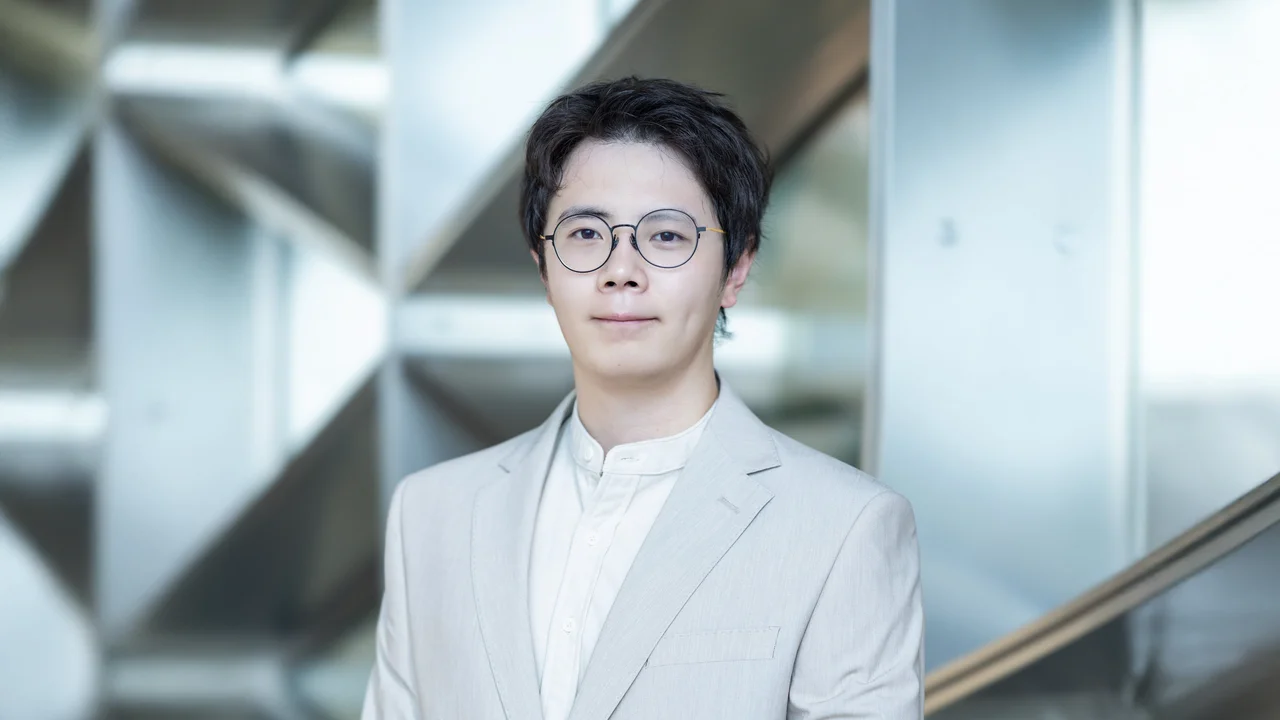
KAUST researcher Xingdi Zhang has received the 2026 EuroVis Best Ph.D. Dissertation Award, one of the field’s highest recognitions for doctoral research in scientific visualization. Presented annually at the EuroVis conference, the award honors exceptional Ph.D. dissertations that have made significant contributions to visualization research.
Zhang, a postdoctoral researcher in Professor Markus Hadwiger’s High-Performance Visualization Research Group (VCCVIS), received the award for his Ph.D. dissertation, "Observer-Relative Flow Visualization and Objective Feature Extraction." The dissertation committee praised his work for its exceptional mathematical depth, technical originality, and strong impact on a central problem in scientific visualization.
“To me, this award is recognition of my entire Ph.D. journey,” Zhang said. “Research fields are often very specialized, with only a small community of experts, so it can be difficult to know how your work compares or whether it is making a real impact. Receiving this award gives me much greater confidence that my research is meaningful and valued by the community.”
“EuroVis is the flagship visualization conference of Eurographics and one of the most prestigious conferences in visualization and visual computing,” said his supervisor Professor Hadwiger. “Since 2018, the conference has presented only one to three Best Ph.D. Dissertation Awards each year. Despite strong international competition, Xingdi was selected as one of only two recipients this year, making this an outstanding achievement.”
A fresh perspective on fluid flows
Zhang’s research spans high-performance computing and AI-driven visual computing, with a particular focus on scientific visualization and vortex extraction in fluid flows. His dissertation established a rigorous mathematical and computational framework for objective flow analysis by combining theoretical insights, advanced algorithms, interactive visualization and data-driven methods.
His doctoral work combined Riemannian geometry — a branch of mathematics that studies curved spaces — with physics and deep learning to advance objective vortex extraction and flow visualization. The research brought together mathematics and GPU-accelerated engineering to integrate state-of-the-art AI techniques for improved analysis of highly complex turbulent flows.
Two cornerstone application areas of his research are aerospace engineering and oceanography; in particular, refining vortex identification to advance aerodynamic analysis and the design of more efficient aircraft, and to improve the detection of ocean eddies.
While pursuing his doctoral studies, Zhang initially believed that interpreting flow features would be a relatively straightforward exercise. He soon discovered, however, that different observers can perceive vastly different flow fields when observing the same underlying physical reality. This realization became the driving force behind his research.
“Early in my Ph.D., my advisor explained a simple example that really inspired me. Imagine a vortex rotating at a constant speed in a 2D plane,” Zhang said. “If the camera rotates together with the vortex, the relative velocity field becomes completely zero. ‘So are the rotating flow and the zero flow actually describing the same vortex?’ Ensuring that we can extract consistent physical features regardless of the observer is exactly what makes this problem both fascinating and challenging.
“The biggest test during my studies was mastering different aspects of mathematics. Studying flows on curved surfaces and run optimization required me to learn differential and Riemannian geometry, variational calculus, etc. And I spent much of my Ph.D. building that rigorous foundation. In the end, it allowed me to connect ideas across multiple disciplines."
A supportive environment for discovery
For Zhang, the ability to weave his work around several disciplines stems from the supportive and encouraging environment fostered within the KAUST VCCVIS.
“I am deeply grateful to my advisor, collaborators and everyone who supported me throughout my Ph.D. My VCCVIS colleagues created a highly supportive environment that encouraged independent exploration. One of our research scientists, Peter Rautek, provided invaluable guidance on coding. My advisor, Professor Hadwiger, was also incredibly patient and helped me build a strong mathematical foundation for my work.”
Looking ahead, he hopes to continue advancing the rapidly growing intersection of artificial intelligence (AI) and scientific visualization.
“My next goal is to combine AI with visualization to better analyze complex turbulent flows that remain challenging for existing methods. In the AI era, what matters most is having the knowledge and judgment to ask the right questions and to guide AI effectively.”
Related People
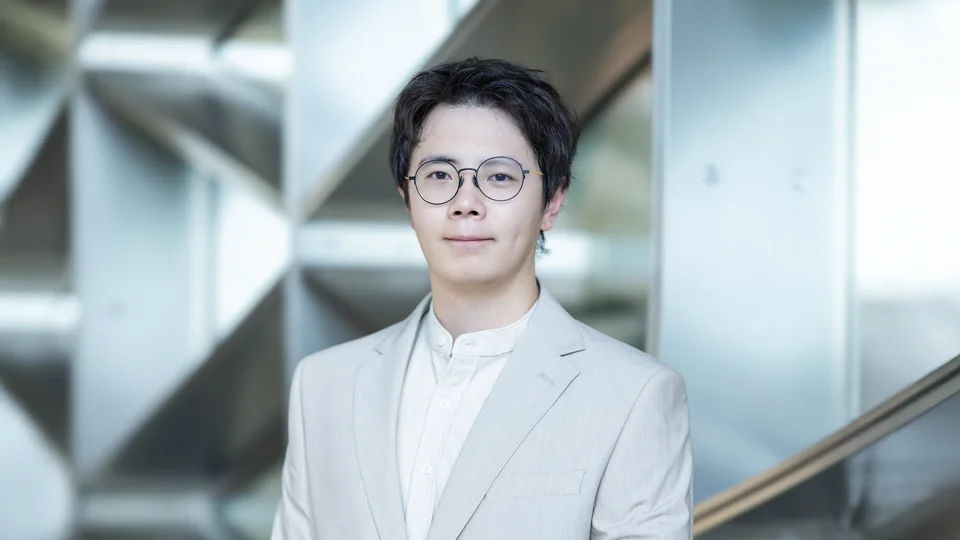
Xingdi Zhang
- Postdoctoral Research Fellow, Computer Science