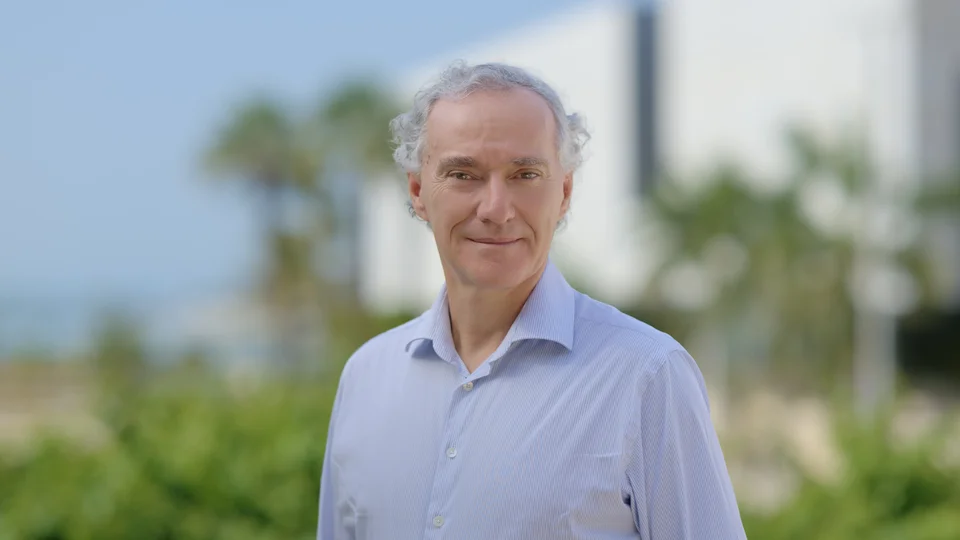
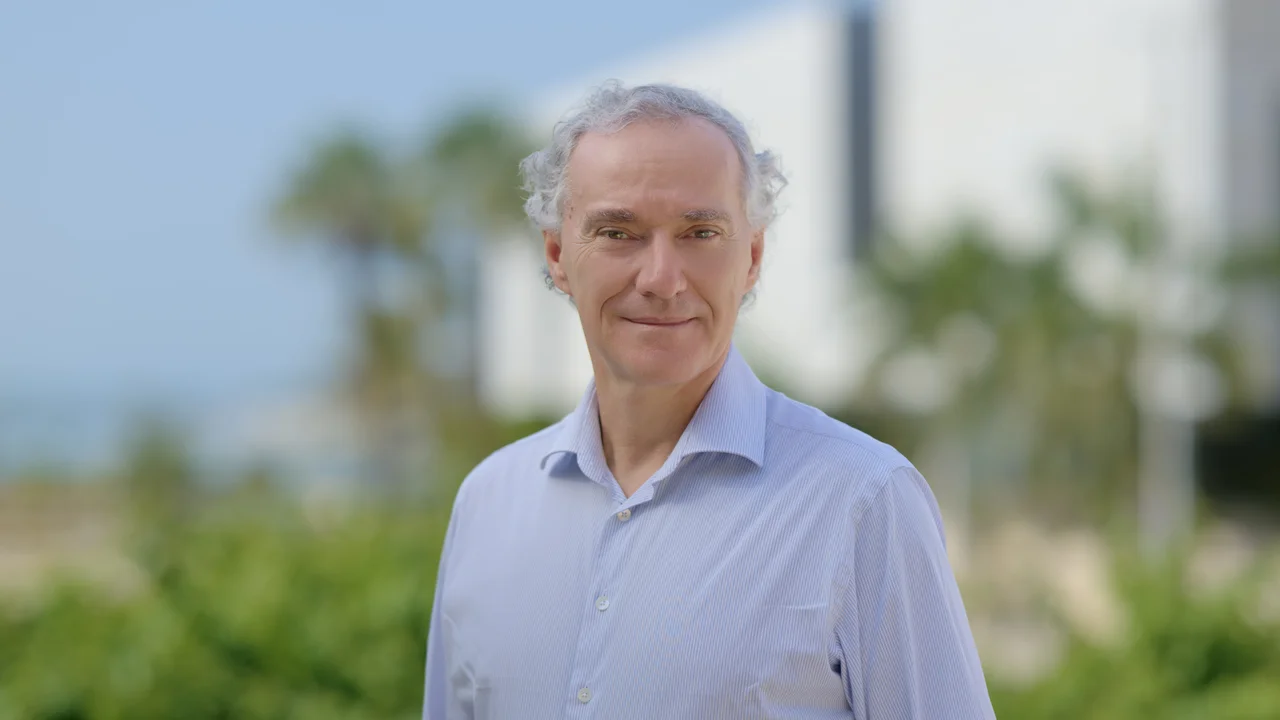
Professor Alessandro Astolfi elected Fellow of EUCA and ACA
KAUST Professor Alessandro Astolfi has been elected an inaugural Fellow of the European Control Association (EUCA) and Fellow of the Asian Control Association (ACA). Both recognitions acknowledge his exceptional contributions to systems and control engineering.
About
Professor Alessandro Astolfi has been elected an inaugural Fellow of the European Control Association (EUCA) and a Fellow of the Asian Control Association (ACA).
Astolfi, a professor of applied mathematics and computational science, was elected as one of only 10 inaugural EUCA Fellows and one of 17 ACA Fellows worldwide in 2026.
The EUCA recognition acknowledges his exceptional contributions to nonlinear and adaptive control theory and to model reduction. The ACA award recognizes his outstanding contributions to control science and engineering and its development across Asia, Oceania and the international community.
Astolfi joined KAUST’s CEMSE Division in February 2026, after almost 30 years at Imperial College London, U.K. His work has reshaped the way engineers analyze and control nonlinear systems.
He earned both honors in the same year he moved from Imperial to KAUST. “There is something reassuring about being told, at the precise moment you are starting again, that the previous thirty years were not wasted,” he said.
A global journey
Europe is where Astolfi was, in his words, “formed, both scientifically and personally.” He studied in Rome and Zurich and taught in Zurich, Milan, Rome and London. He has been actively involved with EUCA and the European Control Conference (ECC) throughout his career, including roles as a member of the EUCA Council, as Editor-in-Chief of the European Journal of Control, and as co-general chair of ECC 2022.
“Being in the inaugural class of EUCA Fellows is recognition from the community that 'made me'—that is a privilege,” he said. “Some of the friendships I made at my first ECC in 1993 turned into collaborations that are still going; the substance of the connection is the people, not the positions.”
Astolfi’s ties to Asia deepened through scientific collaborations, including a visit to Southeast University (SEU) in Nanjing, China, in 2019, where he has since served as a Distinguished Scientist.
“What I had not anticipated was how quickly one visit becomes many. In our field, relationships are built one paper, one visit, one student at a time. Being recognised by the ACA means my work has travelled beyond the rooms I sit in, which is really what any of us hope for.”
An 'intellectual recalibration'
Astolfi holds two doctorates, one in nonlinear robust control from Rome’s La Sapienza and the other in discontinuous stabilization from ETH Zurich. His research centers on nonlinear control theory and feedback methods that can make complex systems behave as intended. A pioneer in model reduction, Astolfi has demonstrated how simplified models support prediction, estimation, control and optimization.
His Immersion and Invariance framework is now a key reference in the field, with applications spanning robotics, power electronics, aerospace, automotive and biomedical systems.
After a lengthy tenure at Imperial, Astolfi described his move to KAUST as an “intellectual recalibration,” one that changed his research environment, colleagues, seminars and daily questions.
“That [switch was] challenging for about six months, and then it [became] enriching,” he explained. “The scale of ambition at KAUST is real, and decisions get made quickly. The student body is genuinely international in a way that few universities can claim.
“The region also supplies research problems that are challenging and that matter: energy, water, desalination, industrial process control, the logistics of very large human gatherings,” he said
Sustaining a mathematical core
Control theory has historically provided guarantees under uncertainty, while advances in computing have enabled increasingly sophisticated methods to operate in real time.
For Astolfi, the challenge lies in preserving those guarantees as data-driven and learning-based methods gain prominence.
“That has moved whole classes of methods, including nonlinear model predictive control, moment-based optimal control and real-time digital twins, from the seminar room into the field,” he said. “Our wave energy work, for instance, only became meaningful when the nonlinear optimal controller could be run in real time.”
The systems under study have changed, too. In 1990, Astolfi and his colleagues typically studied a plant. Today, the object of study is a network: a power system with thousands of inverters, a traffic corridor, or a population.
The field’s focus has shifted from aerospace and process industries toward energy, biology, healthcare and human behavior. Yet the mathematical foundations—geometry, invariance, interconnection, energy flow, dissipation, Lyapunov stability—that underpin the research are remarkably stable.
“Those notions have informed everything I have done across mechanical systems, power electronics, microgrids, infectious disease, wave energy and now food behaviour. It is all in the same toolbox.”
“The reason control has been useful for seventy years is that it is rigorous. We should not trade that away. My greatest concern is that the field may chase fashions and lose its mathematical core.”
A mentor’s lesson
Having mentored countless researchers during his career, Astolfi’s educational approach remains steadfast: teach rigorous material, paired with engineering intuition.
“At KAUST I am building a group in which students see the whole pipeline: from an abstract question about invariance, through a theorem, to an algorithm, to a piece of hardware. I think seeing the whole process is the single most valuable thing a doctoral student can be given.”
“My former students I am proudest of now are professors all around the world, in Rome, Vancouver, Udine, Seoul, Concepción and London; they are in industry positions, from Citi to the European Patent Office.”
His central lesson is this: give a student a problem challenging enough to matter and open enough for them to make it their own, then step back.
“The temptation to solve the problem yourself is enormous and must be resisted. A student who has been carried to a result has a thesis; a student who has been stuck for eight months and got themselves unstuck has a career.”