
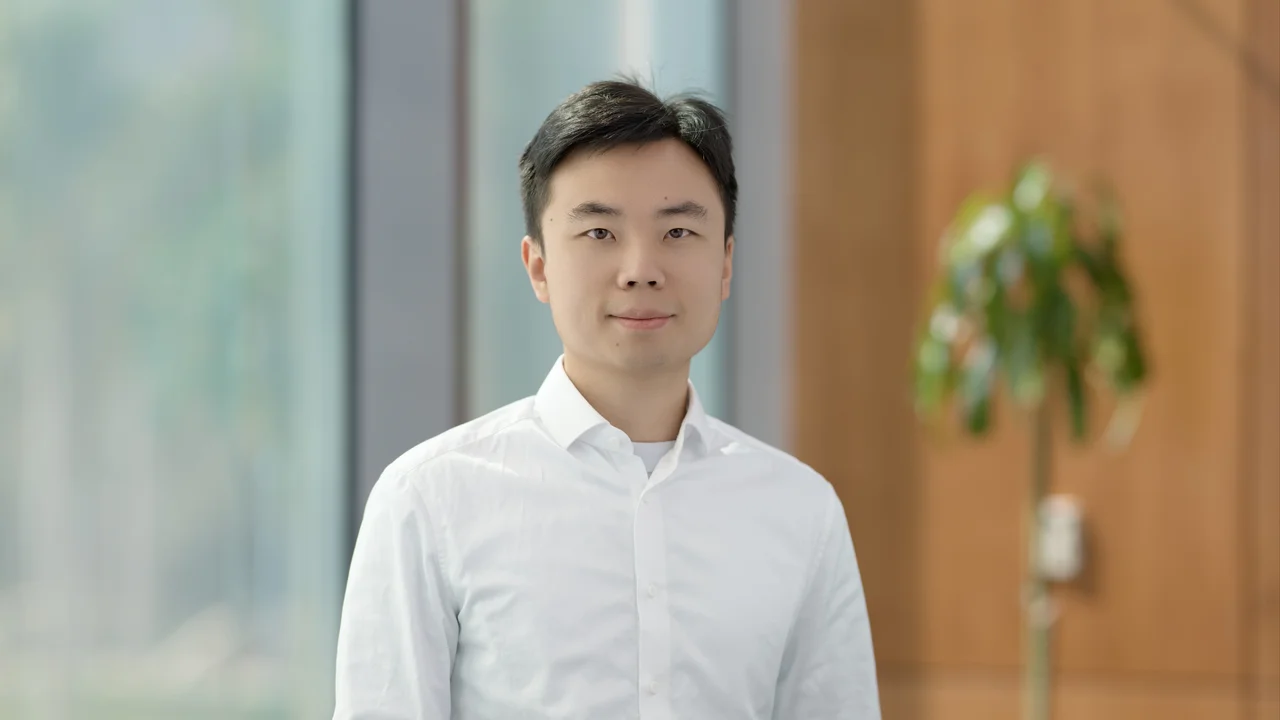
KAUST Ph.D. student Jie Ren receives ACM/IEEE CS George Michael Memorial HPC Fellowship
The computer science doctoral student is one of three recipients worldwide and the first based at a university in Asia or the Middle East.
About
Jie Ren, a Ph.D. student in computer science at KAUST, has received the 2026 George Michael Memorial HPC Fellowship. He is one of three recipients worldwide this year and the first recipient based at a university in Asia or the Middle East.
Jointly presented by the Association for Computing Machinery (ACM) and the Institute of Electrical and Electronics Engineers (IEEE) Computer Society, the fellowship recognizes doctoral students whose research addresses important challenges in high-performance computing. It honors George Michael, an American computational physicist at Lawrence Livermore National Laboratory and a co-founder of the annual Supercomputing Conference.
Ren was selected for advancing GPU-accelerated linear algebra through algorithm-architecture co-design, enabling high-performance sparse solvers and finite element computations on modern supercomputers. These mathematical tools support the calculations used in large-scale scientific simulations.
“I am very grateful and honored to receive the fellowship,” Ren said. “I see it as encouragement for my work in GPU-accelerated numerical computing, and also as motivation to continue learning and contributing to the HPC community.”
Making scientific computing more efficient
Ren develops numerical methods and software that help scientific computations make better use of graphics processing units, or GPUs. These processors can perform many calculations simultaneously. His approach, known as algorithm-architecture co-design, adapts mathematical methods to the capabilities of computing hardware.
His research focuses on sparse linear algebra, discretization methods and computational science. This involves solving large systems of equations and turning mathematical descriptions of physical problems into calculations a computer can perform. His earlier work also covered GPU-accelerated machine learning and computer vision systems.
David Keyes, professor of applied mathematics and computational science and Ren’s adviser, explained that much of high-performance computing focuses on expanding simulations across more computing nodes. Ren looks for improvements in how calculations run within each node.
By managing data movement and combining computational steps, Ren reduces the need to store and retrieve intermediate results. This addresses a common bottleneck in scientific computing, where moving data can take more time than performing the calculations themselves. Keyes said this approach has enabled Ren to accelerate equation solvers and finite element operations used repeatedly in large-scale simulations.
Advancing computational research at KAUST
Ren’s interest in high-performance computing grew from its connections between algorithms, computing systems and scientific applications. During his Ph.D., he became increasingly focused on numerical methods and how they interact with modern hardware.
He credits KAUST’s supportive research environment and the freedom to explore ideas with helping him develop his work.
“This environment has been very important in helping me develop my research during my Ph.D.,” Ren said.
Keyes placed the fellowship alongside other recent recognition for KAUST’s HPC community, pointing to Rabab Alomairy’s 2025 IEEE Computer Society TCHPC Award for Excellence for Early Career Researchers and four Gordon Bell Prize finalist projects involving KAUST researchers between 2022 and 2024.
Ren will formally receive the fellowship this November at SC26, the international high-performance computing conference.
“I hope to continue exploring algorithm-architecture co-design for scientific computing, and to better understand how numerical algorithms, software, and modern heterogeneous hardware can work together,” he said.