
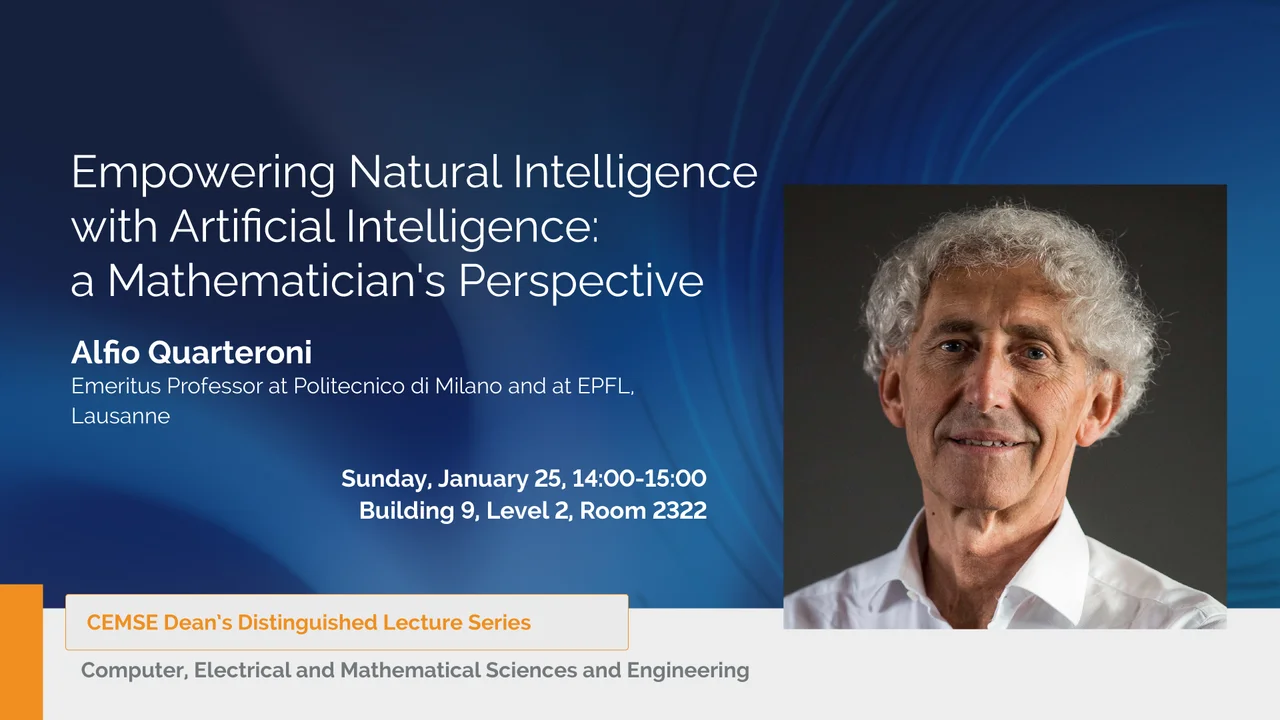
Empowering Natural Intelligence with Artificial Intelligence: a Mathematician's Perspective
A Dean’s Distinguished Lecture on natural intelligence, artificial intelligence and scientific machine learning.
Overview
Abstract
Over recent decades, computational models grounded in physical laws have profoundly transformed our ability to understand and predict complex phenomena in the natural world. By providing a rigorous framework in which scientific insight and technological innovation can flourish, these models embody what may be called "natural intelligence": the cumulative result of centuries of scientific reasoning, mathematical structure and physical understanding.
This lecture begins by illustrating how this paradigm has shaped modern computational science through selected examples. We will discuss large-scale simulations in earthquake engineering, the use of mathematical modeling to enhance sports performance, and—in particular—iHEART, a mathematical model of the complete cardiac function. The iHEART simulator will serve as a central case study, showing how multiphysics and multiscale models of the heart—combining electrophysiology, mechanics and blood flow—can support both scientific discovery and clinical decision-making.
The second part of the lecture turns to artificial intelligence and machine learning, which represent a fundamentally different paradigm: one driven primarily by data rather than by physical principles. We will review the strengths of purely data-driven approaches, highlighting their remarkable successes, while also discussing their limitations.
These considerations naturally lead to the emerging field of Scientific Machine Learning (SciML), where physics-based modeling and data-driven methods are no longer seen as competing philosophies, but as complementary sources of intelligence. SciML offers a new generation of computational models that are more accurate and trustworthy.
In this perspective, the fusion of "natural intelligence" and artificial intelligence is not merely a technical development, but a conceptual shift: a unique opportunity to combine the explanatory power of science with the adaptive strength of data-driven learning. The lecture will argue that this synthesis represents one of the most promising directions for the future of computational science, opening new avenues for understanding complex systems and for translating mathematics into tangible benefits for society.
Join the Livestream
This event will be livestreamed. To join the session, please use the following link: https://kaust.zoom.us/j/92214799636
Presenters
Alfio Quarteroni, Emeritus Professor, Politecnico di Milano and EPFL
Brief Biography
Alfio Quarteroni is an emeritus professor at Politecnico di Milano (PoliMI) Italy, and at École Polytechnique Fédérale de Lausanne (EPFL), Switzerland. Quarteroni is the founder of MOX at PoliMI and a member of several prestigious academies, including the Accademia Nazionale dei Lincei, the European Academy of Sciences, the Academy of Europe, the Lisbon Academy of Sciences, the Swiss Academy of Engineering and Technology, and the Italian Academy of Engineering and Technology.
He has authored 25 books translated into several languages and more than 450 research papers.
Quarteroni has been honored with numerous awards, including the NASA Award in Computational Fluid Dynamics (1992); the Galilean Chair from Scuola Normale Superiore (2011); the International Galileo Galilei Prize for Sciences (2015); the ECCOMAS Euler Medal (2022); the ICIAM Lagrange Prize (2023); the Blaise Pascal Prize for Mathematics (2024); the ECCOMAS Ritz-Galerkin Medal (2024); and the SIAM Ralph Kleinman Prize (2025).
Quarteroni's research spans applications in medicine, geophysics, environmental science, aeronautics and the oil industry. He led the mathematical modeling behind the design of Alinghi, the Swiss yacht that won the America’s Cup in 2003 and 2007, and later developed the first complete mathematical model of the human heart.