
Finite Element Approximation of Fluid-Structure Interaction Problems
We review the main strategies for the finite element approximation of fluid-structure interaction problems and then focus on one of them, the fictitious domain method, analyzing its formulation and convergence properties.
Overview
Many phenomena, from blood flowing through a vessel to a flag waving in the wind, involve a fluid and a deformable solid that influence each other: the fluid pushes the structure, the structure moves, and by moving it changes the region occupied by the fluid. Simulating such fluid-structure interaction problems is challenging precisely because the two subproblems are of different nature and are posed on domains that are not known in advance. After an elementary introduction to the equations involved and to the main difficulties one faces when discretizing them, we review the classical strategies proposed in the literature, and in particular the distinction between methods that follow the moving domain with a deforming mesh and methods that keep the mesh fixed. We then concentrate on one possible strategy, the fictitious domain approach: the fluid problem is extended to a fixed background domain, the structure is described on its own mesh, and the two are coupled through a Lagrange multiplier enforcing the matching conditions. We illustrate the main features of this formulation and the questions it raises from both the theoretical and the numerical point of view, together with some representative examples.
Presenters
Brief Biography
Fabio Credali is a postdoctoral fellow in Prof. Daniele Boffi's NumPDE group at KAUST. He obtained the Ph.D. in Applied Mathematics and Computational Sciences at KAUST in 2023, in cotutelle with the joint Ph.D. program in Computational Mathematics of the Università di Pavia (Italy) and the Università della Svizzera italiana (Switzerland). After a one-year postdoc at IMATI–CNR in Pavia, he returned to KAUST, where he currently holds a postdoctoral position. His research concerns the numerical approximation of PDEs, with emphasis on fluid-structure interaction problems, finite element and virtual element methods.
Related People
Related Researchers
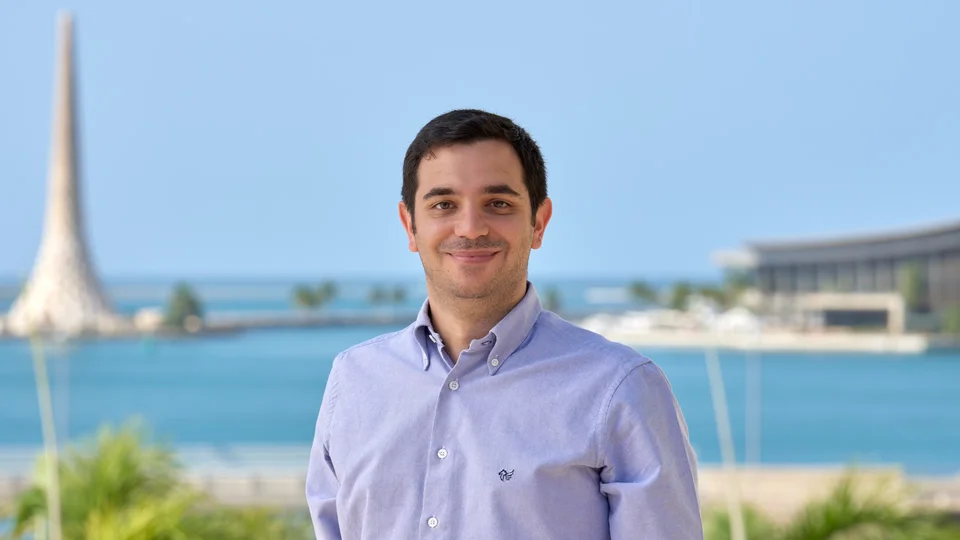
Fabio Credali
- Postdoctoral Research Fellow, Applied Mathematics and Computational Science