
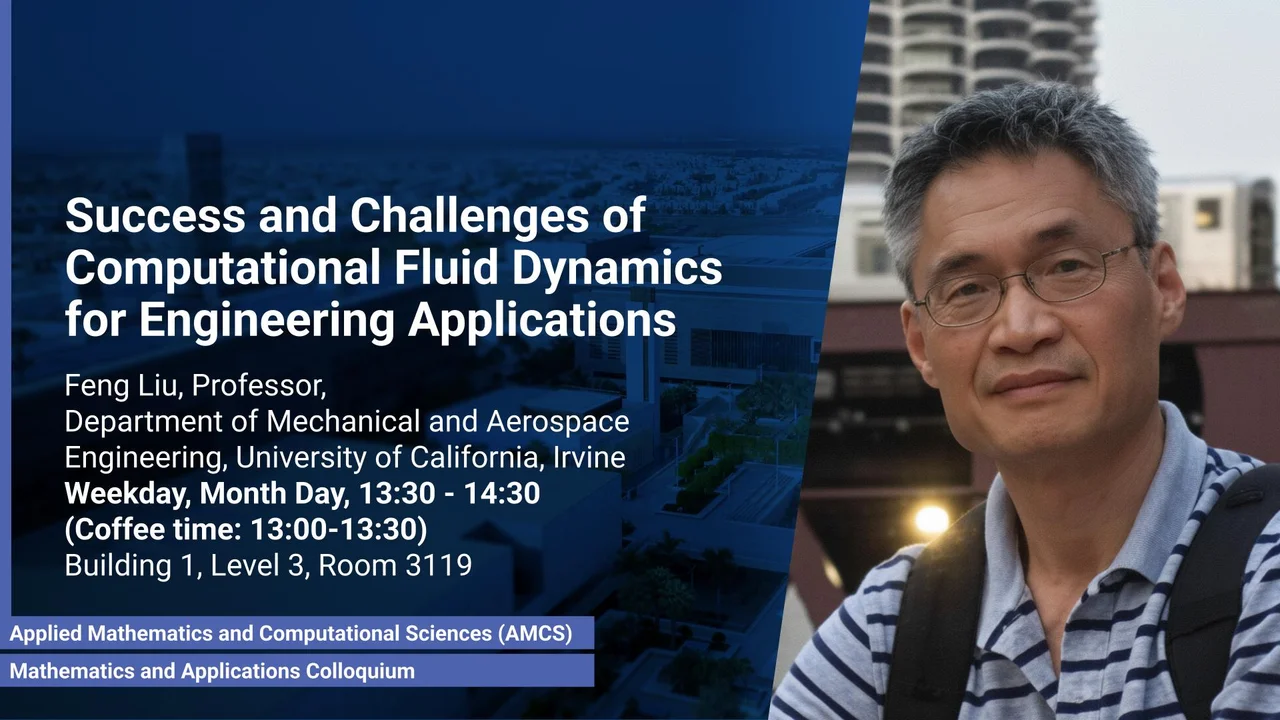
Success and Challenges of Computational Fluid Dynamics for Engineering Applications
The talk will introduce an efficient, accurate, and robust Computational Fluid Dynamics (CFD) software package utilizing a finite-volume algorithm on structured multiblock grids to simulate challenging three-dimension unsteady turbulent flows for multi-disciplinary applications like aerodynamics, aeroelasticity, and combustion, showcasing its successes and remaining challenges in large-eddy simulations for complex reactive flows.
Overview
Simulation of three-dimension unsteady turbulent flows pose major challenges to computational methods for engineering applications. I will present an efficient, accurate, and robust Computational Fluid Dynamics software package for various multi-disciplinary engineering applications including aerodynamics, aeroelasticity, and combustion simulations. The foundation of the solver is based on a finite-volume algorithm for conservation laws on structured multiblock grids with match/patched interfaces to allow treatment of complex geometry and sliding meshes in treating relative motion of rotor blade rows in turbomachinery computation. Successes and remaining challenges will be presented in our latest work on large-eddy simulations in rocket engine combustion chambers and the reactive flow in a turbine-burner rotor stage.
Presenters
Feng Liu, Professor, Department of Mechanical and Aerospace Engineering, University of California, Irvine
Brief Biography
Professor of Mechanical and Aerospace Engineering at the University of California, Irvine. He received his B.S. from Northwestern Polytechnic University in Xi’an, China; M.S. from Beijing University of Aeronautics and Astronautics; and Ph.D. from Princeton University. His research interests include computational fluid dynamics, vortex stability, aeroelasticity, turbomachinery, combustion, and propulsion. He is the author or co-author of more than 120 journal articles. Dr. Liu is a Fellow of AIAA and ASME. He served as the Associate Editor for Journal of Fluids Engineering, International Journal of Computational Fluid Dynamics, and Journal of Propulsion and Power (continuing). He received the 2023 AIAA Air-breathing Propulsion Award “for the turbine-burner engine innovation and other high-impact contributions of computational methods for turbomachinery aerodynamics.”