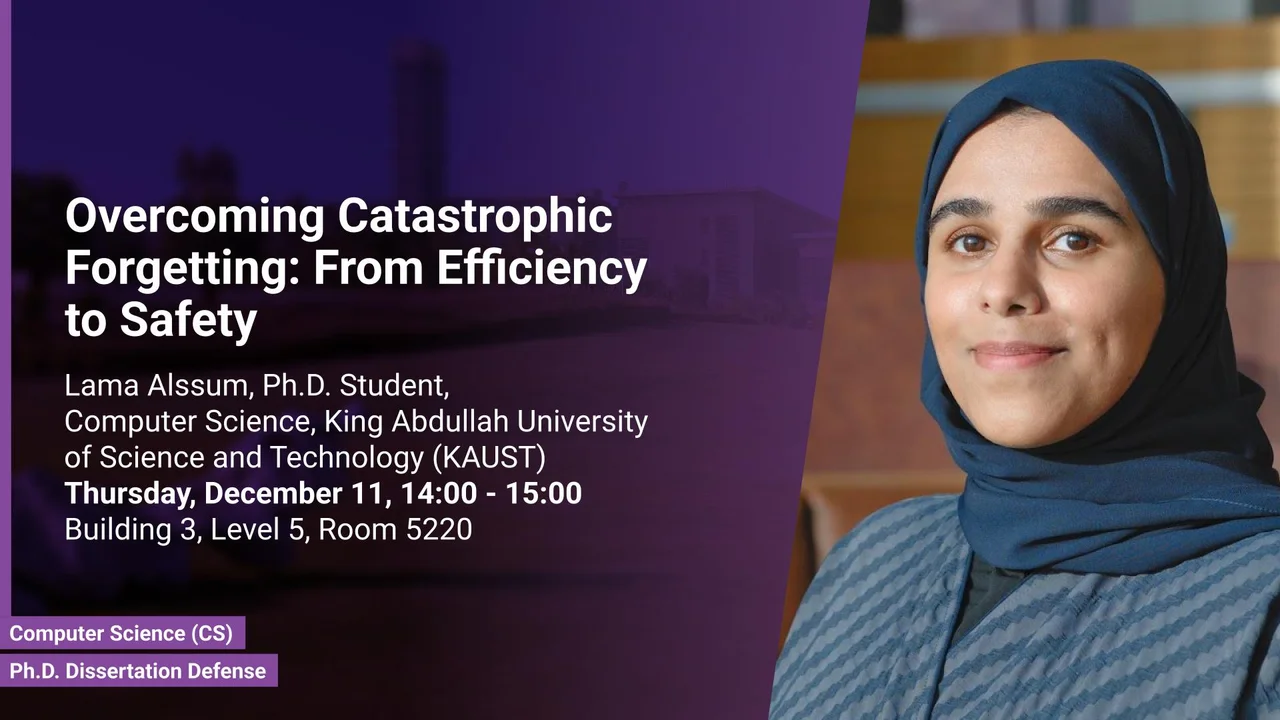
Overcoming Catastrophic Forgetting: From Efficiency to Safety
This thesis addresses the challenge of catastrophic forgetting in AI by developing novel continual learning methods that enhance memory efficiency in video analysis and preserve safety alignment in large language models, ensuring reliable adaptation in both resource-constrained and safety-critical applications.
Overview
The increasing use of artificial intelligence (AI) in education, healthcare, and infrastructure requires systems that can adapt and learn continuously. A central obstacle is catastrophic forgetting, where models lose previously learned knowledge when trained on new tasks. This thesis develops and evaluates continual learning methods for two practical settings: resource-constrained scenarios and safety-critical applications where preserving alignment is essential. We make three main contributions. First, we introduce a lightweight regularizer that improves retention under rehearsal with minimal cost. Second, we present SMILE; a video continual-learning method that greatly reduces memory use while improving performance. Third, we adapt continual learning (CL) approaches to preserve safety alignment as large language models are fine-tuned and show that CL methods can prevent alignment degradation and match or exceed existing safety approaches. Collectively, these contributions lead to effective solutions for both efficient adaptation and safety preservation in deployed AI systems.
Presenters
Brief Biography
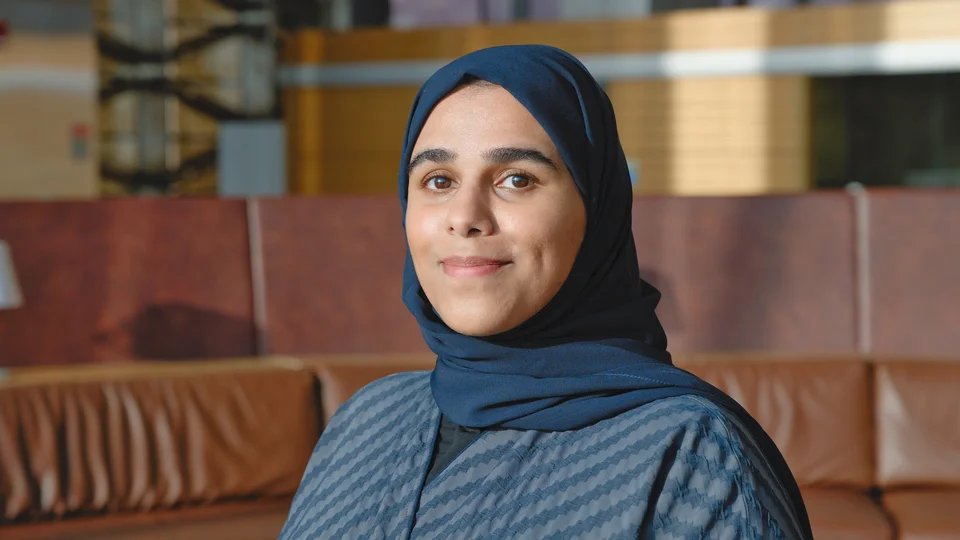
Lama studied Information technology at King Saud University (KSU) in Riyadh and graduated with a Bachelor degree in 2011. After her bachelor degree, she joined KSU as a Teaching Assistant. Later on, she continued her studies and earned her Master degree in Computer Science from the School of Computing Science at the University of Glasgow, United Kingdom.
Lama first joined KAUST as an Intern with Professor Jeff Shamma until she was enrolled for the Ph.D. program in Computer Science working in Professor Bernard Ghanem research group Image and Video Understanding Lab (IVUL).