Efficient Machine Learning for Scientific and Medical Applications
This dissertation addresses key challenges of machine learning in scientific and medical domains by developing methods that improve model efficiency, data efficiency, and learning under real-world constraints.
Overview
Recent progress in deep learning has been driven by scaling data and model size, but this paradigm is increasingly impractical in scientific and medical applications due to high computational cost, limited data availability, and privacy constraints. This dissertation makes four contributions: (1) analyzing and reducing redundancy in large molecular foundation models to improve computational efficiency, (2) demonstrating that dataset alignment can outperform sheer dataset scale for atomic property prediction, (3) transferring knowledge from abundant 2D molecular graphs to improve 3D conformer generation, and (4) introducing a holistic framework for federated continual learning that enables efficient adaptation under distribution shifts in medical settings. Overall, these contributions advance the practicality of machine learning for real-world scientific and medical settings.
Presenters
Brief Biography
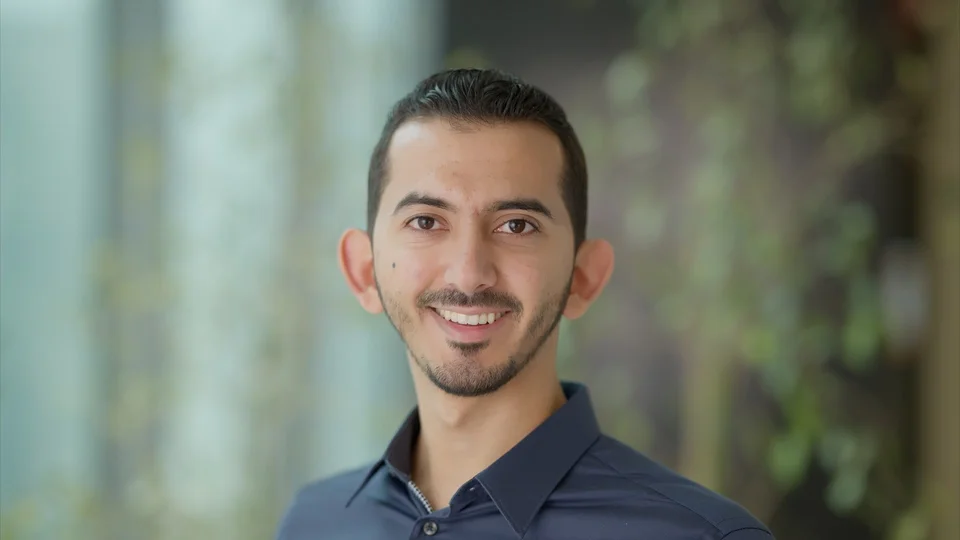
Yasir Ghunaim is a Ph.D. candidate in Computer Science at KAUST in the Image and Video Understanding Lab (IVUL), supervised by Professor Bernard Ghanem. His research focuses on efficient machine learning for scientific and medical applications, with an emphasis on improving data, training, and model efficiency to enable scalable and practical ML systems.
Yasir holds an M.S. in Computer Science from KAUST and a B.S. in Electrical and Computer Engineering from Virginia Tech. Prior to his graduate studies, he gained over seven years of experience in automation systems.