Synergizing Nanophotonics and Artificial Intelligence: From Inverse Design to Intelligent Optical Frontends
This dissertation investigates the transformative convergence of nanophotonics and artificial intelligence (AI).
Overview
The research advances two complementary paths: AI-facilitated nanophotonics inverse design and the deployment of nanophotonics as optical computation frontends.
The dissertation introduces a hybrid optimization framework that combines deep learning with heuristic search and incorporates physics-informed loss functions to enhance robustness against fabrication variations and mechanical deformations. The design framework demonstrates broadband polarization-splitting metasurface on flexible substrates with high efficiency. The dissertation further explores an optical storage paradigm, which trains a photonics foundation model and encodes the learned geometry–spectrum representations as additional storage dimensions, beyond standard multiplexing strategies.
This dissertation further demonstrates metasurface as a computer vision frontend, which extracts spectral information of the scene and projects it onto the sensor plane. Applications include real-time snapshot hyperspectral imaging (HSI), hyperspectral video understanding at Tb/s data rates, and dopamine sensing down to 10−8 mM. Collectively, this dissertation establishes a blueprint for the next generation of intelligent optical systems.
Presenters
Brief Biography
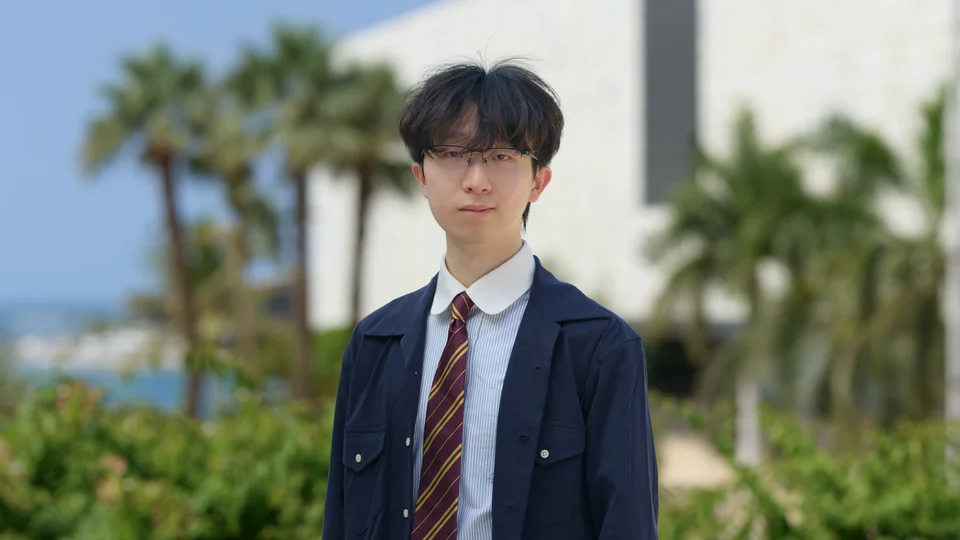
Qizhou Wang is a Ph.D. candidate in Electrical and Computer Engineering (ECE) at King Abdullah University of Science and Technology (KAUST). During his Ph.D. studies, he received CEMSE Division Dean’s List Award. He received his B.S. degree in Communication Engineering from University of Electronic Science and Technology of China (UESTC) in 2020 and M.S. degree in Electrical and Computer Engineering from King Abdullah University of Science and Technology (KAUST) in 2021. He dedicated his doctoral work to integrating nanophotonics with machine learning to create smarter imaging hardware as a member of the Primalight Laboratory research group under the supervision of Professor Andrea Fratalocchi.