Enabling Seamless Connectivity via Virtualization Technologies in 6G Integrated Networks
This thesis investigates how integrated networks powered by such technologies can be designed and optimized to enable seamless connectivity.
Overview
6G networks are expected to support multiple applications that can be enabled by integrated Terrestrial and Non-Terrestrial Networks (TN-NTNs) in both remote and urban regions. However, their heterogeneity, dynamics, and resource constraints introduce multiple challenges in network management, interoperability, and quality of service assurance. Network virtualization technologies, including software-defined networking, network function virtualization, and network slicing, can be adopted to alleviate these issues. Accordingly, this thesis investigates how integrated networks powered by such technologies can be designed and optimized to enable seamless connectivity. We first provide an in-depth survey of virtualization technologies in 6G integrated TN-NTNs, presenting a structured taxonomy and identifying open issues. We then investigated the deployment of virtualized tethered Unmanned Aerial Vehicles (UAVs) in near-shore maritime communication. We analyze the coverage performance and optimize the tethered UAV placement for different scenarios. Moreover, we develop a maritime-oriented slicing framework for integrated aerial-terrestrial networks, supporting two distinct slices. Specifically, we consider an Open Radio Access Network (O-RAN) architecture, which supports the deployment of 6G slicing through its core concepts of RAN virtualization and AI-native optimization. We employ deep reinforcement learning (DRL) to tackle the joint problem of RAN slicing, Virtual Network Function (VNF) orchestration and UAV trajectory control to maximize the energy efficiency while meeting the slices’ requirements. Furthermore, we propose an asymmetric-state hierarchical multi-agent reinforcement learning approach, aiming to maximize the resource utilization. By hierarchically structuring discrete and continuous agents, the algorithm handles the VNF orchestration actions, the RAN slicing actions, and their interdependency. The two agents are coordinated via a novel inter-agent communication module based on various proposed approaches designed to study the communication between the agents. Finally, the thesis considers dense smart-city deployments and addresses mobility management as a key control task in virtualized networks. We develop a DRL-based threshold-free handover optimization scheme that dynamically selects the next serving cell for both ground users and UAVs users. The solution is built on a site-specific urban deployment, with novel state space representation and standard-oriented reward design, and evaluated across multiple scenarios and mobility profiles.
Presenters
Brief Biography
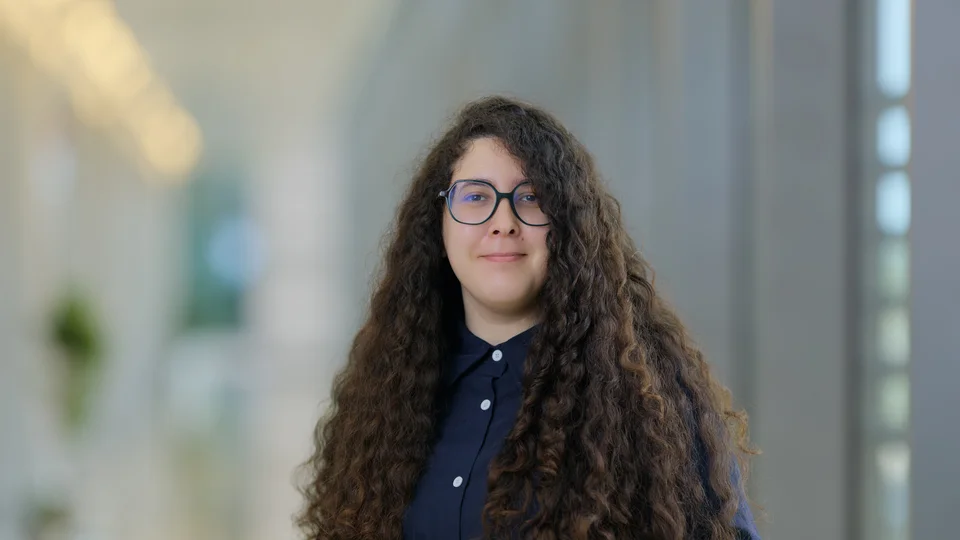
Sahar Ammar is a Ph.D. candidate in Electrical and Computer Engineering at King Abdullah University of Science and Technology (KAUST). She holds an M.S. In Electrical and Computer Engineering from KAUST and a Diplôme d'ingénieur from École Polytechnique de Tunisie, and was a visiting researcher at Universitat Pompeu Fabra (UPF). She has contributed to several projects on intelligent and energy-efficient communication systems across maritime, aerial, and optical wireless networks.