Advancing Monocular Depth Estimation: High-Resolution and Amodal Understanding
This thesis advances monocular depth estimation to develop efficient methods for recovering fine geometric details, such as object boundaries and thin structures, from high-resolution images while preserving scene-wide consistency and metric scale.
Overview
This thesis advances monocular depth estimation along two complementary directions. It develops efficient methods for recovering fine geometric details, such as object boundaries and thin structures, from high-resolution images while preserving scene-wide consistency and metric scale. It also extends depth estimation to partially occluded objects by predicting the relative depth of their surfaces across the full region they project onto the image, including parts hidden from view.
A single RGB image contains cues about the 3D structure of a scene, from the overall layout of surfaces to the fine contours of individual objects. Modern depth models can recover much of that layout, but they typically downsample high-resolution inputs to fit practical memory and compute budgets. Downsampling can erase boundaries and thin structures before the model sees them, and upsampling the resulting depth map cannot reliably bring them back. Learning these details from real-world data is also difficult because depth annotations are often least reliable around the structures that require the most precise supervision.
The thesis first addresses this problem with PatchFusion, which combines the scene-wide consistency of a whole-image depth prediction with the detail recovered from local high-resolution patches. The framework learns to fuse the two sources of information so that neighboring patches agree in scale and structure. PatchRefiner builds on this approach by learning to refine a coarse depth prediction and by using a teacher trained on synthetic data to generate detailed depth pseudo-labels for real images. A training objective separates local detail recovery from metric scale, allowing the model to sharpen boundaries while preserving reliable depth values. PatchRefiner V2 makes the approach more practical by replacing the second full-sized depth model with a lightweight refinement branch that uses coarse scene information to guide the recovery of fine details.
The final part of the thesis asks what depth estimation can recover when part of an object is hidden. Amodal Depth Anything estimates the relative depth of a target object across its full projected image region, including the pixels where another object blocks it from view. The prediction stays aligned to the input image, so it describes where the hidden surface lies in depth at those pixels. To study this task, the thesis introduces a large-scale training dataset for everyday scenes and develops both deterministic and generative models for predicting occluded geometry.
Together, these works improve monocular depth estimation in two ways. They preserve finer geometry where the image provides evidence and infer the depth of object surfaces where that evidence is incomplete.
Presenters
Brief Biography
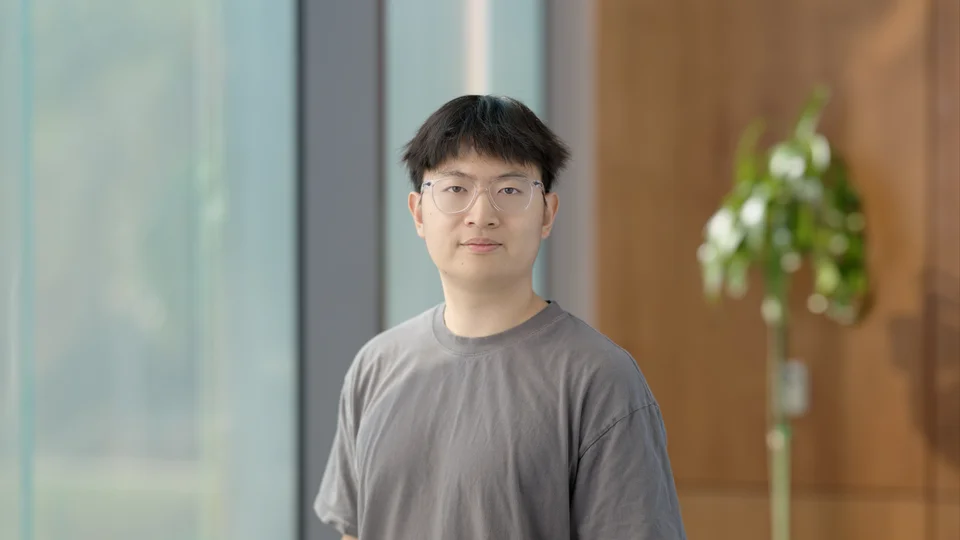
Zhenyu Li is a Ph.D. candidate in Computer Science at King Abdullah University of Science and Technology (KAUST), where he conducts research under the supervision of Prof. Peter Wonka. Before joining KAUST, he earned his bachelor’s and master’s degrees in Computer Science from Harbin Institute of Technology, China. His research focuses on depth estimation, 3D reconstruction, and geometric scene understanding, with broader interests in generative models and embodied perception. He has gained industrial research experience at Meta Reality Labs, ByteDance Seed, DiDi Cargo, and SenseTime, working on applications spanning AR/VR body tracking, 3D foundation models, and autonomous driving.
Li’s research advances the recovery of detailed and coherent three-dimensional geometry from visual observations. His contributions include BinsFormer for monocular depth estimation, PatchFusion and the PatchRefiner series for high-resolution depth prediction, and Amodal Depth Anything for estimating geometry beyond visible object surfaces. His publications have appeared in leading venues including CVPR, ICCV, ECCV, ICLR, ICML, SIGGRAPH, and SIGGRAPH Asia. During his internship at Meta Reality Labs, he developed EgoPoseFormer V2 for accurate and efficient egocentric human motion estimation, which was selected as a CVPR 2026 Highlight. At ByteDance Seed, he contributed to Depth Anything 3, an ICLR 2026 Oral paper.
Li received the KAUST CEMSE Dean’s List Award in 2024 and the China National Scholarship in 2022. His competition achievements include first place in the ICCV 2023 Visual Continual Learning Challenge’s Multitask Learning for Robustness Track and second place in the ECCV 2022 Mobile AI & AIM Monocular Depth Estimation Challenge. His broader research goal is to develop visual systems that can recover, understand, and reason about the three-dimensional world.