Efficient Long-Form Video Understanding: Scaling Perception, Selecting Evidence, and Adapting Computation
This dissertation advances efficient long-form video understanding by developing methods that allocate limited computational resources across three stages: scaling video perception, selecting relevant visual evidence, and adapting reasoning effort to individual questions.
Overview
Long-form video understanding requires capturing temporal events, identifying relevant visual evidence, and reasoning across extended sequences. However, processing long videos is computationally demanding: adapting visual representations consumes substantial training memory, vision-language models have limited visual context, and extended reasoning incurs unnecessary costs for simpler questions. This dissertation investigates how computation can be allocated more effectively across perception, evidence selection, and reasoning.
The first part addresses efficient representation learning for temporal action detection. While frozen visual features limit task adaptation, full end-to-end fine-tuning requires substantial memory. AdaTAD introduces lightweight temporal-informative adapters that enable task-specific learning with frozen backbones, allowing larger models and longer video inputs. ETAD further reduces gradient computation, while OpenTAD provides a unified framework for studying and evaluating temporal action detection methods.
The second part focuses on selecting relevant visual evidence under limited context budgets. Uniform frame sampling often misses important moments, particularly when relevant information is sparsely distributed. BOLT introduces training-free, query-conditioned frame selection that balances relevance and temporal diversity, enabling vision-language models to better utilize their limited visual context without additional training.
The final part investigates adaptive reasoning for video understanding. Extended chain-of-thought reasoning benefits complex questions but can waste computation or cause overthinking on simpler tasks. VideoAuto-R1 introduces a confidence-adaptive framework that first generates a direct answer and then determines whether further reasoning is necessary. This allows the model to reduce unnecessary reasoning while maintaining competitive accuracy.
Together, these contributions establish a unified principle for efficient long-form video understanding: allocating computation according to the downstream task during representation learning, query relevance during evidence selection, and prediction confidence during reasoning. This enables more scalable and computationally efficient video understanding systems.
Presenters
Brief Biography
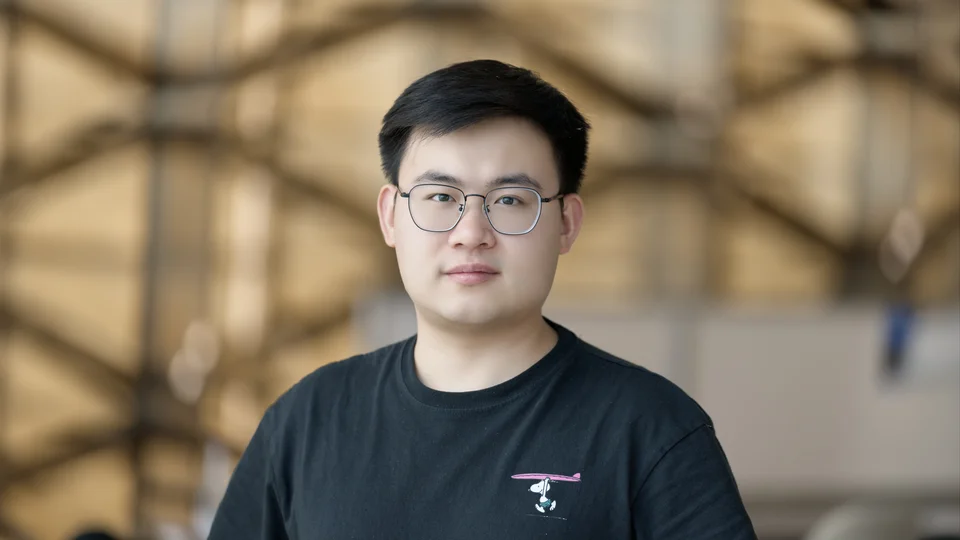
Shuming Liu is a Ph.D. candidate in Computer Science at the GenAI Center of Excellence, King Abdullah University of Science and Technology (KAUST), advised by Prof. Bernard Ghanem. He received his master's degree from Shanghai Jiao Tong University.
He was a Research Scientist Intern with Qwen in 2026, working on long-horizon agentic multimodal reasoning for Qwen-VL models, and with Meta AI in 2025 and 2026, focusing on adaptive reasoning and on-policy self-distillation for video-language models.
He has published multiple papers at leading conferences, including CVPR, ECCV, and ICLR, and has won first place in several CVPR challenges.