
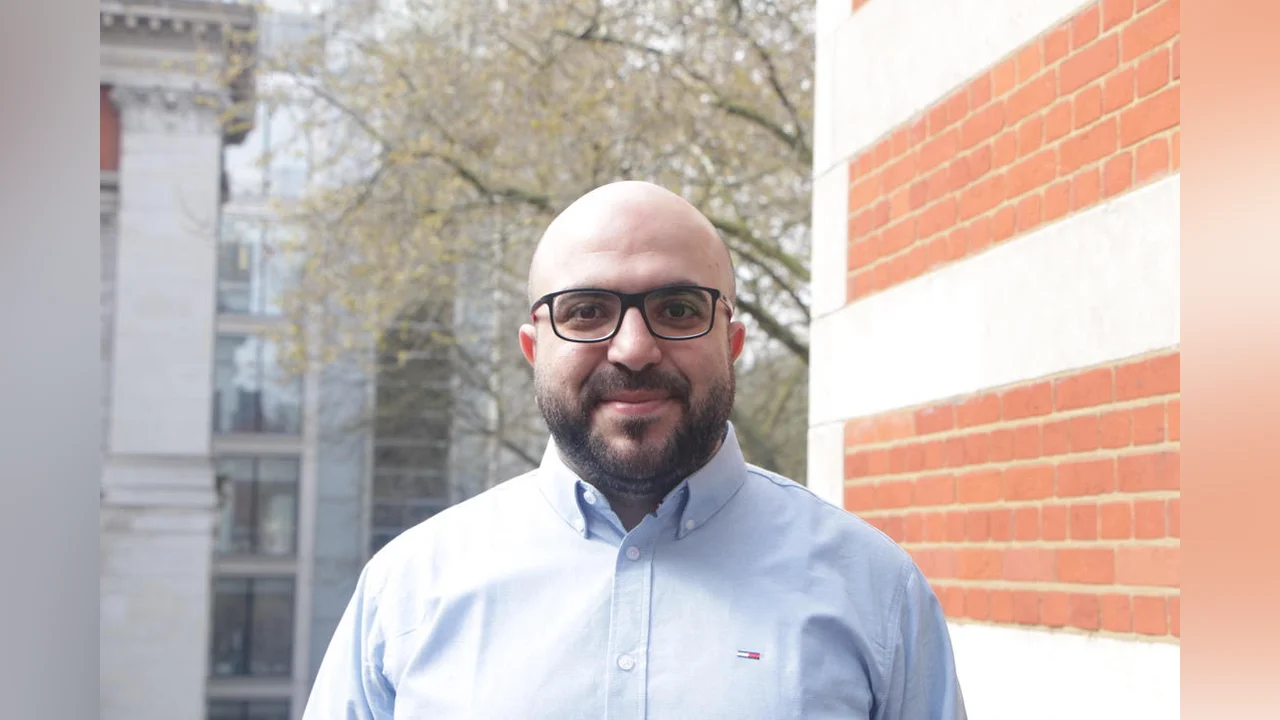
Osama N. Hassan
Postdoctoral Fellow in the Image and Video Understanding Lab (IVUL) at KAUST, working with Prof. Bernard Ghanem. His research spans computer vision, vision-language and multimodal models, and agentic AI systems, informed by a background ranging from optical sensing and computational imaging to machine learning for perception and AI systems that reason and act.
Biography
Osama Hassan is a Postdoctoral Fellow in the Image and Video Understanding Lab (IVUL) at KAUST, where he works with Prof. Bernard Ghanem. He joined KAUST in August 2026.
He received his PhD in Computer Science from Imperial College London under the supervision of Prof. Daniel Rueckert, with research spanning medical image understanding, generative modelling, federated learning, and explainable AI. He also holds an MSc in Electrical and Computer Engineering from the University of California, Los Angeles, and an MSc in Optics and Photonics from Imperial College London, where he graduated with Distinction and ranked first in his cohort. He received his BSc in Electronics and Communications Engineering from Ain Shams University.
Before joining KAUST, Osama was a Senior AI Scientist and AI Tech Lead at Siemens EDA, where he worked on multi-agent AI systems for automated integrated-circuit physical verification. He was also a Research and Teaching Fellow in the Department of Informatics at King’s College London, where he taught computer vision, machine learning, and robotics, and supervised MSc and BSc research projects.
Earlier in his career, he held research internships at Meta Reality Labs, working on perceptual image-quality metrics for AR/VR optics and lens design, and at Samsung Research America, working on camera imaging pipelines. He also spent three years at Si-Ware Systems as a MEMS Development Engineer, developing spectral-imaging technologies for a miniaturised on-chip spectrometer.
Across these roles, his work has evolved from physical sensing and computational imaging to visual and multimodal learning, with a growing focus on intelligent systems that perceive, reason, and act.
Expertise and Interests
My research focuses on visual and multimodal intelligence, with interests spanning computational imaging and sensing, representation learning, multimodal foundation models, and agentic AI. A central theme of my work is understanding how sensing, information representation, and model design influence downstream perception, reasoning, and decision-making. I am also interested in the safety, interpretability, reliability, and rigorous evaluation of learning-based systems.
About
Osama’s research focuses on how machines perceive, represent, and reason about the visual world, and on how such systems can operate reliably beyond controlled benchmarks. His work spans the full visual-intelligence pipeline, from image formation and sensing, to learned visual representations, to multimodal and agentic systems built on top of them. His current interests include computer vision and video understanding, vision-language and multimodal foundation models, and AI systems that reason and act, together with cross-cutting questions in safety, efficiency, reliability, interpretability, and evaluation.
Education
- Doctor of Philosophy (Ph.D.)
- Computer Science, Imperial College London, United Kingdom, 2025
- Master of Science (M.S.)
- Electrical and Computer Engineering, University of California, Los Angeles, United States, 2019
- Master of Science (M.S.)
- Optics and Photonics, Imperial College London, United Kingdom, 2018
- Bachelor of Science (B.S.)
- Electronics and Communications Engineering, Ain Shams University, Egypt, 2015