
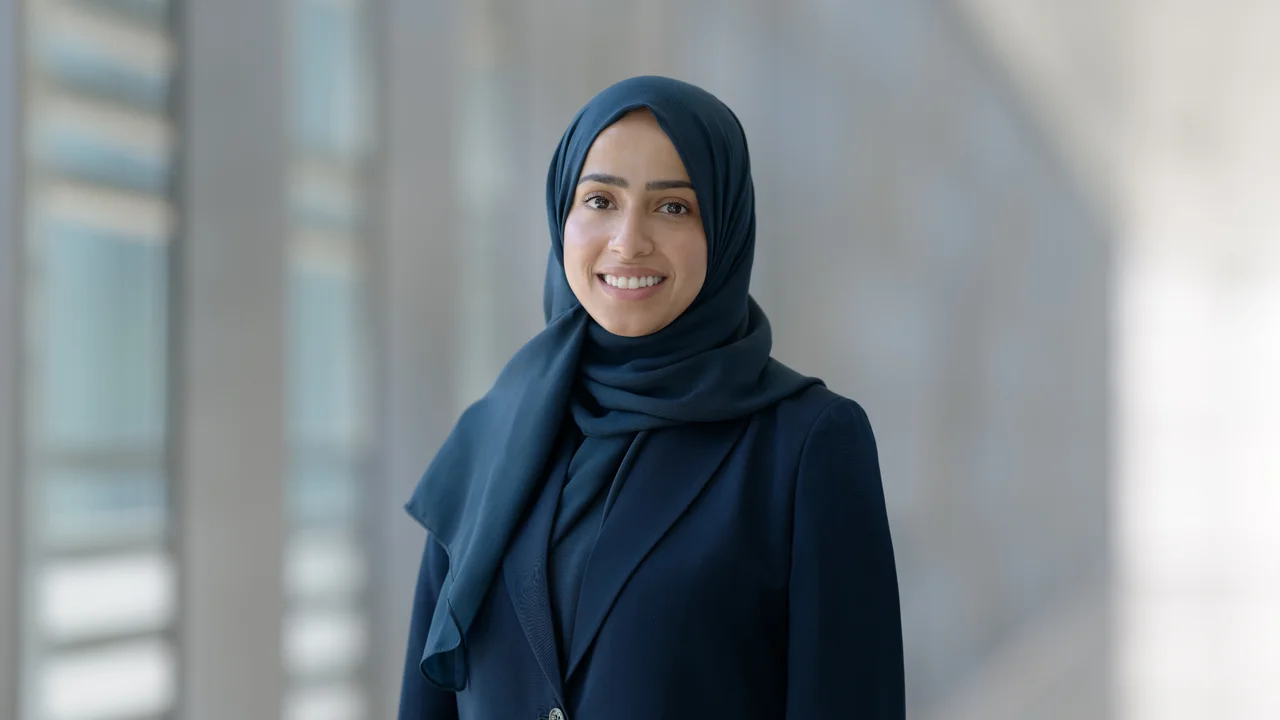
Wedyan Babatain
Professor Babatain’s research focuses on developing soft electronic interfaces through innovations in sensing, actuation, and additive manufacturing for wearable technologies, human-machine interfaces and reconfigurable electronics.
Biography
Wedyan Babatain is an Ibn Rushd Assistant Professor of Electrical and Computer Engineering (ECE) at King Abdullah University of Science and Technology (KAUST) and the principal investigator of the Integrated Interfaces (I²) Lab. Prior to joining KAUST, Babatain was a Postdoctoral Fellow at the MIT Media Lab, where she developed electrically driven actuators and integrated wearable electronics for applications across human-machine interfaces, reconfigurable electronics, and soft robotics. She received her B.S. in Biomedical Engineering from the University of Delaware in 2017, and her M.S. and Ph.D. in Electrical Engineering from KAUST in 2019 and 2022, respectively.
Her research focuses on developing adaptive electronic interfaces that seamlessly sense, respond, and interact with people, machines, and the dynamically changing physical world. Her group develops sensors, actuators, and the fabrication and integration technologies required to realize next-generation electronic systems. By leveraging functional materials and physical phenomena, her research enables soft and compliant electronic interfaces for wearable technologies, human-machine interfaces, reconfigurable electronics, and soft robotic systems.
Babatain has published numerous papers in leading journals, including Advanced Materials, Advanced Science, Advanced Functional Materials, Science Robotics, and ACS Nano, and is an inventor on multiple U.S. patents in flexible electronics, liquid-metal electronics, wearable systems, and digital fabrication.
Her research has received international recognition through honors including the Forbes 30 Under 30 Middle East, MIT Technology Review Innovators Under 35 (MENA), UT Austin EECS Rising Stars, and the SXSW Innovation Awards Finalist.
Expertise and Interests
Professor Babatain’s research focuses on developing soft electronic interfaces through innovations in sensing, actuation, and additive manufacturing for wearable technologies, human-machine interfaces and reconfigurable electronics.
Awards and Distinctions
- Forbes Middle East 30 Under 30, Forbes Middle East, 2023
- Ibn Rushd Postdoctoral Fellowship, KAUST, 2023
- Innovators Under 35 MENA, MIT Technology Review Arabia, 2022
- Rising Star in EECS, The University of Texas at Austin, 2022
- SXSW Innovation Awards Finalist, SXSW, 2022
- Ibn Khaldun Fellowship, Massachusetts Institute of Technology (MIT), 2021
- KAUST Graduate Fellowship, King Abdullah University of Science and Technology, 2017
- Senior Design Award, University of Delaware, 2016
- King Abdullah Scholarship Program (KASP), Saudi Ministry of Education, 2012
Education
- Doctor of Philosophy (Ph.D.)
- Electrical and Computer Engineering, KAUST, Saudi Arabia, 2022
- Master of Science (M.S.)
- Electrical Engineering, KAUST, Saudi Arabia, 2019
- Bachelor of Science (B.S.)
- Biomedical Engineering, University of Delaware, United States, 2017