
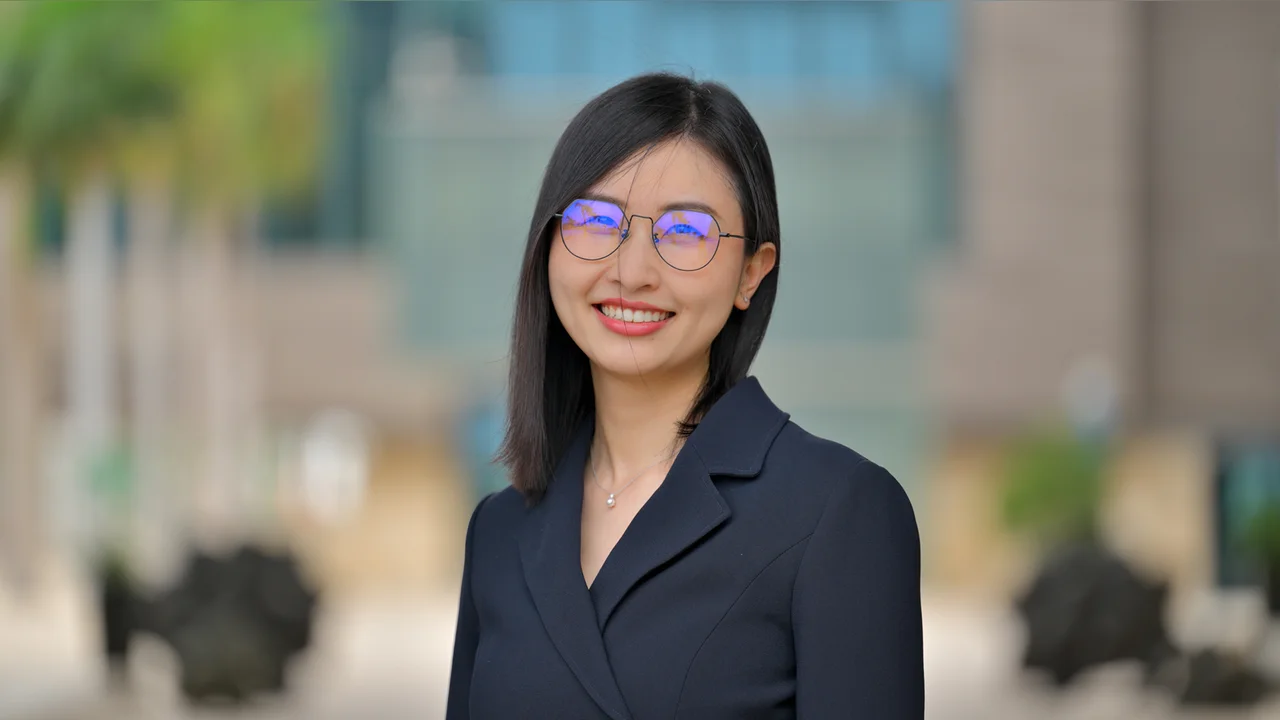
Yating Wan
Dr. Yating Wan, an assistant professor of electrical and computer engineering at KAUST, excels in silicon photonics, with special emphasis on the integration of on-chip light sources.
Biography
Dr. Yating Wan is an assistant professor of electrical engineering and the principal investigator of the Integrated Photonics Laboratory at KAUST.
Dr. Wan specializes in silicon photonics with a focus on integrating on-chip light sources for data communication, optical computing, OPA-based lidar, and quantum information processing.
Before joining KAUST, Dr. Wan worked in Professor John Bowers’ group at the University of California, Santa Barbara (2017–2022), where she led Intel’s project on heterogeneously integrated QD lasers on silicon.
At KAUST, she leads a dynamic team of 20 members, including seven postdoctoral researchers, 11 Ph.D. students, and two master’s students.
Dr. Wan has authored over 100 peer-reviewed publications, including 38 first-author papers (29 journals, 9 proceedings, and 10 journal covers) and 26 corresponding-author publications (11 journals, 15 conferences).
For her pioneering work in on-chip laser integration on silicon, Dr. Wan has received numerous major awards, including the 2021 CLEO Tingye Li Innovation Prize (one awardee worldwide); the 2022 Rising Stars of Light recognition by Light: Science & Applications (three awardees worldwide); inclusion in MIT Technology Review’s 2023 “35 Innovators Under 35 for China”; the 2025 Sony Women in Technology Award with Nature ($250,000 prize, three awardees worldwide); and the 2025 IEEE Photonics Society Young Investigator Award (one awardee worldwide).
Outside her immediate research focus, Dr. Wan has been an active contributor to the broader academic community. She serves as manager and column editor for the LSA Editorial Office in Thuwal, as associate editor for Applied Optics and the IEEE Journal of Quantum Electronics (JQE), and as guest associate editor for the IEEE Journal of Selected Topics in Quantum Electronics (JSTQE).
Dr. Wan is also a technical program committee member for the International Photonics Conference (IPC) and the Conference on Lasers and Electro-Optics (CLEO) and a member of the IEEE Photonics Society Conference Council. She has reviewed more than 100 papers for leading journals across IEEE, Optica and the Nature Publishing Group.
Expertise and Interests
Dr. Yating Wan’s research focuses on advancing integrated silicon photonics through the development of efficient, scalable, and CMOS-compatible on-chip light sources based on quantum dot (QD) lasers. Her work tackles one of the central challenges in photonic integration—realizing reliable, energy-efficient light generation directly on silicon and emerging material platforms such as silicon carbide and thin-film lithium niobate. By leveraging cutting-edge heterogeneous integration techniques, her group has demonstrated QD lasers with record-low threshold currents, ultranarrow linewidths, and remarkable temperature and feedback stability.
These high-performance QD light sources unlock the full potential of silicon photonics as a universal hardware platform that unites communication, computation, and sensing. Building on this foundation, Dr. Wan’s research explores transformative applications, including photonic computing units (PCUs) for AI acceleration, ultra-efficient optical interconnects for data centers and high-performance computing, silicon photonics-integrated LiDAR for autonomous systems, and chaos-based photonic hardware for next-generation cybersecurity.
Through the seamless integration of materials science, device engineering, and system-level photonic architectures, Dr. Wan’s work bridges the gap between laboratory breakthroughs and industrial-scale deployment. Her vision is to enable an intelligent, energy-sustainable future powered by next-generation AI hardware, high-speed interconnects, and secure optical technologies built on fully integrated QD-on-silicon photonic platforms.
Professional Profile
Service Contributions
-
-
Associate Editor of IEEE Journal of Quantum Electronics (JQE) , 2023 - present
-
Associate Editor of Applied Optics, 2024 - present
-
Awards and Distinctions
- School of Engineering PhD Research Excellence Award, Hong Kong University of Science and Technology (HKUST), 2017
- PIERS Young Scientist Award, 2018
- Rising Stars Women in Engineering Asia , 2018
- Rising Stars Women in EECS, 2020
- OGC Best Young Scientist Award, 2021
- CLEO Tingye Li Innovation Prize, 2021
- Rising stars of Light , 2022
- Optica Ambassador, 2024
- IEEE Photonics Society Young Investigator Award, IEEE, 2025
- Sony Women in Technology Award with Nature, Sony and Nature, 2025
Education
- Doctor of Philosophy (Ph.D.)
- Electronic and Computer Engineering, The Hong Kong University of Science and Technology, Hong Kong, 2017
- Bachelor of Science (B.S.)
- Optical Engineering, Zhejiang University, China, 2012
About our lab
The Integrated Photonics Laboratory works on silicon photonics with special emphasis on the integration of on-chip light sources. Leveraging state-of-the-art nanofabrication technology and interdisciplinary cooperation, we develop photonic integrated circuits that can be applied to data communications, biosensors/bioimaging, energy harvesting, machine vision, and quantum information processing.
Selected Publications
Five Selected Publications in KAUST
- B. Dong, Y. Wan*, W. W. Chow, C. Shang, A. Prokoshin, R. Koscica. H, Wang, J. E. Bowers, “Turnkey locking of quantum-dot lasers directly grown on Si”, Nature Photonics, 1-8, 2024 (*corresponding author, Impact: 32.3)
- Z. Zhou, X. Ou, Y. Fang, E. Alkhazraji, R. Xu, Y. Wan*, J. E. Bowers, “Prospects and applications of on-chip lasers”, Elight 3 (1), 1-25, 2023. (Featured by Light: Science & Applications, *corresponding author, Impact: 27.2).
- A. Prokoshin, M. Gehl, S. E. Madaras, W. W. Chow, Y. Wan*, “Ultra-narrow-linewidth hybrid-integrated self-injection locked laser at 780 nm”, Optica, 11(7), 1024-1029, 2024. (*corresponding author, Impact: 8.4).
- E. Alkhazraji, W. W. Chow, F. Grillot, J. E. Bowers, Y. Wan* “Linewidth narrowing in self-injection-locked on-chip lasers”, Light: Science & Applications. 12(1), 162, 2023. (*corresponding author, Impact: 20.26).
- A. Prokoshin, W. W. Chow, B. Dong, F. Grillot, J. E. Bowers, Y. Wan*, “Linewidth narrowing in self-injection locked lasers: effects of quantum confinement”, APL Photonics, 9(8), 2024.
Selected Publications before joining KAUST.
- Y. Wan, C. Xiang, J. Guo, R. Koscica, MJ Kennedy, J. Selvidge, Z. Zhang, L. Chang, W. Xie, D.Huang, A. C. Gossard, and J. E. Bowers*, “High speed evanescent quantum-dot lasers on Si”, Laser & Photonics Reviews 2100057, 2021. (Front cover)
- Y. Wan, J. Norman, Y. Tong, MJ Kennedy, W. He, J. Selvidge, C. Shang, M. Dumont, A. Malik, H. K. Tsang, A. C. Gossard, and J. E. Bowers*, “1.3 µm quantum-dot distributed feedback lasers directly grown on (001) Si”, Laser & Photonics Reviews. 14 (7), 2070042, 2020. (Back cover)
- Y. Wan, C. Shang, J. Huang, Z. Xie, A. Jain, D. Inoue, B. Chen, J. Norman, A. C. Gossard, and J. E. Bowers*, “Low-dark current 1.55 μm InAs quantum dash waveguide photodiodes”, ACS nano 14(3), 3519-3527, 2020.
- Y. Wan, S. Zhang, J. Norman, MJ Kennedy, W. He, Y. Tong, C. Shang, J. He, H. K. Tsang, A. C. Gossard, and J. E. Bowers*, “Directly modulated single-mode tunable quantum dot lasers at 1.3 µm”, Laser & Photonics Reviews. 14(3), 1900348, 2020. (Back cover)
- Y. Wan, S. Zhang, J. Norman, MJ Kennedy, W. He, S. Liu, C. Xiang, C. Shang, J. He, A. C. Gossard, and J. E. Bowers*, “Tunable quantum dot lasers directly grown on silicon”, Optica, 6(11), 1394-1400 (2019).
- Y. Wan, J. Norman, Q. Li, MJ. Kennedy, D. Liang, C. Zhang, D. Huang, Z. Zhang, A. Y. Liu, A. Torres, D. Jung, A. C. Gossard, E. L. Hu, K. M. Lau, and J. E. Bowers*, “1.3 µm submilliamp threshold quantum dot micro-lasers on Si”, Optica, 4(8), 940-944 (2017). (Front cover)
- Y. Wan, D. Jung, C. Shang, N. Collins, I. Macfarlane, J. Norman, M. Dumont, A. C. Gossard, and J. E. Bowers*, “Low-threshold continuous-wave operation of electrically-pumped 1.55 μm InAs quantum dash microring lasers”, ACS Photonics, 6 (2), pp 279–285 (2019).
- Y. Wan, D. Innoue, D. Jung, J. Norman, C. Shang, A. C. Gossard, and J. E. Bowers*, “Directly modulated quantum dot lasers on silicon with a milliamp threshold and high temperature stability”, Photonics Research, 6(8), 776-781 (2018). (Front cover)
- Y. Wan, C. Shang, J. Norman, B. Shi, Q. Li, N Collins, M Dumont, K. M. Lau, A. C. Gossard, and J. E. Bowers*, “Low threshold quantum dot lasers directly grown on unpatterned quasi-nominal (001) Si”, IEEE Journal of Selected Topics in Quantum Electronics. 26, 1-9, 2020.
- Y. Wan, Q. Li, A. Y. Liu, A. C. Gossard, J. E. Bowers, E. L. Hu, and K. M. Lau*, “Optically pumped 1.3 μm room-temperature InAs quantum-dot micro-disk lasers directly grown on (001) silicon,” Optics Letters, 41(7), 1664-1667 (2016). (15 most cited articles published in Optics Letters between 2016 and 2018)
- Y. Wan, Q. Li, A. Y. Liu, A. C. Gossard, J. E. Bowers, E. L. Hu, K. M. Lau*, “Temperature characteristics of epitaxially grown InAs quantum dot micro-disk lasers on silicon for on-chip light sources” Applied Physics Letters, 109 (1), 011104 (2016). (Front cover and most highly read paper of 2016 by Applied Physics Letter)
- Y. Wan, Z. Zhang, R. Chao, J. Norman, D. Jung, C. Shang, Q. Li, MJ. Kennedy, D. Liang, C. Zhang, J. Shi, A. C. Gossard, E. L. Hu, K. M. Lau, and J. E. Bowers*, “Monolithically Integrated InAs/InGaAs Quantum Dot Photodetectors on Silicon Substrates”, Optics Express, 25(22), 27715-27723 (2017).
For the complete list and PDF paper files, please visit the publications list on "KAUST Academic Research Portal", KAUST Repository, Google Scholar, or her CV.
Questions and Answers
Why KAUST?
1. KAUST offers strong startup funding for me to build a world-class lab and provides flexible and sustained support to pursue long-term research and scientific goals so that I can spend sufficient quality time advising students and discussing ideas.
2. KAUST has world-leading facilities for semiconductor material growth, device nano-fabrication, and characterizations. Those facilities are supported and maintained by excellent and experienced scientists and technicians to make full use.
3. KAUST is a beautiful place, with the Red Sea just steps away.
4. KAUST takes care of everything (housing, children education, transportation, visa, etc. ) so that you can fully focus on research.
5. KAUST provides work-play-live environment, it has state-of-the-art fitness facilities and ample recreational amenities, infinity pool with its magnificent view overlooking the sea, a 9-hole, par 36 golf course, full range of PADI scuba diving courses from Open Water all the way up to Dive Master, numerous fine dining and casual fare restaurants, private chartered boat cruises, snorkeling and diving trips, and traditional fishing trips, etc. There is a wide range of activities and opportunities for keeping fit, active and entertained.
6. KAUST is very international, it attracts students, postdocs, scientists, and faculties from all around the world. I enjoy the diverse and international university community of faculty, students, staff, and the cross-disciplinary organization between Academic Divisions and Research Centers.