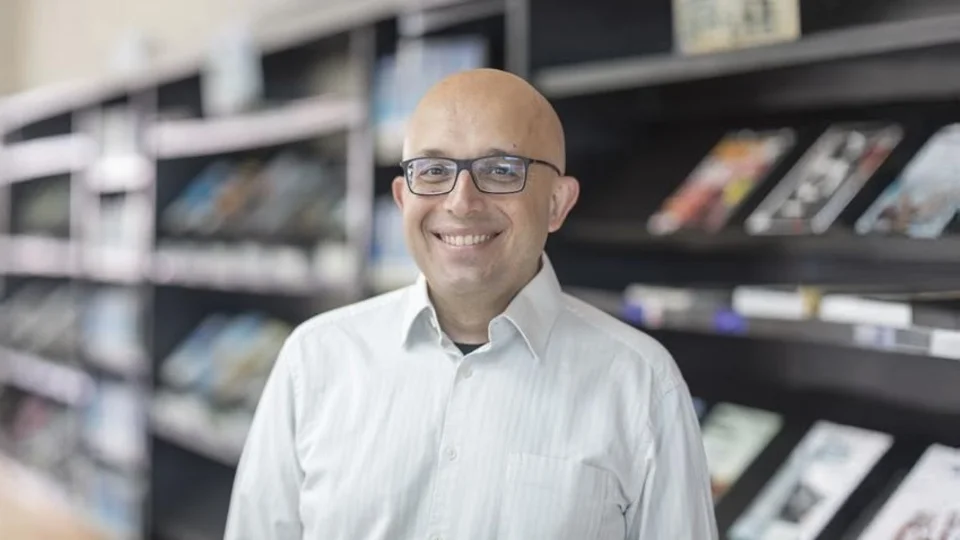
Professor Hakan Bagci named an Institute of Electrical and Electronics Engineers (IEEE) Fellow
KAUST Professor Hakan Bagci has been named an IEEE Fellow, the organization’s highest distinction, in recognition of his contributions to computational electromagnetics.
About
Hakan Bagci, a professor of electrical and computer engineering at KAUST, has been elevated to the rank of Fellow of the Institute of Electrical and Electronics Engineers (IEEE), effective January 1, 2026. Bagci was recognized by the preeminent organization for his contributions to computational electromagnetics.
The IEEE Fellow designation is the highest honor within the organization. Each year, this distinction is limited to no more than 0.1% of the total IEEE voting membership. According to IEEE, this prestigious grade is reserved for “members whose extraordinary accomplishments in any of the IEEE fields of interest are deemed fitting of this prestigious grade elevation.”
These fields of interest encompass a diverse array of disciplines, including engineering, computer sciences and information technology, physical sciences, biological and medical sciences, mathematics, technical communications, education, management, and law and policy.
The IEEE—established to advance technology for the benefit of humanity—has over 486,000 members in more than 190 countries.
Regarding his elevation, Bagci said, “I am deeply honored by this recognition. Becoming an IEEE Fellow is especially meaningful because it comes from a global community of peers whose work I greatly respect. This acknowledgement reflects the collective efforts of my students, collaborators, and colleagues, whose contributions made this possible.”
Bridging electromagnetic theory and simulation
Bagci’s research at KAUST focuses on developing advanced computational methods for the practical design and optimization of complex electromagnetic and multiphysics systems.
His Computational Electromagnetics (CEM) research group develops mathematically rigorous and computationally efficient algorithms for solving differential and integral formulations of Maxwell’s equations, enabling high-fidelity modeling of complex electromagnetic phenomena. These methods allow advances in sensing, communications and photonics by improving both accuracy and computational performance.
“The overarching goal of my work is to translate rigorous electromagnetic theory into simulation tools that directly enable next-generation technologies in communications, sensing, photonics and optoelectronics,” he said.
One major research thrust focuses on simulating metasurfaces—ultrathin structures that manipulate electromagnetic waves. The group has developed an efficient solver that models large, complex metasurfaces without resolving fine geometric details, enabling applications such as beam shaping, radar cross-section reduction and smart electromagnetic environments.
A second research direction centers on simulating plasmonic photoconductive devices for terahertz generation used in imaging, spectroscopy and high-speed wireless systems. These simulations rely on a multiphysics framework developed by the group that couples electromagnetic and semiconductor physics to predict and optimize device performance.
“Together, our research aims to provide predictive and scalable simulation tools that accelerate the transition from concept to practical technologies,” Bagci said. “I am grateful for KAUST’s research environment, which has enabled me to create work with a real-world impact.”