
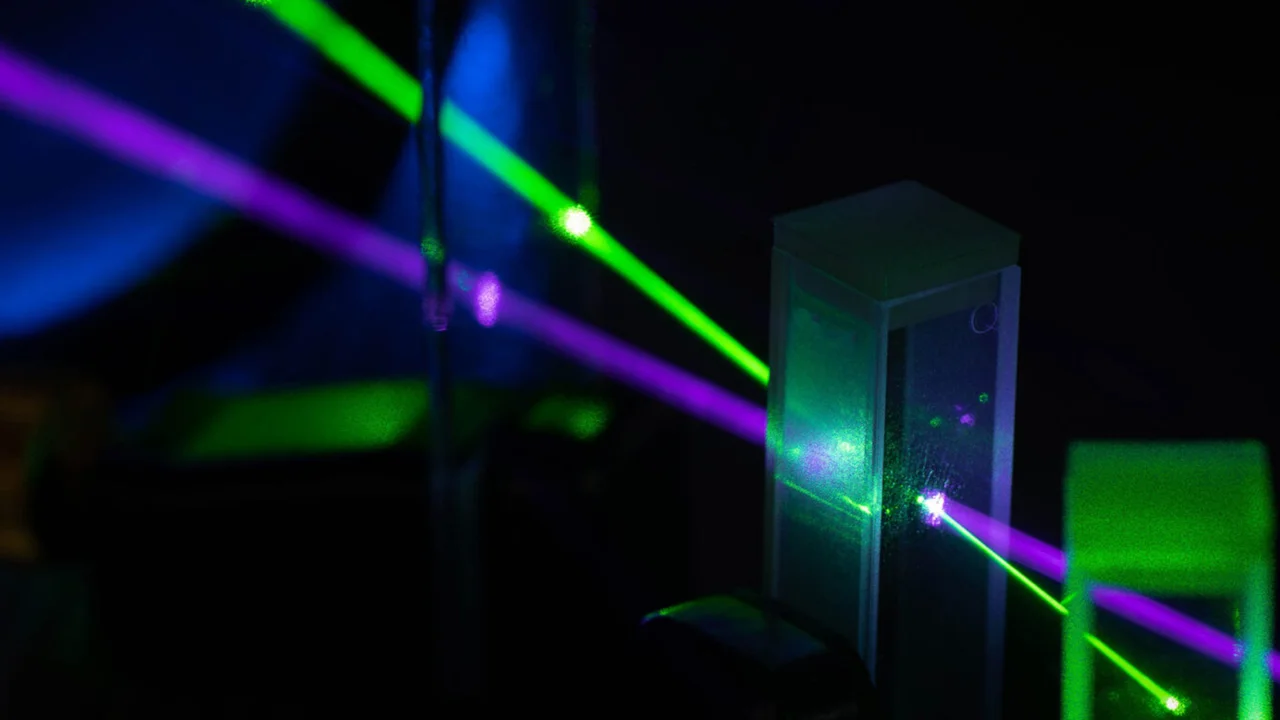
Quantum dot lasers outshine expectations
Resilient quantum dot lasers are set to make simpler, greener, and cheaper light-driven integrated circuits.
About
Quantum dot (QD) semiconductor lasers have been shown to operate reliably under strong optical feedback, which results from external light being reflected back from other circuit components[1]. A KAUST-led team says its discovery is the key to simpler and cheaper on-chip integration.
This advance brings these lasers closer to practical use in compact, scalable photonic circuits that enable faster data transfer and processing while using less energy.
Photonic integrated circuits typically use quantum well-based lasers containing III-V-type semiconductor materials like gallium arsenide, which are ideal for long-distance, high-speed data transmission in fiber optic networks. But when incorporated into standard silicon-based circuits, these lasers face specific hurdles. They are highly sensitive to optical feedback, which degrades performance, and can undergo coherence collapse — a chaotic state in which the laser signal becomes unstable and noisy — even under modest feedback levels.
As a result, quantum well-based lasers typically require optical isolators, which allow light transmission in just one direction, or complex engineering to prevent feedback when used on circuits. These protective measures add cost, complexity, and energy consumption.
In contrast, QD lasers are thermally stable, efficient, and resistant to optical feedback thanks to their ability to maintain a consistent, narrow-linewidth signal. This could eliminate the need for optical isolators, simplifying packaging and reducing costs. But, can the lasers stay reliable without isolators in real circuits, where reflections can be much stronger?
Read the full story on KAUST Discovery.
Related People


Ying Shi
- Postdoctoral Research Fellow, Electrical and Computer Engineering