How data is transforming transplantation in Saudi Arabia
About
Every organ transplant is a race against time. The outcome often hinges on finding a biologically compatible donor at the right time. Success depends on a complex combination of factors: organ quality, timing, patient readiness, logistics, clinical practices and long-term risks.
Transplantation medicine relies on care coordination among multidisciplinary providers across institutions and on long-term patient monitoring. Improving data systems plays a crucial role in assessing key performance indicators, ensuring timely transplants and determining which patients benefit most from the organ allocation process.
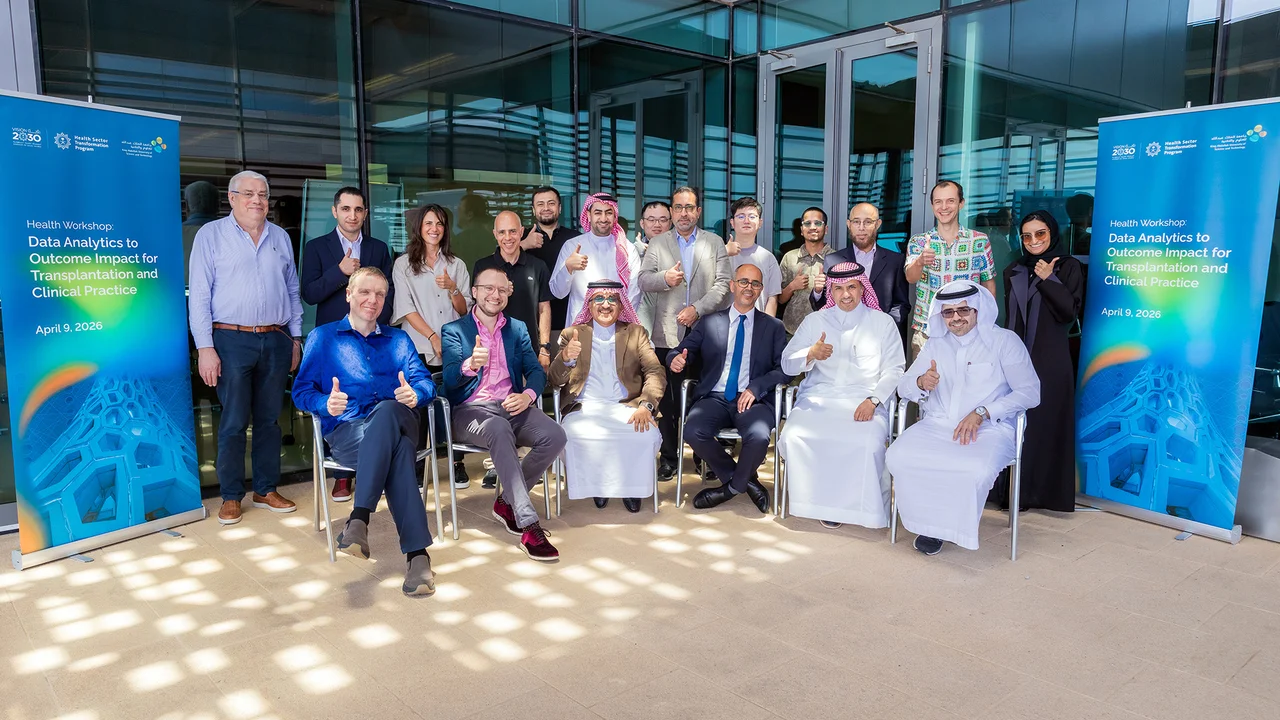
To explore how data analytics can enhance transplant outcomes across Saudi Arabia and beyond, KAUST hosted the National Data Analytics to Outcome Impact for Transplantation and Clinical Practice workshop.
Held on April 9, the on-campus event, supported by the Health Sector Transformation Program (HSTP), brought together clinicians, transplant researchers, data scientists, computational scientists and policy experts. Sessions focused on how national-scale advanced analytics and computational tools can strengthen clinical decision-making within Saudi Arabia's transplantation ecosystem.
“We wanted the workshop to focus not just on data analytics, but on how data can improve outcomes for patients. In transplantation, that connection is very direct,” said KAUST alumnus and workshop co-organizer Michał Mańkowski.
Key directions included strengthening national transplant data systems and developing predictive models to inform decisions on organ offers, patient risk and long-term outcomes. Researchers also demonstrated how multi-omics data can improve patient stratification and how artificial intelligence can enhance diagnostic and therapeutic decision-making.
“In transplantation, simulation is very important," Mańkowski said. "We often need to understand what might happen if a policy changes before it is implemented. Computational tools can help us test those scenarios safely.”
Across their shared findings, one of the biggest challenges Mańkowski and his colleagues encountered was the fragmentation of transplant data. Different institutions may define the same event differently, making it harder to coordinate care and evaluate outcomes. Shared data and computational tools can help create a more coordinated, efficient and transparent transplant system.
“The challenge is building systems that allow that data to inform decisions consistently across institutions," added Mikhail Moshkov, workshop co-organizer and professor of applied mathematics and computational science at KAUST. "This is where computational methods and national coordination become critical.”
“Strengthening how data is integrated and analyzed at a national level is an important, critical task that has to be accomplished,” said Dr. Fawaz Al Ammary (M.D. Ph.D.), associate professor of medicine and director of mixed methods research in kidney health and transplantation at the University of California, Irvine. “The only way to advance, innovate and conduct clinical trials is to establish a strong national data infrastructure across Saudi transplant centers to advance value-based care and improve long-term transplant outcomes and health care costs.”
Creating a transparent transplant system
Chronic kidney disease (CKD) often progresses silently for years, and by the time it becomes clinically apparent, patients may already be seriously ill and in need of urgent lifesaving dialysis or transplantation. Reducing its impact in the Kingdom will require closer collaboration between clinicians, researchers and data scientists.
Mańkowski is an assistant professor of computer science in the Department of Surgery at the New York University Grossman School of Medicine. His research focuses on the intersection of data science, artificial intelligence and machine learning, operations research and transplantation.
“My work looks at how organs are allocated, how patients are matched and how health systems can make faster, fairer and more evidence-based decisions. If every center uses different definitions, systems and workflows, it becomes much harder to make consistent decisions.
“In transplantation, decisions have traditionally relied on clinical factors, lab results, histology and Human Leukocyte Antigen (HLA) matching. These remain essential; however, emerging approaches—genomics, transcriptomics, proteomics, metabolomics, immune profiling and molecular HLA matching—offer a deeper understanding of rejection risk, organ injury and long-term graft outcomes,” he said.
The challenge now is translating this complexity into usable tools. That means designing trusted decision-support systems around real clinical workflows: who will use the tool, when they will use it and what action it is intended to support.
“KAUST is well-positioned for this work, bringing together advanced computational science with national healthcare priorities. The workshop marked an important step in building those connections.”