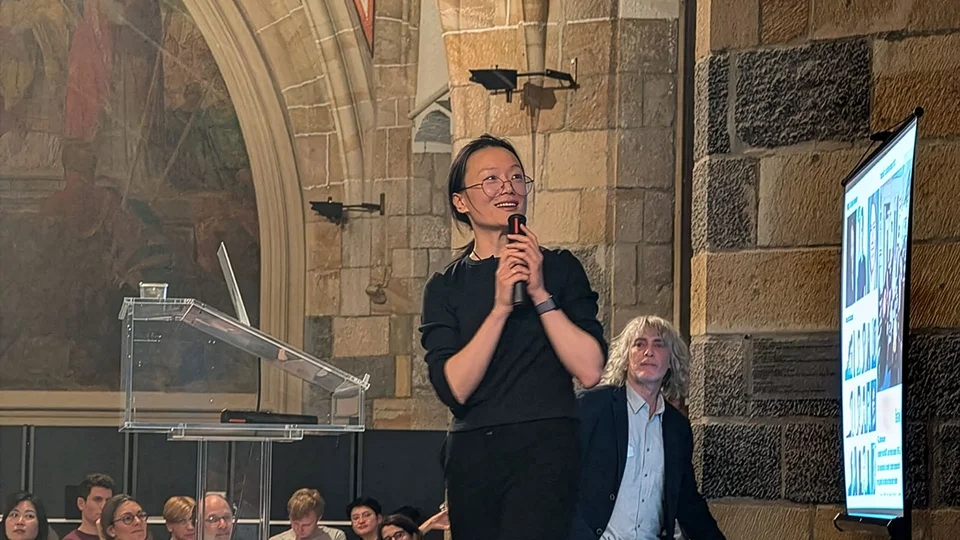
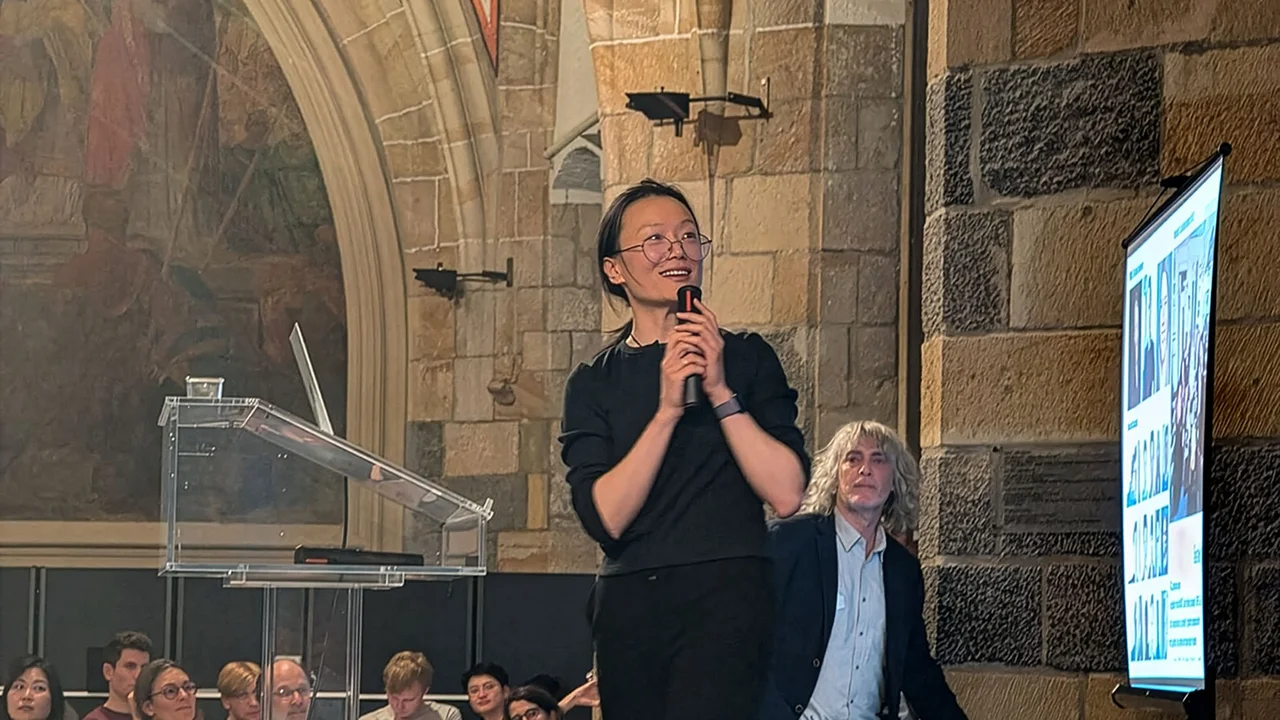
KAUST alumna Professor Jing Ren receives the Eurographics Young Researcher Award
The award highlights contributions spanning geometry processing, digital fabrication and computer vision.
About
Professor Jing Ren (Ph.D '21) has won the European Association for Computer Graphics (Eurographics) Young Researcher Award. Presented annually to two early-career researchers, the award recognizes individuals who have already made significant contributions and show exceptional promise for future impact.
Ren, who joined the Université de Montréal as an assistant professor in May 2026, obtained her Ph.D. at KAUST, advised by Professors Peter Wonka and Maks Ovsjanikov. She then spent one year as a postdoctoral fellow and two years as a senior researcher at the Interactive Geometry Lab, ETH Zurich, where she was advised by Professor Olga Sorkine-Hornung.
The Eurographics award recognized contributions made during her time at both KAUST and ETH Zurich. Her theoretically grounded contributions to geometry processing have supported applications in computational fabrication and contributed to research in computer vision and machine perception.
"It is an honor to see my name listed among the previous Eurographics awardees,” she said. “Sometimes I feel the research I do is not immediately impactful; however, receiving this award encourages me to keep working on the topics I love, since they have been recognized by researchers I admire."
Where the past shapes the future
Ren’s interest in shape analysis, geometry processing and digital fabrication can be traced back to a childhood fascination with geometry. She credits her former advisors with opening the door to computer graphics.
"I learned everything from Peter and Maks; that is how I entered the fascinating world of geometry processing.
"Peter is a professional and knowledgeable researcher, but also a fun person. I was excited by the prospect of working with him, and that is how I ended up at KAUST. Maks taught me all the proofs and how to translate them into code; Peter trained me how to formulate problems and come up with counterexamples. They, and my former postdoctoral advisor, Olga, are my role models as researchers, colleagues and supervisors."
Her current research focuses on developing mathematical methods that help computers understand and manipulate complex shapes. In shape matching, she finds ways to accurately map one shape onto another — even when the shapes are highly detailed or distorted — by combining geometric representations with techniques that preserve orientation and structure.
Ren’s digital fabrication work investigates how flat cutting or stitching patterns translate into three-dimensional forms, allowing designers and engineers to predict and control how a 2D design will curve and take shape in the real world. To achieve this, she uses metamaterial design and computational versions of origami and kirigami — traditional paper art techniques that transform flat sheets into three-dimensional structures — to engineer materials that achieve target shapes or mechanical properties, with applications across architecture, soft robotics and solar energy.
Across both areas, she combines mathematical rigor with computational efficiency, making previously intractable geometric problems more practical for real-world applications. "I love that there are so many numerical tools to make geometry tangible," she said. "During my postdoc, I became interested in digital fabrication — moving beyond simply displaying results on a monitor. It's very hard to describe the sense of achievement after successfully realizing the results from the algorithm, even if the result itself is a failure case.”
Walks, waves and research puzzles
As a new chapter in her career unfolds in Canada, Ren looks back fondly on her time at KAUST: "I had a wonderful time at KAUST. My former VCC colleagues have always been willing to share their knowledge and insights. My time there helped me to see more of the computer graphics community beyond my own tiny world.
"The campus and community were also peaceful. I often took long walks along the Red Sea after sunset. That always helped me to clear my mind and solve whatever research puzzle I happened to be working on."