

Hang Lu receives 2026 SPIE Optics and Photonics Scholarship
Awarded while Lu was pursuing her Ph.D. at KAUST, the scholarship recognizes her research advancing photonic technologies for communications, imaging and hardware security.
About
KAUST Ph.D. graduate Hang Lu received a 2026 Optics and Photonics Scholarship from SPIE, the international society for optics and photonics, during her doctoral studies. The scholarship recognizes Lu's potential contributions to optics, photonics and related fields. This year, SPIE is awarding $351,000 in scholarships to 85 outstanding student members.
Lu completed her Ph.D. at the KAUST Photonics Laboratory under the supervision of Professor Boon S. Ooi. Her research takes a comprehensive approach—from device physics and nanofabrication to system-level implementation—centered on vertical-cavity surface-emitting lasers (VCSELs) and integrated photonic systems.
"Receiving this recognition is especially meaningful. The SPIE represents a global community that has driven many of the advances that shape modern photonics. Technologies we use every day, including high-speed communication networks, sensors and imaging systems, are built on decades of innovation in optics and photonics. I feel fortunate to have contributed a small piece to that greater effort," she said.
The possibilities of light
A small change in device geometry can dramatically alter how light evolves within a cavity. By engineering device geometry and optical dynamics, Lu explores how these interactions can unlock unexpected behaviors, enabling scalable photonic technologies for entropy generation, high-speed secure communication, imaging and hardware security. Together with her KAUST colleagues, she is developing compact photonic platforms capable of producing complex optical behaviors that would otherwise require much larger or more complicated systems.
What drew Lu to semiconductor optoelectronics and photonic integrated circuits was the realization that light sits at the intersection of fundamental science and transformative technology.
Although humans have studied light for centuries, many of the technologies that define modern photonics are young. The laser was first demonstrated in 1960, and integrated photonics has largely emerged within the last few decades.
Yet these innovations have already transformed communication, sensing, imaging and many aspects of everyday life. For researchers such as Lu, that rapid progress suggests there is still much to discover.
"I view photonic devices not only as components that transmit information, but as physical systems that can also generate, process and protect information," Lu said. "A laser used for communication, for example, can also serve as a source of randomness and a tool for hardware security. Discovering capabilities like these is especially exciting because we are still far from fully understanding and exploiting the possibilities of light.
"My research focuses on uncovering new capabilities hidden within existing photonic technologies by engineering the devices. I am particularly interested in how functions typically handled by layers of electronics, computation and software can instead emerge directly from the physical behavior of photonic devices. Bridging the gap between discovery and practical implementation is what excites me most."
Learning to think beyond novelty
Lu credits her supervisor, Professor Ooi, with shaping her approach to research.
"He taught me that good research should not stop at novelty. It should also ask whether a technology is practical and can create a real impact. This shaped how I think about scalability and the path from discovery to deployment."
For Lu, the SPIE recognition reinforces the value of pursuing ambitious research questions, even when the path forward is uncertain.
"The scholarship provides encouragement at an important stage of my career. As researchers, we often spend years working on challenging problems without knowing where they will ultimately lead.
"Photonics is entering an exciting era, with opportunities spanning communications, computing, sensing, healthcare and security. I hope to continue working at this intersection of fundamental science and practical engineering, helping translate advances in photonics into technologies that address real-world needs."
Related People

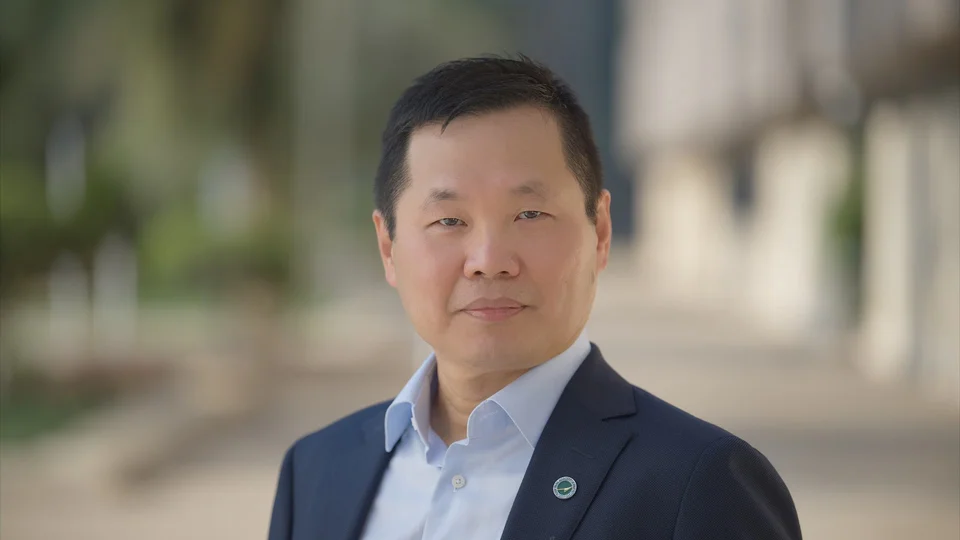
Boon Ooi
- Al-Khawarzmi Distinguished Professor, Electrical and Computer Engineering