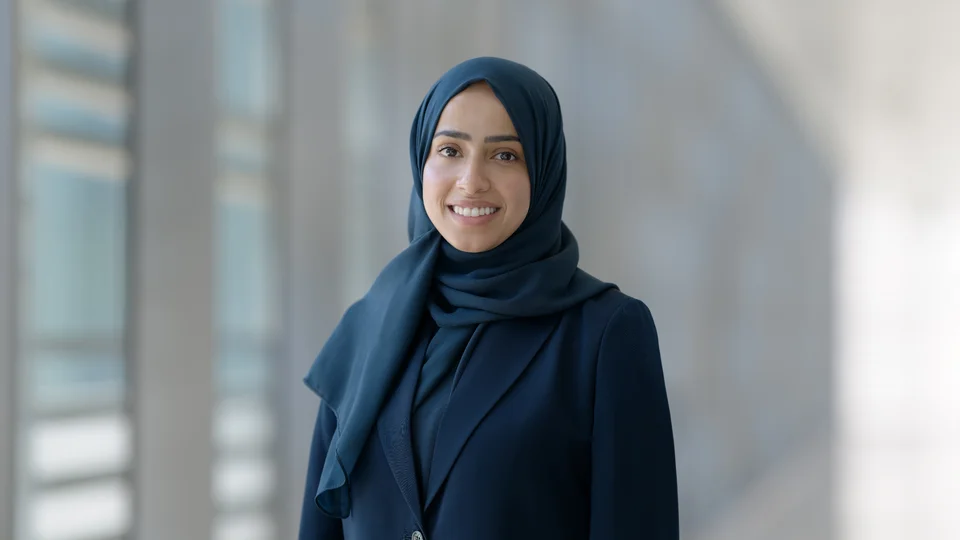
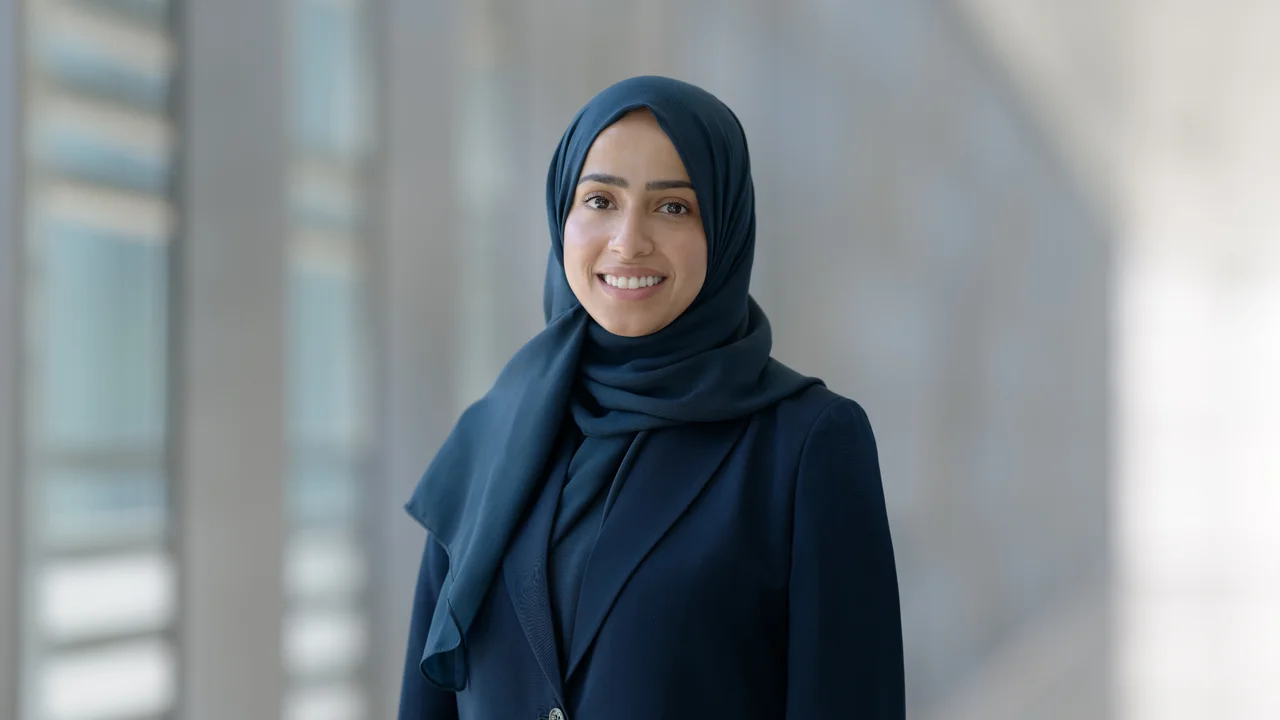
Wedyan Babatain returns to KAUST to establish the Integrated Interfaces Lab
KAUST alumna Wedyan Babatain returns as the first Saudi female faculty member in the Electrical and Computer Engineering program, launching a new lab focused on adaptive electronic interfaces and systems.
About
Electronic systems are increasingly moving beyond traditional computers and into wearable technologies, robotics and devices that interact directly with the human body. Yet most electronics still have fixed forms and functions, relying on static interfaces to interact with people and the physical world. This rigidity limits their ability to adapt to the soft, dynamic environments in which they operate.
To keep pace, electronics utilised in wearable technologies, robotics and dynamic environments must do more than simply compute: they must sense, respond and physically adapt to the people and environments around them. Developing that kind of intelligent interface is what KAUST alumna Wedyan Babatain has built her career around.
Babatain returns to KAUST as an Ibn Rushd assistant professor of electrical and computer engineering and the first Saudi female faculty member in the University's Electrical and Computer Engineering program.
Her research explores electronics built with unconventional materials: stretchable liquid metals, self-healing circuits that reroute around damage, and devices that conform to the human body, integrate into clothing, and enable soft machines to move and respond.
Babatain, the principal investigator of the recently formed Integrated Interfaces (I²) Lab, aims to enable the next generation of healthcare technologies and human-machine interfaces built on these adaptive foundations.
"My work combines innovations in sensing, actuation, fabrication, and system integration,” she said. “I hope to establish new design principles for electronic systems that interact more naturally with people, machines, and the physical world."
Coming full circle
Babatain’s perseverance in the lab and classroom earned her the King Abdullah Scholarship Program (KASP), awarded by the Ministry of Education, to complete her undergraduate studies in the United States.
KAUST has since played a prominent role in her research career. She first joined the University as a visiting student in 2017. She then went on to obtain her master’s degree ('19) in electrical engineering and her Ph.D. ('22), supported by the KAUST Graduate Fellowship. During her time at KAUST, she developed her research interests and began to pursue the academic career that would eventually bring her back to the University as a faculty member.
After graduating from KAUST, Babatain joined MIT as a postdoctoral fellow at the MIT Media Lab. Her time at MIT further broadened her perspective on interdisciplinary research and reinforced the importance of tackling challenging problems through diverse collaborations.
She sees the chance to return to KAUST to establish her own research group as both a privilege and a responsibility.
"Returning to KAUST as a faculty member feels like coming full circle. During my M.S. and Ph.D., I had the opportunity to work on exciting research, collaborate with people from around the world, and learn from outstanding mentors in an environment that fostered curiosity, collaboration, and innovation," she said.
"And now I look forward to contributing to the University's research ecosystem, supporting my country's growing research and innovation ambitions, mentoring the next generation of scientists and engineers, and developing technologies that can make a meaningful impact."
Forging a path in integrated interfaces
Babatain's work mirrors the Kingdom’s ambition to build a knowledge-based economy driven by science, technology and innovation. The I² Lab focuses on three connected areas: soft sensors and actuators for wearable and body-worn systems; materials and interfaces that enable electronics to stretch, physically reconfigure and self-heal; and fabrication and integration technologies that make these systems scalable and suitable for real-world applications.
The technologies developed by the lab will have applications that span healthcare and wearable technologies, assistive devices, human-machine interfaces and soft robotics.
"I² researchers will develop systems that use embedded intelligence to interact more naturally with people and their environments," she said.
"Beyond the science, one of my key goals is to build a collaborative and interdisciplinary research environment where students are empowered to pursue ambitious ideas and given the tools to build them."
The importance of resilience
The world-renowned American mathematician John Allen Paulos once said: "Uncertainty is the only certainty there is, and knowing how to live with insecurity is the only security." For Babatain, embracing uncertainty has been a guiding principle of her development as a researcher.
"Research is a marathon, not a sprint. Setbacks are not the exception; they are the default. Do not wait until every idea feels perfect before stepping into the lab. Some of the best lessons come from prototypes that do not work the first time.
"Many of the ideas I have pursued started by noticing something unexpected and choosing to chase it rather than dismissing it as a failed experiment. Resilience is just as important as creativity, and I have learned to appreciate the small wins along the way."
It is an approach Babatain now hopes to pass on to the students and researchers joining the I² Lab as she begins a new chapter at KAUST, this time building the research environment in which the next generation can develop their own ideas.