CEMSE–PSE team wins EWSHM 2026 Students & Young Professionals Challenge
KAUST team's ultra-low-power sensor system extends battery life from days to years, winning first place at the 12th European Workshop on Structural Health Monitoring (EWSHM 2026).
About
Keeping wireless sensors running for years without frequent battery replacements remains a key challenge for large-scale structural health monitoring (SHM) of bridges, aircraft, pipelines and other critical infrastructure.
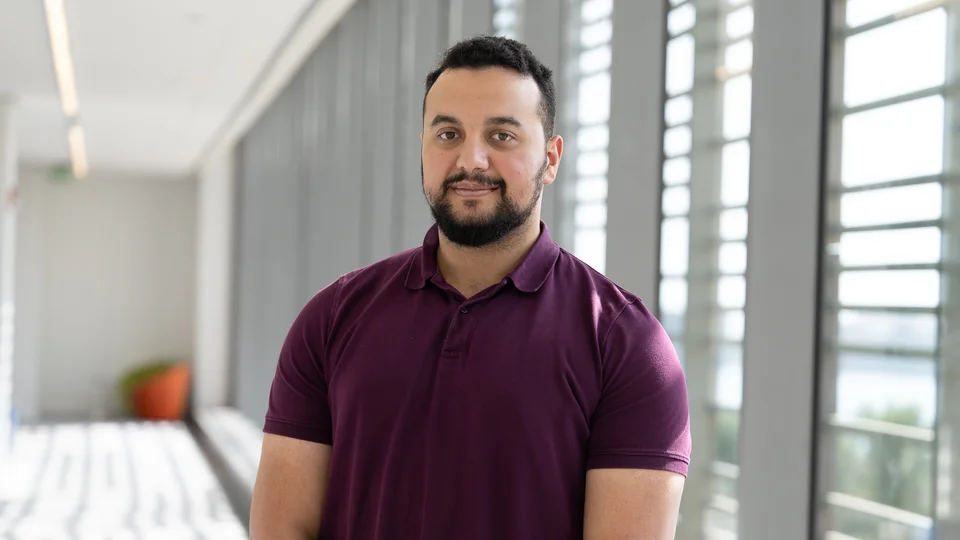
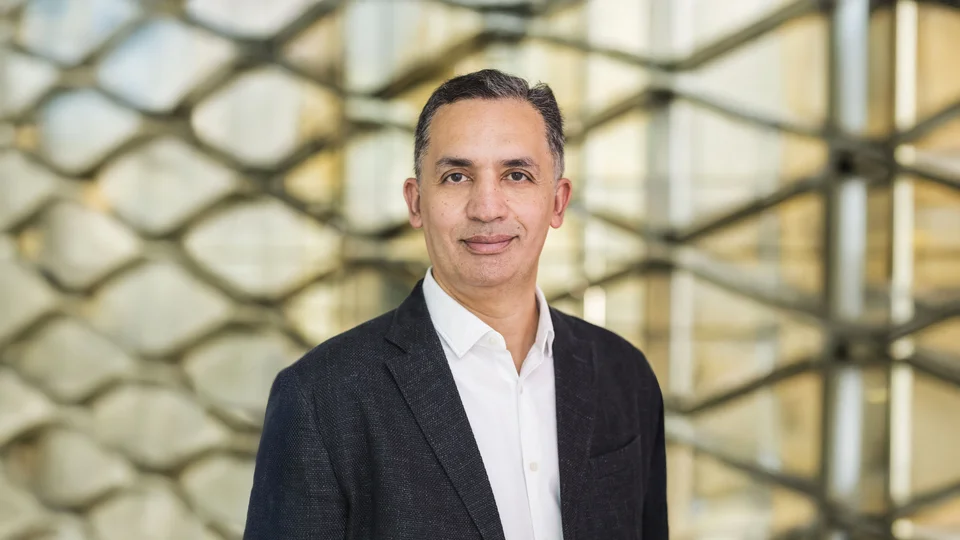
Omar Khalifa from the Computer, Electrical and Mathematical Sciences and Engineering (CEMSE) Division, together with his colleagues Dr. Aldyandra Hami Seno and Dr. Hassan A. Mahmoud from the Physical Science and Engineering (PSE) Division, have developed an ultra-low-power wireless sensing system that addresses this challenge. Their work was awarded at the 12th European Workshop on Structural Health Monitoring (EWSHM 2026) Students & Young Professionals Challenge.
The team's winning solution was to redesign how sensor nodes operate when idle. Rather than adding new energy sources or sensors, the KAUST researchers cut standby power consumption by a factor of 40. That single change extended projected battery life from less than three days to more than two years on a single battery — an estimated 270-fold increase in operating lifetime. The improvement makes long-term monitoring of critical infrastructure far more practical.
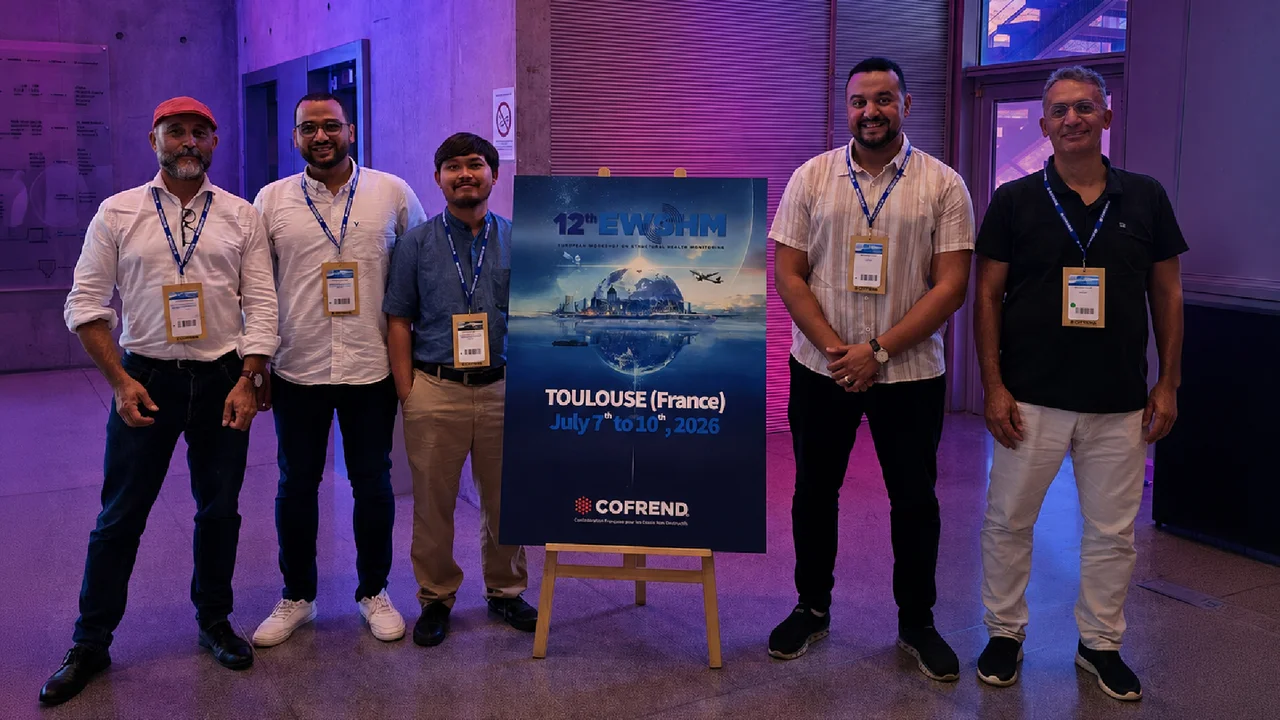
The innovative interdivisional solution was awarded at the Students & Young Professionals Challenge at the 12th European Workshop on Structural Health Monitoring (EWSHM 2026). Organized biennially, the EWSHM is Europe’s leading conference on SHM. The 12th EWSHM took place in Toulouse, France, from July 7 to 10, 2026.
"What made our presentation stand out was the depth of the evidence behind it,” Omar Khalifa said. “We did not present a concept; we presented a component-by-component energy characterization of the platform. Because our characterization went deeper than any existing profile of the ALTO platform, our technology is already informing future hardware revisions. That credibility with the jury carried us to first place."
Khalifa is an electrical and computer engineering Ph.D. candidate in the Information Science Lab under Professor Tareq Al-Naffouri. He focuses on energy-efficient Internet of Things (IoT) systems for large-scale, off-grid monitoring.
Hami Seno and Mahmoud are postdoctoral fellows in Professor Gilles Lubineau's Mechanics of Composites for Energy and Mobility (MCEM) Laboratory, where their research spans digitizing composite structures for structural integrity monitoring and developing flexible, wireless sensing technologies.
For the winning project, Khalifa led the IoT architecture, firmware and power optimization, while Hami Seno and Mahmoud led the structural health monitoring system and mechanical design.
"This competition sits exactly at the heart of my Ph.D.,” Khalifa said. “Seeing several ideas I have been developing for years win first place at Europe’s premier SHM conference is strong validation that [my] research direction matters far beyond the lab."
A dynamic interdivisional effort
The CEMSE–PSE collaboration began nearly two years ago through ENERCOMP, a KAUST research consortium focused on monitoring non-metallic and composite assets. It paired the PSE Division’s expertise in sensing, materials and structural mechanics with the CEMSE Division’s strengths in electronics, communications and wireless IoT systems.
"The team's close collaboration with industry through the ENERCOMP consortium helped shape solutions that addressed genuine industry needs,” Hami Seno said. “That practical focus contributed to the positive reception our work received from both the academic and industrial communities."
Over the past two years, the working relationship has grown into joint publications, registered intellectual property and international recognition.
"Taking on this EWSHM challenge together was a natural next step. Our partnership has given us a realistic understanding of what successful field deployment demands," Khalifa added.
The group's experience developing industrial IoT systems in Saudi Arabia’s harsh desert environment proved invaluable. It gave the researchers practical insight into building resilient, reliable systems and a deeper understanding of where energy is lost in real-world wireless sensor nodes.
"Neither division could have built this solution alone,” Mahmoud said. “It required PSE’s expertise in structural mechanics and sensing alongside CEMSE’s strengths in communications, electronics and systems integration. KAUST makes that kind of collaboration unusually easy, thanks to a research ecosystem that actively supports students who want to present their work on a global stage."
The team credited their supervisors, Professors Lubineau and Al-Naffouri, with fostering an environment that pushed every design decision to be grounded in sound engineering principles — an approach that helped them weave sensing technologies, embedded systems and structural health monitoring into one coherent solution.
"I am very proud of what the team was able to achieve," Hami Seno added. “I hope we build on what we learned at EWSHM 2026 to create impactful solutions going forward."
Future focus
Looking ahead, the team plans to further develop and validate its ultra-low-power monitoring system for real-world SHM applications. Future work will focus on improving energy efficiency, integrating energy-harvesting technologies to enable self-sustaining operation, and enhancing the system's sensing capabilities and long-term reliability.
"Our next step is to further develop and validate this technology in real-world structural health monitoring applications,” Khalifa said. “Ultimately, we want to develop scalable, autonomous monitoring systems that can operate for extended periods with minimal maintenance."
Energy is a strategic research priority for KAUST and a key pillar of Saudi Vision 2030. The recent CEMSE–PSE success at EWSHM 2026 exemplifies this commitment, showcasing how interdisciplinary collaboration has the ability to transform a critical energy-efficiency challenge into a globally recognized engineering solution.