Professor Keyes elected to the European Academy of Engineering
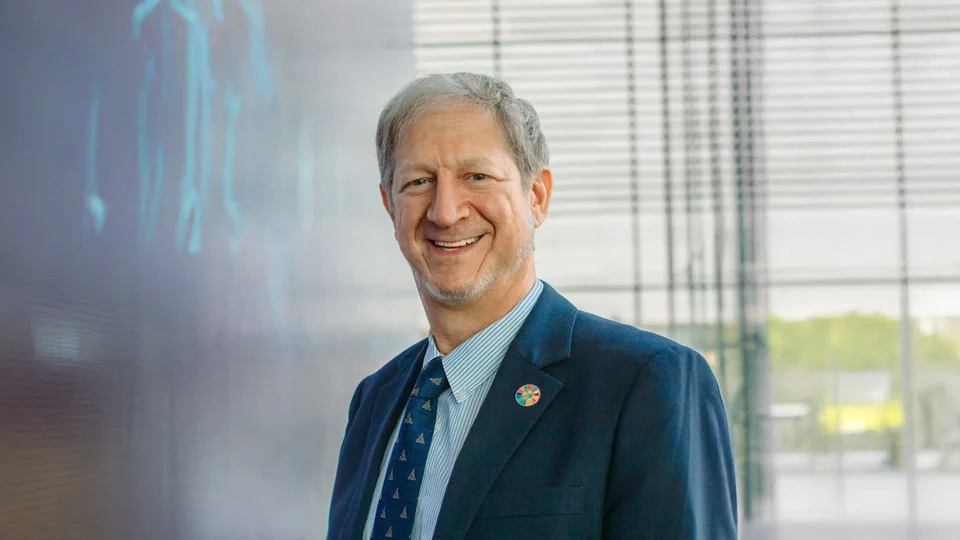
Professor David Keyes has been elected to the European Academy of Engineering (EAE) as part of its 2026 class. This international honor recognizes Keyes' distinguished career in high-performance computing (HPC), computational science, and numerical methods.
About
Professor David Keyes has been elected to the European Academy of Engineering (EAE) as part of its 2026 class. The EAE election is the latest in a series of international honors recognizing Keyes' distinguished career in high-performance computing (HPC), computational science, and numerical methods.
Founded in 1992 in Gothenburg, Sweden, the EAE promotes interdisciplinary research and development across the basic and applied sciences. The 2026 cohort comprises 147 members, including 21 Nobel Laureates, four Turing Laureates, two Fields Medalists, 10 Breakthrough Prize winners, six Wolf Prize winners, and eight ENI Awardees.
'Science ignores borders'
Keyes, a professor of applied mathematics and computational science and an adjunct professor in Columbia University’s Department of Applied Physics and Applied Mathematics, has a longstanding connection with the European HPC community as a prominent figure in the field.
His ties with European HPC researchers predated his move to the Kingdom in 2009. During the earlier part of his career, Keyes spent a decade collaborating with European counterparts as a faculty affiliate of several laboratories of the U.S. Department of Energy.
The path of progress in HPC, from historical benchmarks, megascale to gigascale to terascale to petascale, progressed at a remarkably consistent rate: a factor of 1,000 in performance per decade since the late 1970s. However, the jump from petascale to exascale took 14 years and was achieved in 2022.
“The HPC community broadened its international partnerships as it faced the technological and algorithmic challenges of exascale computing,” Keyes explained. “Europe operates four of the top ten research systems in the world today, overall.
“I was at KAUST during the entire exascale campaign, so my European colleagues were natural collaborators," he said. “Science ignores borders, and it brings great pleasure to be recognized by European colleagues and to bring such an honor to KAUST. My EAE election was a delightful surprise. I was not aware that I had been nominated.”
At the forefront of HPC advances
Keyes' dedication to advancing HPC goes beyond academia, including substantial work with U.S. federal agencies and major collaborations with major computing hardware companies such as Cerebras, Nvidia, Intel, HPE-Cray, and IBM.
His research concentrates on the algorithmic connection between parallel computing and numerical analysis, covering scalable solvers for partial differential equations, spatial statistics, and machine learning. He has co-created methods and frameworks such as Newton-Krylov-Schwarz, pseudo-transient continuation, Additive Schwarz Preconditioned Inexact Newton, Hierarchical Matrix Multigrid, and Hierarchical Computations on Manycore Architectures.
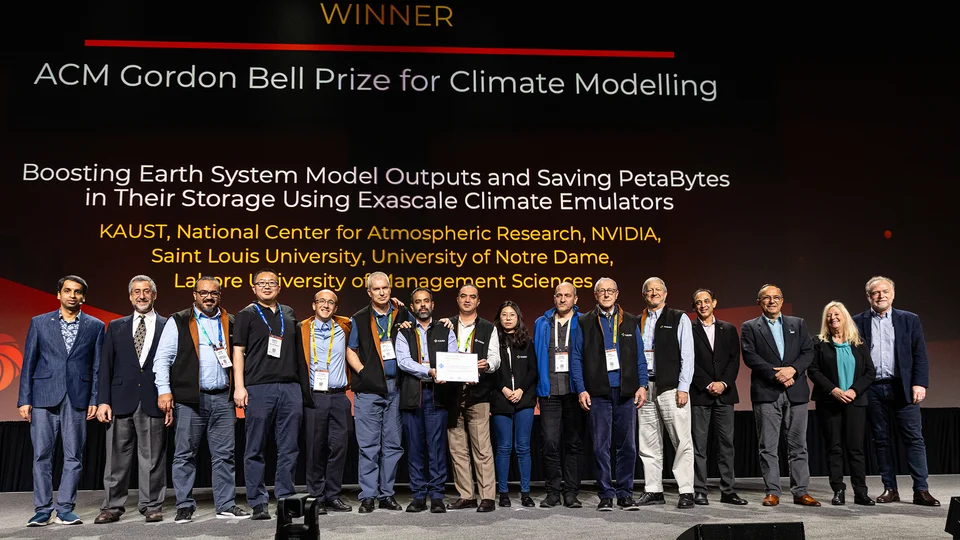
Keyes' work in computational fluid dynamics (CFD) on parallel systems garnered significant attention and funding, including an NSF Presidential Young Investigator Award. His contributions to scientific simulation and high-performance computing have earned him several honors, such as the Sidney Fernbach Award (IEEE Computer Society, 2007), the SIAM Prize for Distinguished Service to the Profession (2011), and the NSF Presidential Young Investigator Award (1989), and sharing the Gordon Bell Prize for Climate Modeling (ACM, 2024) and the Gordon Bell Prize (ACM, 1999).
Harnessing the exponential growth of computing power
Keyes frames his work around a simple observation that not every experiment can be run. Certain lab experiments may be impossible, difficult to measure, risky, too lengthy, or simply too costly to execute at the desired resolution and repetition. Computation assists scientists by identifying the limited set of experiments essential for confirming findings or designs produced computationally.
As experimental tools grow more expensive with each generation and computation becomes more affordable, trends increasingly favor computational discovery and design.
The consistent exponential increase in computing power acts as a dependable multiplier; however, new algorithms that improve computer efficiency keep evolving.
“I would rather have today’s algorithms on yesterday’s computers than yesterday's algorithms on today’s computers,” he emphasized. “One of the most [significant] changes is today’s preoccupation with the energy efficiency of computation – doing more science with less electrical power.”
Artificial intelligence and computer simulation are increasingly integrated, combining traditional equation-solving with machine-learning predictions to create faster, smarter, and more adaptable virtual environments.
For Keyes, AI adds a complementary form of power to traditional simulation: “Scientific machine learning is usually done on simulations, because experimental data is too sparse. Therefore, powerful AI reinforces the relevance of powerful simulation; it does not replace it. Computation lies behind the headlines of all KAUST's sustainability mission areas.”
A bright future
Keyes is one of KAUST’s many faculty members driving technological advancement and enhancing the reputation of one of the world’s fastest-growing nations. Under his leadership, computation has remained central to the University's mission, with its research labs and HPC ecosystem consistently delivering strong results in research, simulations, and global AI benchmarks.
“The one area of life that gets monotonically better with years is HPC. I include in 'HPC' the fusion of traditional simulation with AI and quantum computing.
“Students see this exciting fusion of computational technologies, and they can pursue it at KAUST as well as anywhere else. I have had the best students of my career at KAUST, and I have more confidence in their next steps as graduates than in my own.”