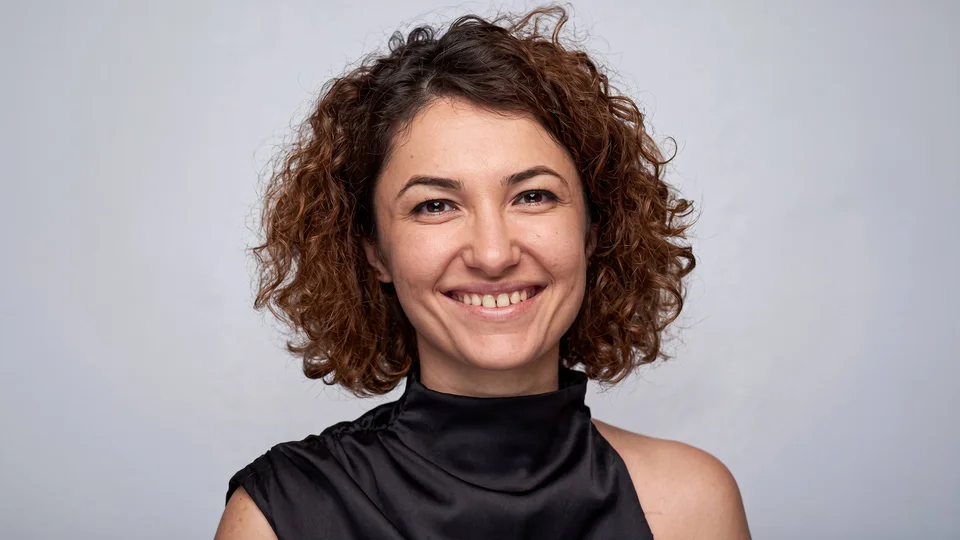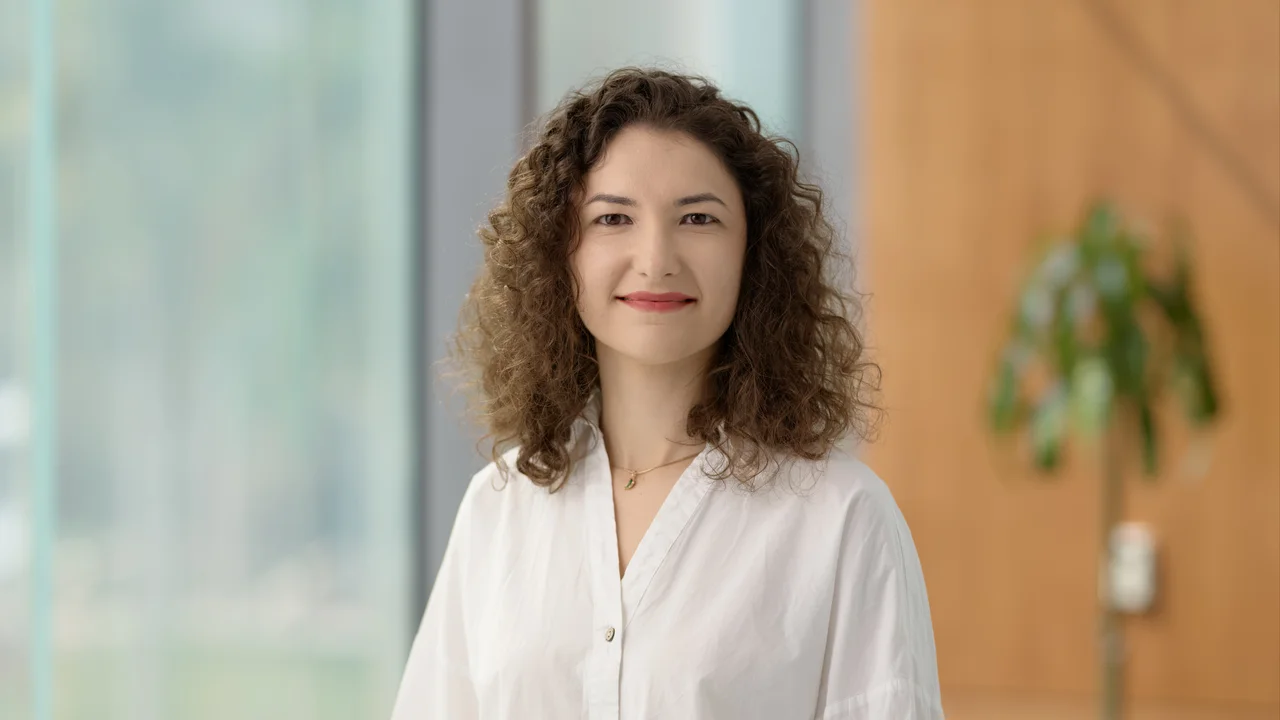
KAUST postdoctoral fellow Yeva Gevorgyan wins the 2026 Wagner Sessin Award
Gevorgyan has been awarded the 2026 Wagner Sessin Award for her notable contributions to dynamical and planetary astronomy.
About
KAUST postdoctoral fellow Yeva Gevorgyan has been awarded the 2026 Wagner Sessin Award in Dynamical and Planetary Astronomy. The early-career award recognizes young researchers who have made notable contributions and demonstrate potential for leadership in the fields of dynamical and planetary astronomy or orbital mechanics and control.
Gevorgyan will receive the biennial prize during the opening session of the Brazilian Colloquium on Orbital Dynamics (CBDO 2026), which will take place from December 7–11 in Volta Redonda, Rio de Janeiro state, Brazil.
“Dynamical astronomy is where my research career began, and being recognized as a potential future leader in the field by that community means a lot to me,” she said. “I am very happy to receive this early career award. Only two people are awarded every two years.”
Across fields and borders
Gevorgyan is an applied mathematician whose work spans planetary science, mean-field games (MFGs), and control theory.
She obtained her Ph.D. ('20) in applied mathematics from the University of São Paulo (USP), Brazil, including a one-year research stay at the Paris Observatory, France, working on planetary tides.
After postdoctoral positions at USP and the University of Arizona, U.S., Gevorgyan joined KAUST in 2024 to work with Professor Diogo Gomes on numerical methods for MFGs. In 2026, she began working with Professor Alessandro Astolfi on system identification, realization theory, and model reduction for nonlinear dynamical systems.
Her path into planetary science began with mathematics. “What I love most about being an applied mathematician is using mathematics to understand the world around us, and celestial mechanics is one of the oldest and most beautiful examples of that,” she said. “For centuries, explaining the motion of the planets has pushed mathematics and physics forward.”
Her fascination with the mathematics of planetary systems has taken her around the world. After earning her undergraduate degree in physics in Armenia, she moved to Brazil, France, and the United States before arriving in the Kingdom in 2024.
“I think living in so many countries has made me comfortable with new situations. Each move meant a new language, a new culture, and new ways of thinking, so exploring new research fields came naturally. I speak four languages fluently, in three different alphabets. That’s also why I feel very much at home at KAUST, where so many cultures and languages come together.”
What moons reveal
Comparing Earth with other planets and moons helps Gevorgyan and her colleagues understand how our own planet has evolved over time.
“The models developed for other planets are also useful here on Earth,” she explained. “Similar mathematical models of how materials deform over time are used to study Earth’s tides and the slow rebound of the land after ice sheets melt. I find it fascinating that models can help us understand not only how planets and moons move, but also what happens inside them and how their interiors shape their evolution over billions of years.”
A central question in planetary geophysics is what moons and planets are like on the inside. Planetary scientists cannot directly examine the deep interiors of moons such as Europa or Enceladus, but the moons’ tidal responses give us clues about what lies beneath the surface.
“Tides heat a moon from the inside and slowly change its orbit. Both effects depend on the moon’s composition. The difficulty is that realistic models can be computationally very expensive, while simpler ones may miss important physical effects,” Gevorgyan said.
“My work aims to bridge that gap. Tidal heating may help sustain subsurface oceans, making it an important process in understanding potentially habitable worlds.”
Her current research at KAUST addresses similar challenges beyond planetary science. Many real-world systems, from power grids to chemical processes, are difficult to model. Sometimes the governing equations are unknown, and a model must be built directly from measurements.
“This is called system identification. In other cases, we have a mathematical model, but it is too complex to work with. Model reduction allows us to replace it with a simpler one that preserves the behavior we are interested in.”
For Gevorgyan, planetary science and control theory meet naturally. “When a moon is deformed by tides, you can think of it as a system with an input, the tidal force, and an output, the deformation,” she said.
“Classical models of planetary materials, built from springs and dashpots, reproduce that input-output relationship, and in control theory this is called a realization. Realistic materials often require very large models, so finding a simpler description that still reproduces the measured responses well enough is a model reduction problem.”
Next steps
Gevorgyan is a member of the KAUST Nonlinear Systems and Control (NLSC) group, led by Professor Astolfi, with whom she is developing methods to build mathematical models from data, without specifying the models’ functional form in advance.
“Good models are essential for understanding and controlling a system, so this work is relevant to many applications, from mechanical systems to chemical and biological processes. We are also applying methods from control theory to investigate what information about planetary interiors can be recovered from tidal observations.”
In practice, measurements are noisy and taken at discrete times. Researchers often do not know a system’s complexity in advance or need to identify it while controlling the system.
“Extending our methods to these realistic situations is the next challenge. We anticipate that our techniques can both benefit from and help develop new methods in applied machine learning. There is still a lot to explore,” she noted.