Double success for the KAUST ANGLE Lab
Researchers from KAUST’s Advanced Grids and Linked Engineered Systems Lab (ANGLE) placed first in the Ministry of Energy Hackathon in Riyadh and the European L2RPN AI4REALNET 2026 Challenge.
About
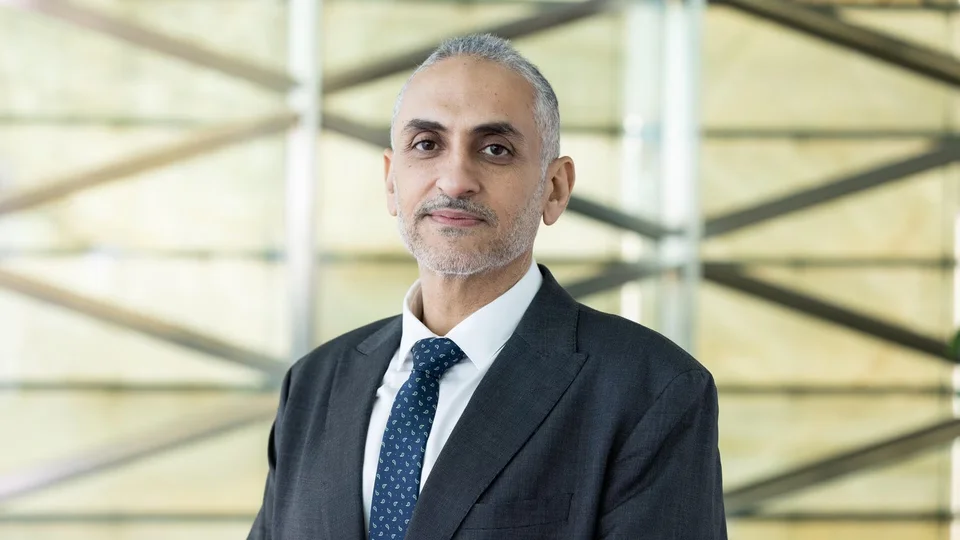
Established in 2021 by Professor Charalambos Konstantinou and Professor Shehab Ahmed, ANGLE researches electric power and advanced mechatronic systems, with a focus on power grid modeling and real-time simulation.
The lab advances research in cyber-physical energy systems, with an emphasis on real-time industrial control applications, critical smart grid infrastructure, and the cyber-secure and resilient integration of renewable energy resources. It also develops an engineering and science education program to train the next generation of engineers.
ANGLE team wins first place at the Ministry of Energy’s inaugural Energy Hackathon
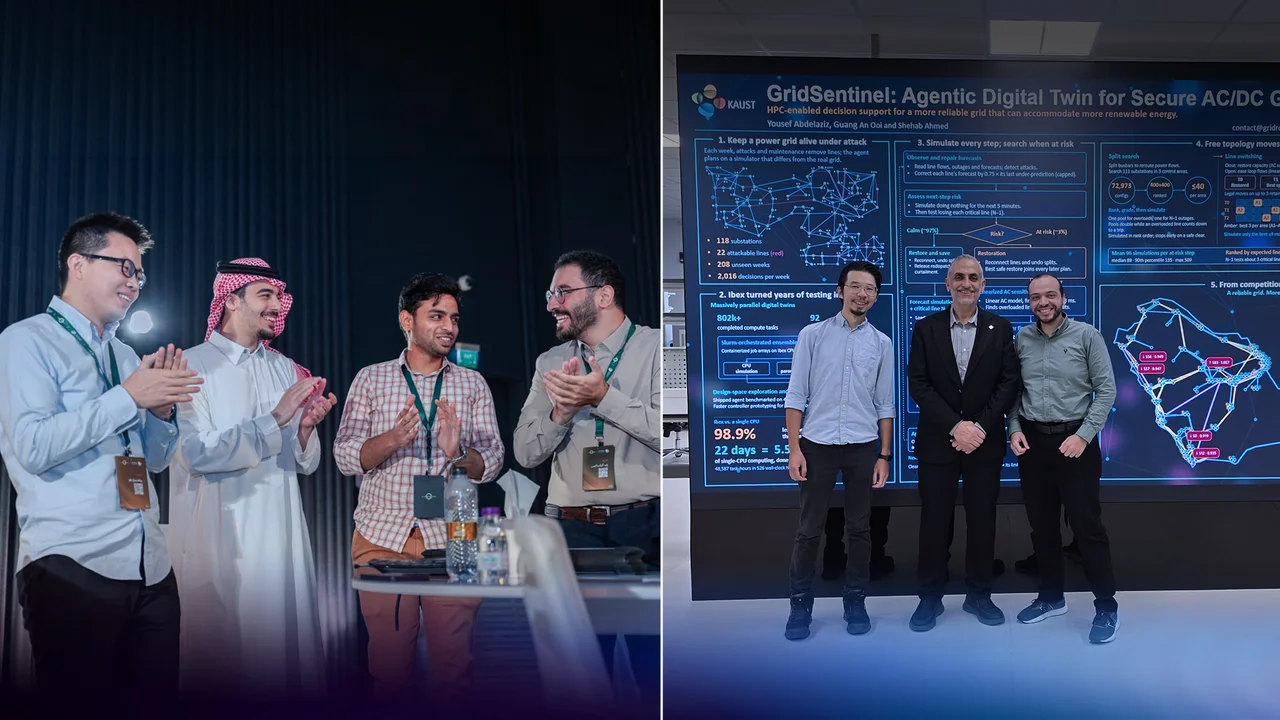
A team of ANGLE researchers, led by master’s student Abdulrahman Al Saud, with postdoctoral researchers Rongxing Hu and Zaint Alexakis, research scientist Mohammad Asim Aftab, and Ph.D. student Gokul Krishnan, won the Intelligent Control track at the Ministry of Energy’s inaugural Energy Hackathon held in Riyadh from October 7 to 9, 2026, for their innovative energy management solution, AGORA.
The project, which won out against more than 1,200 teams from across the Kingdom, the project will receive funding from WPC Energy Congress for commercialization, with the Ministry of Energy providing funding and support to bring the solution to market.
AGORA: Utilizing the Kingdom’s energy efficiently
Saudi Arabia has set an ambitious goal of reaching net-zero emissions by 2060, with a major expansion of renewable energy at the heart of that effort.
Because of the country’s climate and landscape, solar and wind output can fluctuate hourly due to passing clouds, dust, and shifting winds, while electricity demand also varies. As more renewables are added to the grid, balancing supply and demand becomes increasingly challenging.
Today, the safest choice for energy operators is to curtail energy, which means switching it off and letting it go to waste. In search of an alternative, the AGORA team investigates how, instead of disposing of the energy, it could be put to greater use.
AGORA is designed for the country’s existing and expanding power network. It coordinates current assets in the Kingdom, such as desalination plants, district cooling, data centers and battery storage to absorb surplus solar energy.
“We see that wasted energy as a lost market opportunity worth more than SAR 5.2 billion a year, and the figure will keep growing as the Kingdom installs more renewable capacity,” Alexakis said.
“Saudi Arabia already has world-class industrial infrastructure that can do exactly that: desalination plants, to turn surplus electricity into fresh water; district cooling systems, can store it as cooling; electrolyzers, can turn it into hydrogen, which can either be used directly or converted back into electricity; and the Kingdom's large battery storage systems can store it directly as electricity.”
The brain behind the energy
AGORA acts as a decision-making brain for the energy system, directing surplus energy toward facilities that can use it most efficiently. It does this by establishing a merit order, a ranking system that identifies which facilities could use the surplus most effectively while accounting for the Kingdom’s existing infrastructure.
In preliminary case studies, the team estimates that AGORA could recover approximately SAR 3.5 billion a year in value currently lost to curtailment.
“For us, that is the real potential of the solution: turning a growing energy-transition challenge into an economic opportunity and helping bring the Kingdom's ambitions to life,” Alexakis noted. “AGORA strengthens and revitalizes what the country already has and turns energy that was once wasted into an asset for the whole economy.”
Reflecting on the hackathon result, Alexakis added: “[The Hackathon] filled us with great joy and pride, above all because the problem we addressed is so closely tied to the Kingdom's vision, and it showed us that our research can make a real difference. Competing alongside more than 1,200 teams from across the country, with so many brilliant ideas and diverse backgrounds, made it more meaningful.”
The AGORA team now plans to put its research into practice. The team plans to begin with laboratory pilots and continue developing AGORA toward full operation.
ANGLE Lab takes first place in global L2RPN AI4REALNET 2026 Challenge
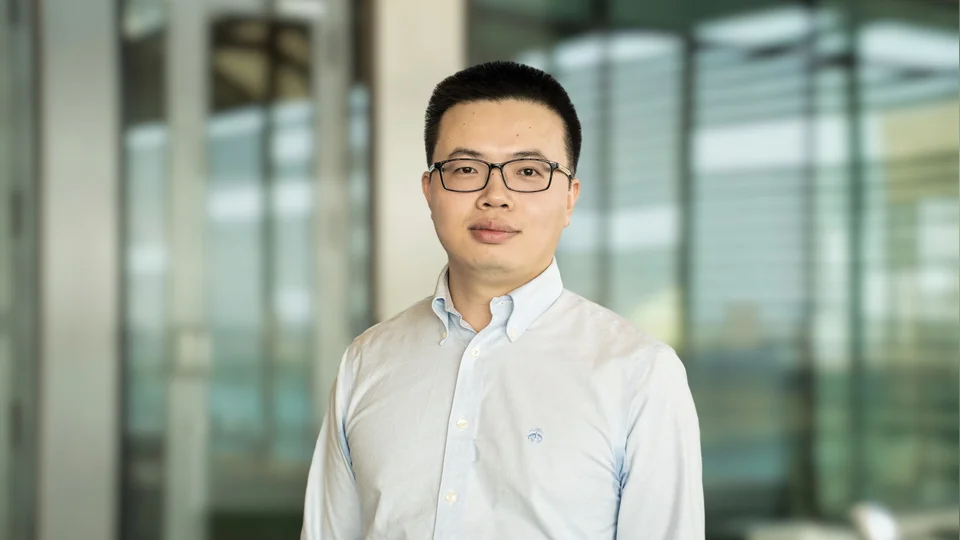
A team of ANGLE researchers, led by postdoctoral fellow Yousef Abdelaziz and postdoctoral researcher Guang An Ooi, secured first place in the L2RPN AI4REALNET 2026 Challenge.
Organized by RTE-France and TenneT, the international power grid management competition was hosted on Codabench as part of the Horizon Europe AI4REALNET Competitions project.
The competition tested how well artificial intelligence agents could adapt to operating conditions on a power transmission grid. It focused on whether the agents could remain reliable when the simulated grid differed from the operational environment. The ANGLE Lab agent, GridSentinel, placed ahead of numerous international teams, including the University of Vermont, Virginia Tech and Fraunhofer IEE.
After an initial phase, the organizers selected the 10 highest-ranked teams for the validation phase. They determined the final ranking using a hidden set of 208 weekly scenarios. The ANGLE team said its main challenge was closing the gap between simulation and reality.
“Our agent could test its decisions only on a model of the grid, but it was scored on a hidden ‘real’ grid with different properties, so a decision that looked safe in simulation could behave differently,” Abdelaziz explained.
“On top of that, an adversary kept attacking transmission lines, and an attack on a key corridor could push the grid toward a blackout within minutes. We had to test every idea over hundreds of simulated weeks before we could trust it. KAUST gave us both the physics intuition and the tools to build GridSentinel.”
Reflecting on the team’s result, Abdelaziz said: “It was a great moment for the whole team. We had worked on it for months, testing idea after idea, and the final ranking was decided on 208 weeks of grid operation that no team had seen.
“Finishing first in a competition designed by two of Europe’s largest grid operators, RTE and TenneT, ahead of strong teams from leading universities and national laboratories, showed us that with the University’s resources and support, we can compete with the best in the world, and win.”
‘The timing is right’
GridSentinel manages the power grid like a careful control-room operator would, testing every move in a simulator before acting. In five-minute intervals, it looks five minutes ahead and checks for line overload and whether the grid would withstand the sudden failure of one of its most vulnerable lines.
When the grid is safe, GridSentinel quietly reconnects lines to reduce costs. When danger arises, it progresses through incremental stages, starting with the least expensive fix and moving to the most expensive, escalating only as needed. First, it reroutes power by reconnecting lines and rearranging substation connections, exploring approximately 73,000 options. It adjusts generator, battery and renewable output only as a last resort. Built on grid physics, GridSentinel allows operators to review and explain every decision.
“For Saudi Arabia, the timing is right,” Abdelaziz said. “Vision 2030 aims to generate around half of the Kingdom’s electricity from renewables, and solar and wind make the grid more variable and harder to operate. Tools that make fast, safe decisions help the grid absorb more clean energy without blackouts. For KAUST, the result shows what its computing facilities make possible: we developed and tested GridSentinel on the Ibex high-performance computing cluster at the KAUST Supercomputing Lab.”
Next steps
The team now intends to apply GridSentinel to a Saudi power system. They have developed a demonstration model of the Kingdom’s transmission network based on real data, including its high-voltage direct current interconnections.
Building on this research, the team intends to extend the agent to day-ahead operational planning and real-time corrective control, using the Ibex HPC cluster to evaluate numerous candidate actions in parallel while keeping system operators in charge of the final decision.
“Alongside this work, we are preparing a journal article that presents the GridSentinel methodology in detail, together with its application to the Saudi grid,” Abdelaziz said.