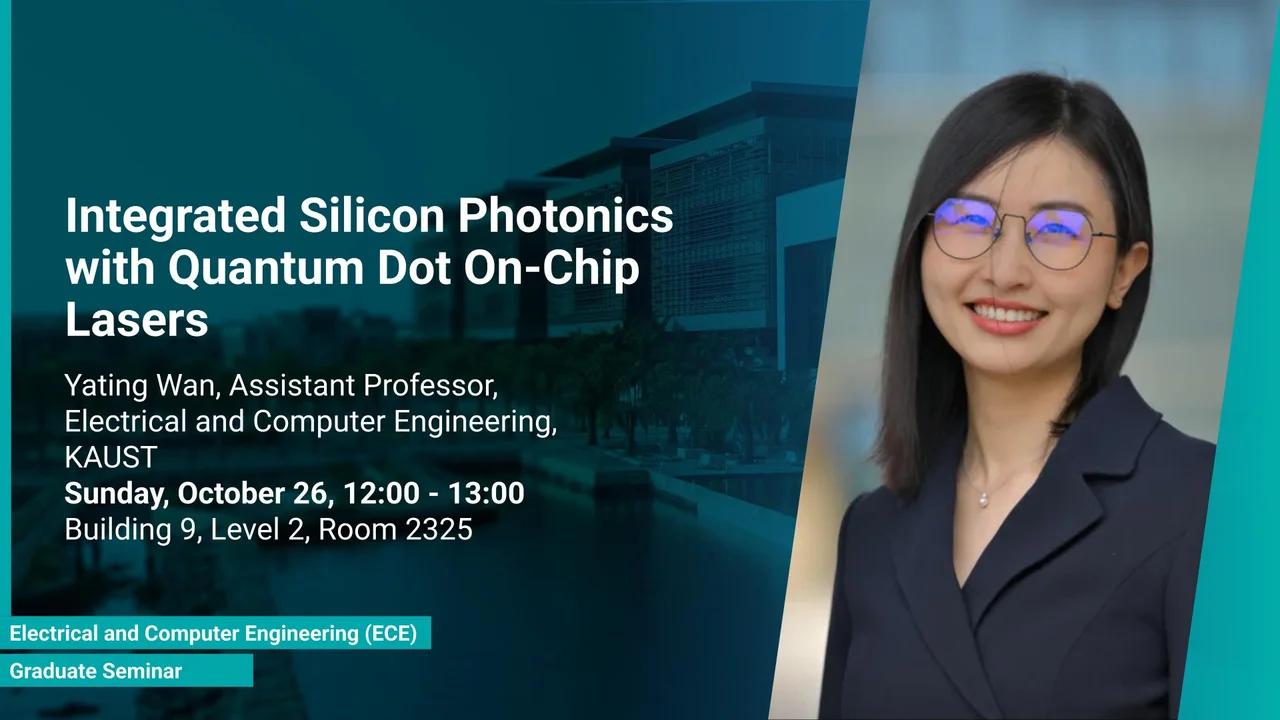
Integrated Silicon Photonics with Quantum Dot On-Chip Lasers
Integrated silicon photonic has emerged as a leading solution for scalable, power-efficient, and environmentally friendly applications. This talk will focus on the prospects and applications of on-chip lasers, a critical component driving the advancement of photonic integrated circuits (PICs). We will discuss various approaches to integrating lasers on silicon and their applications in optical communication, computing, and LiDAR, with a particular emphasis on heterogeneous integration of quantum dot (QD) lasers. QD lasers offer unique advantages, including high immunity to reflection, superior thermal stability, low threshold, and long-term reliability, making them ideal for high-speed optical interconnects, AI-driven computing, and quantum photonic systems. By leveraging the defect tolerance and temperature resilience of QDs, we achieve high-performance, energy-efficient integration with silicon photonics. This talk will highlight recent breakthroughs in QD-on-silicon integration, performance optimizations, and future directions toward heterogeneous photonic systems, paving the way for a new generation of high-speed, low-energy, and scalable optical circuits for next-generation applications.
Overview
Presenters
Brief Biography
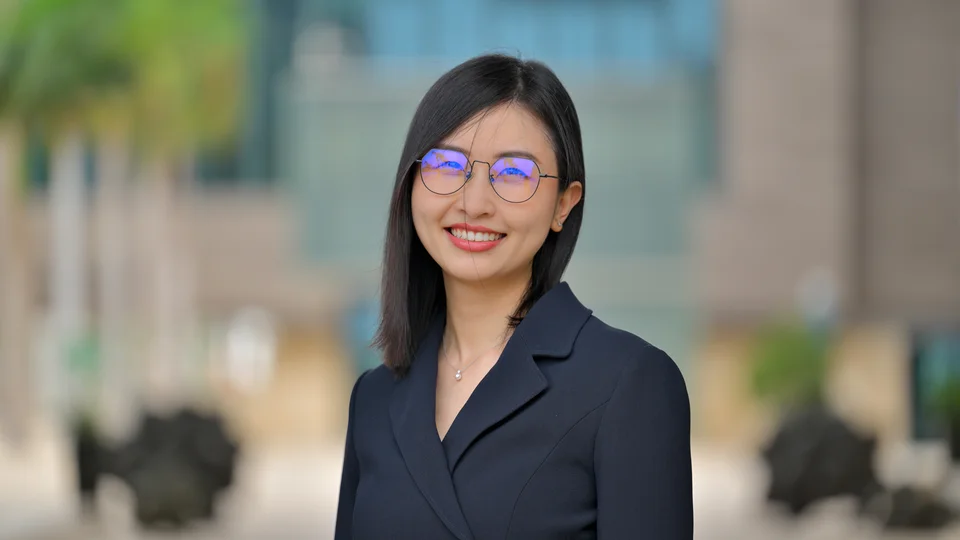
Dr. Yating Wan is an assistant professor of electrical engineering and the principal investigator of the Integrated Photonics Laboratory at KAUST.
Dr. Wan specializes in silicon photonics with a focus on integrating on-chip light sources for data communication, optical computing, OPA-based lidar, and quantum information processing.
Before joining KAUST, Dr. Wan worked in Professor John Bowers’ group at the University of California, Santa Barbara (2017–2022), where she led Intel’s project on heterogeneously integrated QD lasers on silicon.
At KAUST, she leads a dynamic team of 20 members, including seven postdoctoral researchers, 11 Ph.D. students, and two master’s students.
Dr. Wan has authored over 100 peer-reviewed publications, including 38 first-author papers (29 journals, 9 proceedings, and 10 journal covers) and 26 corresponding-author publications (11 journals, 15 conferences).
For her pioneering work in on-chip laser integration on silicon, Dr. Wan has received numerous major awards, including the 2021 CLEO Tingye Li Innovation Prize (one awardee worldwide); the 2022 Rising Stars of Light recognition by Light: Science & Applications (three awardees worldwide); inclusion in MIT Technology Review’s 2023 “35 Innovators Under 35 for China”; the 2025 Sony Women in Technology Award with Nature ($250,000 prize, three awardees worldwide); and the 2025 IEEE Photonics Society Young Investigator Award (one awardee worldwide).
Outside her immediate research focus, Dr. Wan has been an active contributor to the broader academic community. She serves as manager and column editor for the LSA Editorial Office in Thuwal, as associate editor for Applied Optics and the IEEE Journal of Quantum Electronics (JQE), and as guest associate editor for the IEEE Journal of Selected Topics in Quantum Electronics (JSTQE).
Dr. Wan is also a technical program committee member for the International Photonics Conference (IPC) and the Conference on Lasers and Electro-Optics (CLEO) and a member of the IEEE Photonics Society Conference Council. She has reviewed more than 100 papers for leading journals across IEEE, Optica and the Nature Publishing Group.