Advancing Monitoring Capabilities: The Role of Wearable Sensors in Advancing Healthcare, Environmental, and Marine Studies
This talk examines the transformative impact of wearable sensor technologies across healthcare, environmental monitoring, and marine biology.
Overview
In healthcare, these sensors enable continuous monitoring for enhanced patient care and disease management. Environmental applications range from real-time pollution monitoring to ecosystem management, while in marine biology, wearable sensors facilitate non-invasive studies of aquatic life. The discussion will highlight technological advancements in sensor miniaturization, embedded AI (edge AI) and energy efficiency, emphasizing the critical role of interdisciplinary collaboration in optimizing wearable technologies for diverse applications.
Presenters
Brief Biography
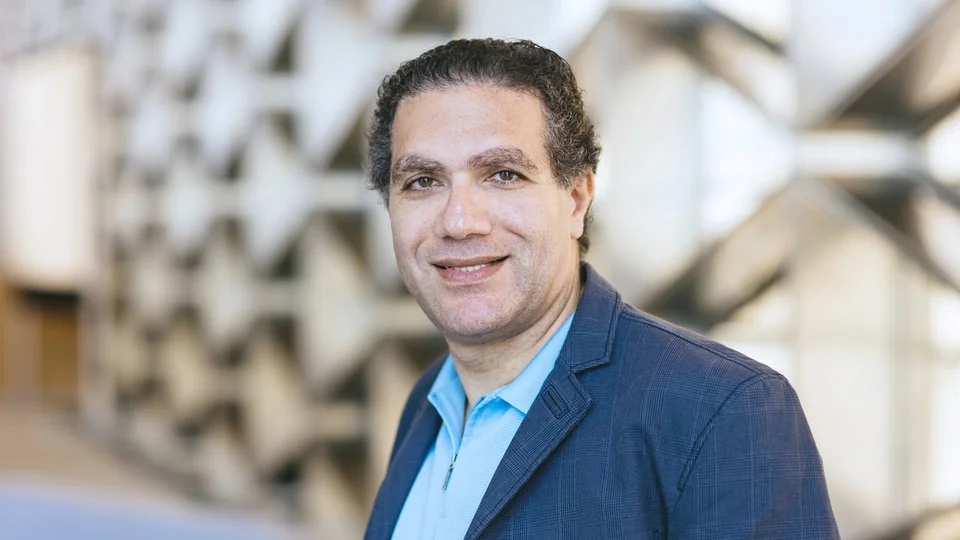
Professor Salama received his B.S. (Hons.) degree from Cairo University, Egypt, in 1997. He obtained his M.S. and Ph.D. degrees in electrical engineering from Stanford University, U.S., in 2000 and 2005, respectively.
The principal investigator of the KAUST Sensors Lab, Salama joined the University in 2009. From 2009 to 2011, he served as the founding program chair for Electrical Engineering at KAUST. Before joining KAUST, he worked as an assistant professor at Rensselaer Polytechnic Institute, U.S., from 2005 to 2009.
Dr. Salama—a senior member of the Institute of Electrical and Electronics Engineers (IEEE)—has authored 360 articles and holds 50 patents on low-power mixed-signal circuits for intelligent, fully integrated sensors and nonlinear electronics, particularly memristor devices.
His work on complementary metal-oxide semiconductor (CMOS) sensors for molecular detection has been funded by the National Institutes of Health (NIH) and the Defense Advanced Research Projects Agency (DARPA). He is also the co-founder of Ultrawave Labs, a biomedical imaging company.
Salama received the Stanford-Berkeley Innovators Challenge Award in Biological Science.