Bayesian Spatio-Temporal Modeling for Environmental Monitoring and Epidemiology: Disaggregation and Disease Spread Dynamics
Overview
This PhD thesis introduces innovative statistical frameworks for modeling and interpreting spatial and spatio-temporal dynamics in geostatistical data and point processes, with applications in air pollution monitoring and infectious disease dynamics. The first project focuses on spatial disaggregation of normally distributed multivariate geostatistical data, motivated by air pollution applications in Portugal and Italy. The second project extends spatial disaggregation to a spatio-temporal setting for univariate normally distributed data, with the methodology illustrated through the monitoring of air pollution in India. By generating higher-resolution spatial and temporal estimates, this research improves air quality assessment and helps identify localized pollution hotspots.
The third project investigates the estimation of disease spread velocities using spatio-temporal log-Gaussian Cox point processes, with an application to the spread of COVID-19 in Cali, Colombia, in 2020. The final project proposes a spatio-temporal model to estimate velocities of disease spread from aggregated counts of infected individuals. This approach is particularly useful when individual-level locations are unavailable due to confidentiality constraints, and it is illustrated using dengue data from Sergipe, Brazil, in 2022. Together, these methods provide insights into the speed and direction of epidemics, helping to reveal how infectious diseases spread across space and time.
Overall, this thesis advances statistical methodology for spatial and spatio-temporal modeling by providing flexible and scalable frameworks for environmental and epidemiological applications. The proposed methods enhance the understanding of complex processes such as air pollution and infectious disease spread, supporting more informed decision-making in public health.
Presenters
Brief Biography
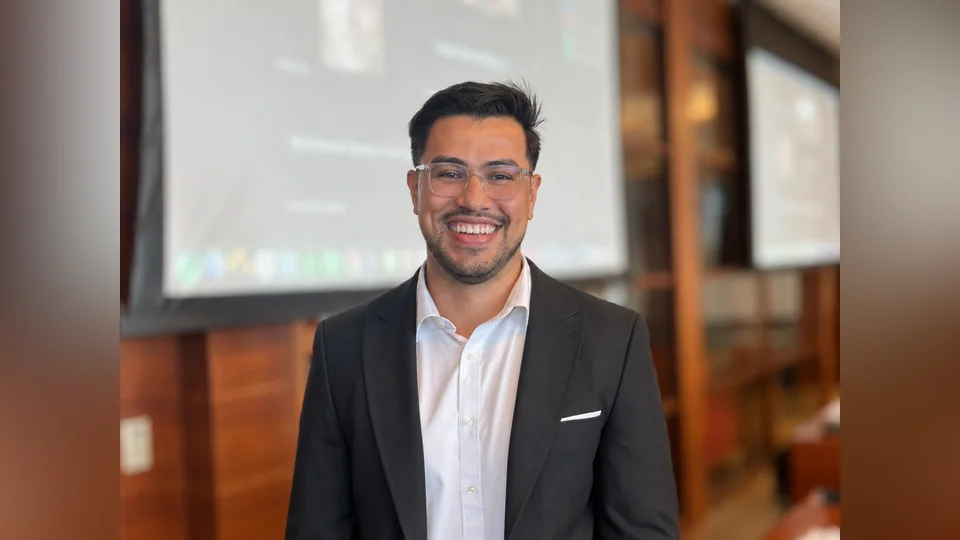
Fernando Rodriguez Avellaneda is a postdoctoral researcher at King Abdullah University of Science and Technology (KAUST). He completed his Ph.D. in Statistics at KAUST in 2026 under the supervision of Professor Paula Moraga. He also holds an M.Sc. in Mathematics and a diploma in Artificial Intelligence from the National University of Colombia.
His doctoral research focused on Bayesian spatial and spatio-temporal modeling for environmental monitoring and epidemiology. His work included statistical methods for spatially disaggregating air-pollution data and estimating the velocity and direction of infectious-disease spread.
In his current research, Fernando develops statistical methods for ecological and fisheries data, with particular emphasis on coral-reef systems, reef-fish biomass, spatial ecological processes, and uncertainty quantification.