
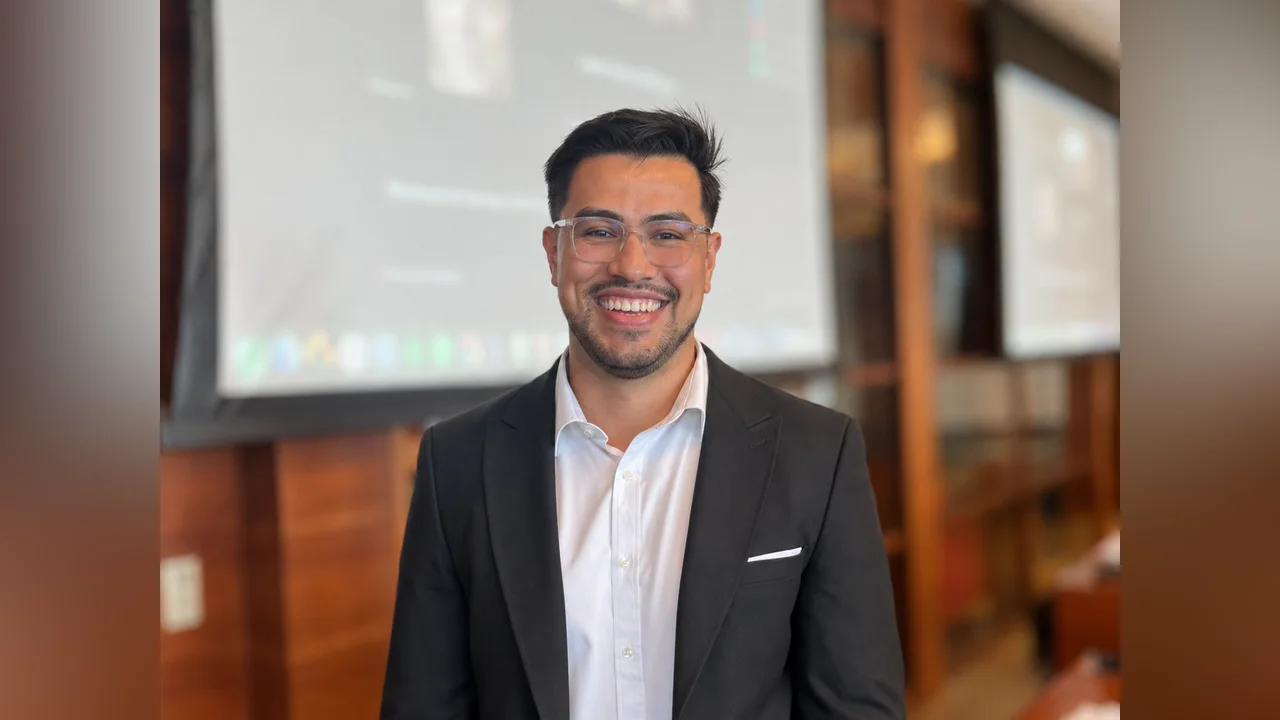
Fernando Rodriguez Avellaneda
Fernando Rodriguez Avellaneda is a Bayesian statistician specializing in spatial and spatio-temporal modeling. His research develops computational methods for complex geospatial data, with applications in environmental monitoring, infectious-disease dynamics, coral-reef ecology, fisheries, and uncertainty quantification.
Biography
Fernando Rodriguez Avellaneda is a postdoctoral researcher at King Abdullah University of Science and Technology (KAUST). He completed his Ph.D. in Statistics at KAUST in 2026 under the supervision of Professor Paula Moraga. He also holds an M.Sc. in Mathematics and a diploma in Artificial Intelligence from the National University of Colombia.
His doctoral research focused on Bayesian spatial and spatio-temporal modeling for environmental monitoring and epidemiology. His work included statistical methods for spatially disaggregating air-pollution data and estimating the velocity and direction of infectious-disease spread.
In his current research, Fernando develops statistical methods for ecological and fisheries data, with particular emphasis on coral-reef systems, reef-fish biomass, spatial ecological processes, and uncertainty quantification.
Expertise and Interests
• Bayesian spatial and spatio-temporal statistics
• Bayesian hierarchical and latent Gaussian models
• Spatial disaggregation and change-of-support problems
• Environmental and ecological statistics
• Coral-reef ecology and fisheries
• Uncertainty quantification and propagation
About
Fernando Rodriguez Avellaneda is a postdoctoral researcher at King Abdullah University of Science and Technology (KAUST), working at the intersection of Bayesian statistics, geospatial data science, and environmental research.
He develops spatial and spatio-temporal statistical methods for complex geospatial data, including data observed at different spatial resolutions, multivariate environmental processes, point patterns, and ecological systems. His methodological interests include Bayesian hierarchical modeling, latent Gaussian models, stochastic partial differential equation models, spatial disaggregation, multivariate spatial modeling, and log-Gaussian Cox processes.
His research has been applied to air-pollution monitoring, infectious-disease dynamics, coral-reef ecology, reef-fish biomass, and the quantification and propagation of uncertainty in ecological assessments. He primarily develops and implements his methods using R, R-INLA, and other Bayesian computational tools.
Education
- Doctor of Philosophy (Ph.D.)
- Statistics, King Abdullah University of Science and Technology (KAUST), Saudi Arabia, 2026
- Master of Science (M.S.)
- Mathematics, National University of Colombia (UNAL), Colombia, 2019
- Bachelor of Science (B.S.)
- Mathematics, Distrital , Colombia, 2017