Robust and Efficient Methods for Nonlinear Electromagnetic Inversion: Regularization, Optimization, and Learning-Assisted Strategies
This dissertation develops several physics-based and learning-assisted methods to improve the robustness, capability, and computational efficiency of nonlinear EM inversion.
Overview
Quantitative electromagnetic (EM) inversion offers the possibility to image targets that are inaccessible to optical- or contact-based measurements. This capability enables practical tasks such as subsurface imaging, assessing internal damage in infrastructure, identifying dielectric contrasts in biological tissues, and monitoring materials and industrial processes. Reliable inversion can therefore reduce the need for destructive sampling, give evidence to early diagnosis and maintenance, and improve safety while lowering inspection costs and downtime. Practical applications of EM inversion, however, are often highly nonlinear with incomplete data corrupted by noise. Furthermore, the inversion algorithms normally run iteratively, which requires repeated EM simulations. Thus, addressing nonlinearity, ill-posedness, and computational cost is essential for turning EM inversion from a theoretical technique into a reliable imaging and inspection tool.
The first contribution of this dissertation focuses on regularization methods, which are indispensable to reconstruct stable and physically meaningful solutions from incomplete and noisy measurements. Two distinct regularization methods are investigated. The $l_1 / l_2$-norm of the model gradient provides an explicit, scale-invariant sparsity prior for preserving sharp edges and is incorporated into the Gauss-Newton inversion through an alternating direction method of multipliers (ADMM) formulation. In contrast, plug-and-play (PNP) regularization provides an implicit image prior described by a pre-trained Swin-Conv-UNet (SCUNet) denoiser and is implemented based on the Gauss-Newton inversion with the half-quadratic splitting (HQS) algorithm. Both methods decouple the regularization term from the data fidelity term, allowing the prior information and nonlinear inversion to be handled separately. Such a strategy can effectively solve EM inversion problems with complex regularization terms, while the two proposed methods effectively impose their respective prior information and stabilize the inversion.
The second contribution addresses strong nonlinearity arising from multiple scattering caused by high contrast or electrically large targets. The resulting nonconvex optimization problem often contains multiple local minima, making conventional inversion algorithms converge to incorrect solutions. To improve contrast-source inversion (CSI), the first proposed method updates the contrast at each iteration using one randomly selected contrast source. This reduces the cost of each iteration and perturbs the inversion, helping it to escape poor local minima. Based on this idea, the second method generates a contrast candidate from each updated contrast source and selects the one with the smallest data misfit. This retains the perturbation effect while replacing the random selection with a deterministic decision. The PNP regularizer is applied to both of the methods to compensate for the information loss and stabilize the inversion. In the third proposed method, a UNet refines the results of data equation optimization to provide a better initial guess to the nonlinear iterations. For the last method, a hybrid objective function combining the structural similarity index measure (SSIM) and the $l_2$-norm with an adaptive weighting scheme is proposed to provide a more convex and smoother optimization landscape. These methods improve the reliability of EM inversion for highly nonlinear problems, making it more suitable for practical imaging tasks involving high contrast or electrically large objects, where reliable initial guesses are often unavailable and conventional algorithms are prone to poor local minima.
Beyond inversion quality and robustness, practical EM inversion methods must have a manageable computational cost. Gauss-Newton inversion is particularly expensive because each outer iteration requires the solution of a normal equation, whose inner iterations repeatedly involve forward and adjoint simulations. To address this bottleneck, a Fourier neural operator (FNO) is trained as a learned preconditioner and incorporated into the flexible conjugate gradient (FCG) method. The network assists the inner solver in approaching the normal equation solution with fewer iterations. The trained preconditioner remains effective for permittivity distributions, noise levels, and operating frequencies that differ from those used for training, demonstrating its ability to generalize beyond the training conditions. This method can therefore be trained offline and reused for subsequent practical problems to significantly improve the efficiency of EM inversion.
Presenters
Brief Biography
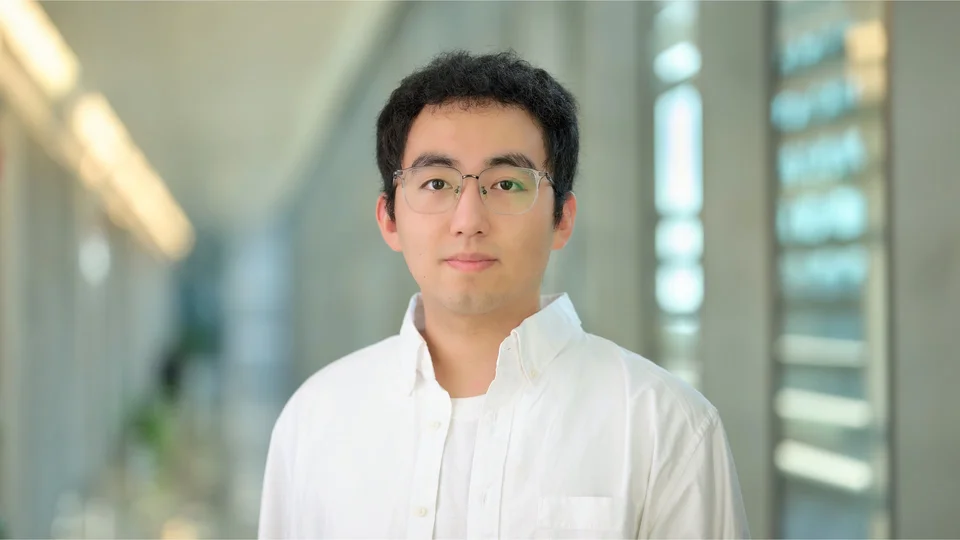
Lingqi Gao received the B.E. and M.S. degrees in applied geophysics from Jilin University, Changchun, China in 2019 and 2022. Since 2022, he has been a Ph.D. student in Electrical and Computer Engineering at King Abdullah University of Science and Technology, Thuwal, Saudi Arabia, under the supervision of Prof. Hakan Bagci.