Discrete Structures in Möbius and Laguerre Sphere Geometry with Applications in Architectural Geometry
This thesis addresses challenges in the design of freeform facades is the correct segmentation of the surface into manufacturable size panels from the perspective of architectural geometry.
Overview
One of the main challenges in the design of freeform facades is the correct segmentation of the surface into manufacturable size panels. This thesis addresses this problem from the perspective of architectural geometry. It presents two novel discrete geometric structures within two classical sphere geometries, namely Möbius and Laguerre geometry, that represent a mesh-like surface whose faces are restricted to spherical, conical, and flat patches. Motivated by the application, we describe a discrete geometric structure in Möbius geometry composed of spheres, that represents a surface composed of spherical faces, circular arc edges, and point vertices, named a sphere mesh, or mesh with spherical faces. We study its geometry in the projective model of Möbius geometry and find combinatorial constraints regarding the existence of its geometric support structure. We develop initialization and optimization methods based on the theory to approximate surface designs with sphere meshes. In the same fashion, we describe a similar discrete structure in Laguerre geometry, a mesh composed of oriented spheres, oriented cones, and oriented planes. We study its geometric properties in connection with its smooth limit, where an extension of a classical surface-theoretic concept of conjugacy was found by considering a surface with a sphere congruence attached to it, which we call L-conjugacy. The theory is then used in the initialization of an oriented sphere congruence that approximates a positively curved design, in order to panelize it with a mesh-like structure composed of spherical, conical, and flat panels.
Presenters
Brief Biography
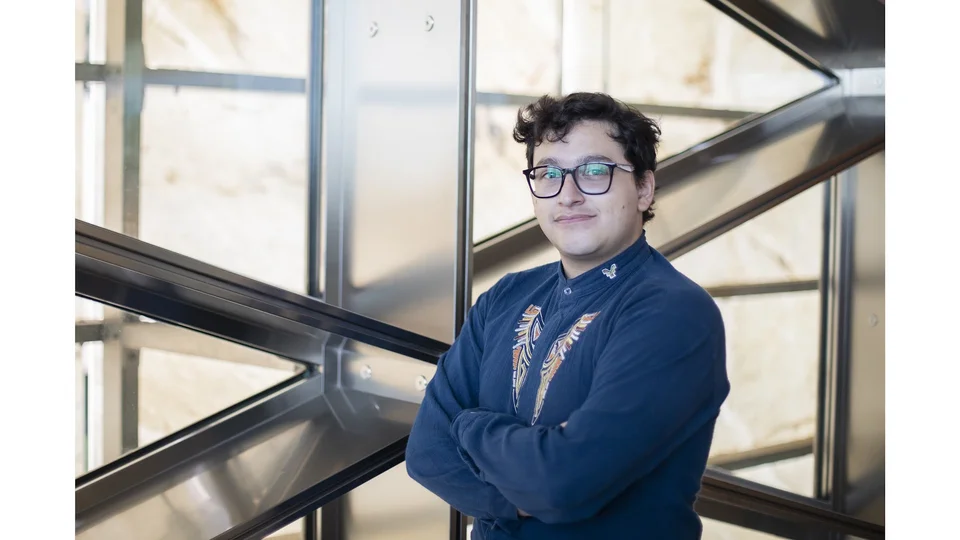
Anthony Ramos is a Ph.D. student in Applied Mathematics and Computational Science at King Abdullah University of Science and Technology (KAUST). He studied theoretical physicist at Yachay Tech University, and his growing interest in geometry led him to study discrete differential geometry, computational geometry, and geometry processing. He co-authored a paper that received the Best Technical Paper Award at SIGGRAPH Asia 2023, and received the KAUST CEMSE Division's Dean’s List Award in 2023 and 2024.