
Device-Level Intelligence for Adaptive Sensing and Bio-Integrated Systems
Inspired by biological sensory systems, this talk presents our efforts toward neuromorphic sensing, where these functions are integrated within the same device using multifunctional memory technologies.
Overview
Conventional electronic systems separate sensing, memory, and computation into different hardware units, resulting in significant energy consumption and data movement. I will first discuss our work on CMOS-compatible flash memory devices for in-memory sensing, demonstrating reconfigurable devices capable of operating as synapses or neurons while leveraging mature semiconductor platforms. I will then present our contributions to photonic and multimodal neuromorphic sensing, where memristive devices based on emerging materials enable direct processing of optical and environmental stimuli such as light, humidity, and gases within the memory element itself. I will also briefly discuss our exploration of brain-inspired device functionalities that emulate adaptive neural behaviors. Finally, I will introduce our recent efforts toward soft and bio-integrated neuromorphic systems, including microfluidic neuromorphic memories and wearable biopatches that combine sensing, memory, and actuation in soft materials for next-generation adaptive electronics and healthcare technologies. Together, these advances point toward material-level intelligence, where devices can directly sense, process, and respond to environmental information in an energy-efficient manner.
Presenters
Brief Biography
Nazek El-Atab is an associate professor of Electrical and Computer Engineering (ECE) and the principal investigator of the Smart, Advanced Memory Devices and Applications (SAMA) Lab. El-Atab joined the University in October 2017. She received her B.Sc. in computer and communications engineering in 2012 from Rafik Hariri Canadian University in Lebanon, and her M.Sc. in microsystems engineering in 2014 and Ph.D. in interdisciplinary engineering in 2017 from the Masdar Institute of Science and Technology in the UAE, under a cooperative program with MIT and funded by the U.S. Office of Naval Research.
Her research focuses on the design and fabrication of multifunctional electronic devices that integrate sensing, memory, and computation, with applications in neuromorphic sensing, intelligent edge systems, and adaptive electronics. Her group develops novel memristive and memory-based devices using emerging materials and soft systems to enable energy-efficient sensing and processing directly at the hardware level.
El-Atab is an IEEE Electron Devices Society Distinguished Lecturer. She serves as associate editor-in-chief of Applied Nanoscience (Springer Nature) and associate editor for IEEE Transactions on Electron Devices, IEEE Electron Device Letters, Nano Select (Wiley) and Microelectronics Engineering (Elsevier). She has published more than 100 papers in international peer-reviewed scientific journals and conference proceedings, authored two books and two book chapters, and holds seven filed U.S. patents.
El-Atab has received several awards for her research, including the 2015 For Women in Science Middle East Fellowship from L’Oréal-UNESCO and the 2017 L’Oréal-UNESCO International Rising Talents Award. She was featured among the 2019 “Remarkable Women in Technology” by UNESCO. She also participated in the 70th Lindau Nobel Laureate Meeting in Germany, was selected as a 2020 UC Berkeley EECS Rising Star, named among the MIT Technology Review Arabia “Innovators Under 35” in 2020, recognized among the BCG V60 Women in Sustainability, and selected as a NEOM Changemaker in 2021. She has been listed among the 2023 “Rising Stars” by Advanced Materials (Wiley) and among the 2024 “Emerging Leaders” by the Journal of Physics D: Applied Physics (IOP).
Her research has been widely covered in international media, including IEEE Spectrum, National Geographic, BBC, MIT Technology Review, and Sky News Arabia.
Related People
Related Researchers
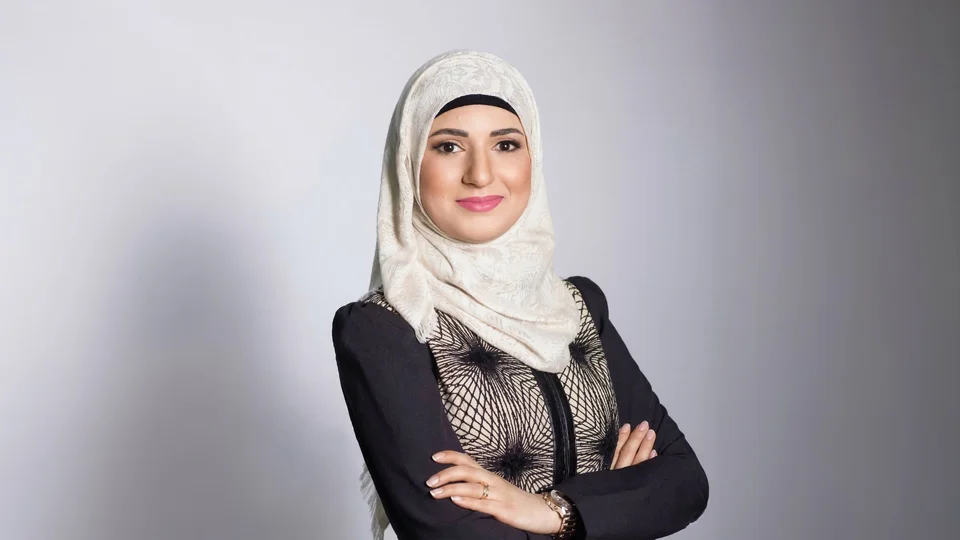
Nazek El-Atab
- Associate Professor, Electrical and Computer Engineering