Integrated Silicon Photonics with Quantum Dot On-Chip Lasers: Enabling Scalable and Energy-Efficient Photonic Systems
This talk presents how quantum dot lasers integrated on silicon provide the missing on-chip light source for scalable photonic systems spanning AI computing, hardware security, and coherent LiDAR sensing.
Overview
The rapid growth of artificial intelligence, high-performance computing, and secure communication has created an urgent demand for faster and more energy-efficient hardware platforms. Silicon photonics has emerged as a powerful solution by combining the scalability of CMOS electronics with the speed of light. However, its full potential relies on one essential element — an efficient and reliable on-chip light source. In this talk, I will present our recent breakthroughs in integrating quantum dot (QD) lasers onto silicon and other photonic platforms through heterogeneous integration. These QD-based light sources exhibit record-low threshold currents, ultranarrow linewidths, and remarkable temperature and feedback stability, paving the way for scalable, CMOS-compatible optical systems.
Building on this foundation, I will discuss how such integrated light sources enable a wide range of emerging applications - from photonic computing units (PCUs) for AI acceleration, to silicon photonics-integrated LiDAR for autonomous systems, and chaos-based photonic hardware for next-generation cybersecurity. By connecting materials innovation, device engineering, and system-level integration, our work aims to transform silicon photonics into a universal hardware platform — one that unites communication, computation, and sensing through light, paving the way toward an intelligent and energy-sustainable future.
Presenters
Brief Biography
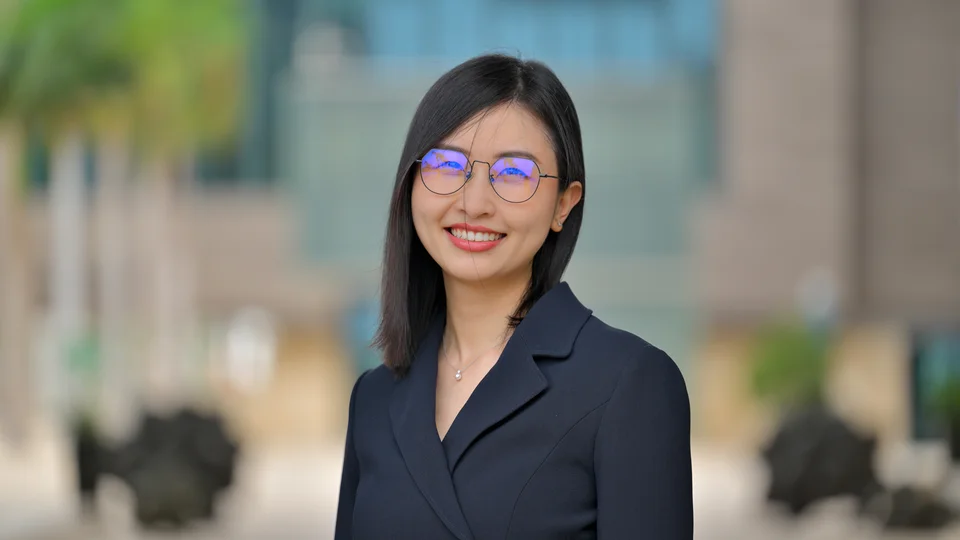
Dr. Yating Wan is an assistant professor of electrical engineering and the principal investigator of the Integrated Photonics Laboratory at KAUST.
Dr. Wan specializes in silicon photonics with a focus on integrating on-chip light sources for data communication, optical computing, OPA-based lidar, and quantum information processing.
Before joining KAUST, Dr. Wan worked in Professor John Bowers’ group at the University of California, Santa Barbara (2017–2022), where she led Intel’s project on heterogeneously integrated QD lasers on silicon.
At KAUST, she leads a dynamic team of 20 members, including seven postdoctoral researchers, 11 Ph.D. students, and two master’s students.
Dr. Wan has authored over 100 peer-reviewed publications, including 38 first-author papers (29 journals, 9 proceedings, and 10 journal covers) and 26 corresponding-author publications (11 journals, 15 conferences).
For her pioneering work in on-chip laser integration on silicon, Dr. Wan has received numerous major awards, including the 2021 CLEO Tingye Li Innovation Prize (one awardee worldwide); the 2022 Rising Stars of Light recognition by Light: Science & Applications (three awardees worldwide); inclusion in MIT Technology Review’s 2023 “35 Innovators Under 35 for China”; the 2025 Sony Women in Technology Award with Nature ($250,000 prize, three awardees worldwide); and the 2025 IEEE Photonics Society Young Investigator Award (one awardee worldwide).
Outside her immediate research focus, Dr. Wan has been an active contributor to the broader academic community. She serves as manager and column editor for the LSA Editorial Office in Thuwal, as associate editor for Applied Optics and the IEEE Journal of Quantum Electronics (JQE), and as guest associate editor for the IEEE Journal of Selected Topics in Quantum Electronics (JSTQE).
Dr. Wan is also a technical program committee member for the International Photonics Conference (IPC) and the Conference on Lasers and Electro-Optics (CLEO) and a member of the IEEE Photonics Society Conference Council. She has reviewed more than 100 papers for leading journals across IEEE, Optica and the Nature Publishing Group.