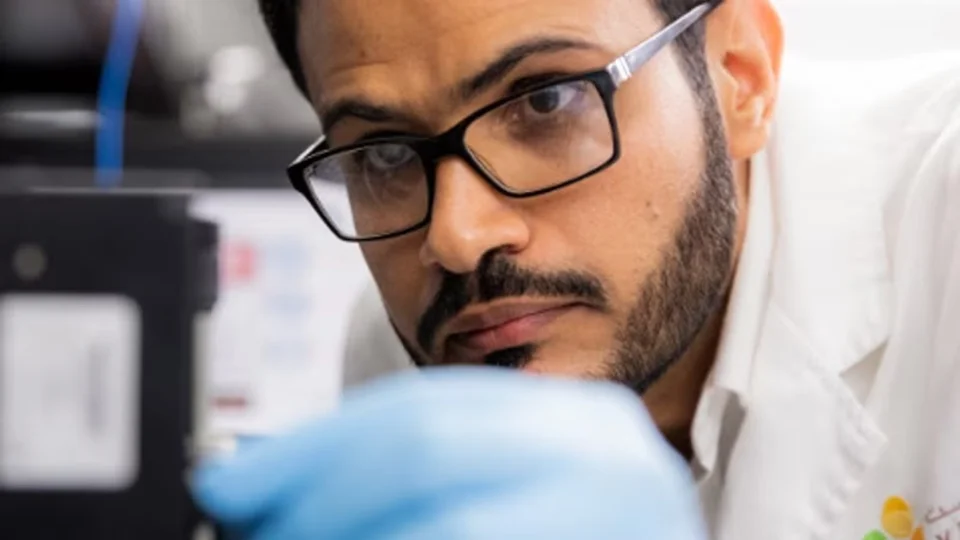
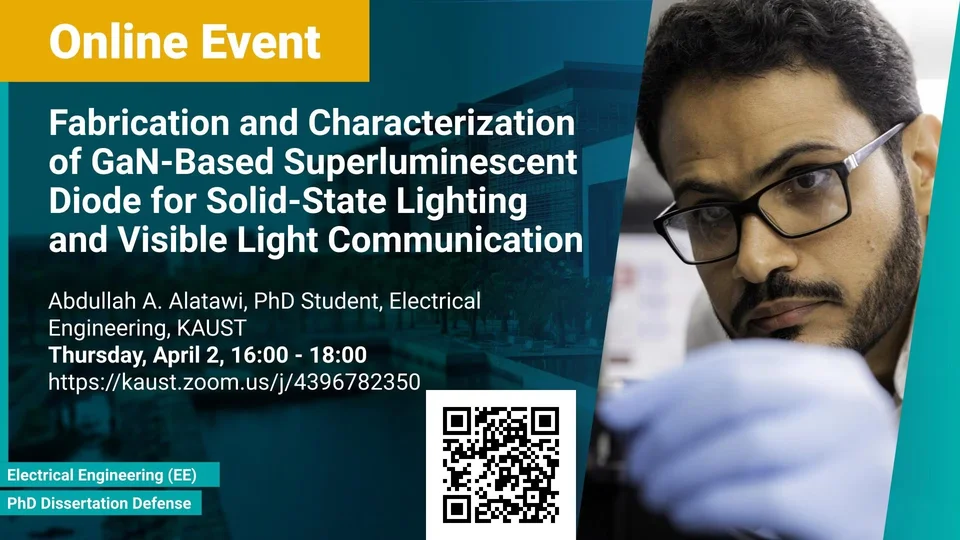
About Abdullah A. Alatawi Abdullah A. Alatawi Ph.D. Student, Electrical and Computer Engineering optoelectronic device fabrication solid-state lighting Visible light communications Abdullah Alatawi is a Ph.D. student at Photonics Laboratory at King Abdullah University of Science and Technology (KAUST). His research interests include the study of semiconductor lasers, LEDs, and SLDs for applications in energy-efficient lighting and visible light communications. He received his master of science in optical nanotechnology engineering from the University of Kassel in Germany (2014). The topic of his thesis covers the investigation and improvement of VCSEL devices. He received his B.SC in Aerospace Engineering from King Fahad University of Petroleum and Minerals (KFUPM) in Events Presented Events Mar 29 - Apr 4, 2020 Fabrication and Characterization of GaN-Based Superluminescent Diode for Solid-State Lighting and Visible Light Communication Abdullah A. Alatawi, Ph.D. Student, Electrical and Computer Engineering Apr 2, 16:00 - 18:00 KAUST Fabrication and Characterization solid-state lighting Visible light communications This dissertation is devoted to the fabrication and electrical and optical characterization of a new class of III-nitride light-emitter known as superluminescent diode (SLD). SLD works in an amplified spontaneous emission (ASE) regime, and it combines several advantages from both LD and LED, such as droop-free, speckle-free, low-spatial coherence, broader emission, high-optical power, and directional beam. Here, SLDs were fabricated by a focused ion beam by tilting the front facet of the waveguide to suppress the lasing mode. They showed a high-power of 474 mW on c-plane GaN-substrate with a large spectral bandwidth of 6.5 nm at an optical power of 105 mW. To generate SLD-based white light, a YAG-phosphor-plate was integrated, and a CRI of 85.1 and CCT of 3392 K were measured. For the VLC link, SLD showed record high-data rates of 1.45 Gbps and 3.4 Gbps by OOK and DMT modulation schemes, respectively. Additionally, a widely single- and dual-wavelength tunability were designed using SLD-based external cavity (SLD-EC) configuration for a tunable blue laser source.
Fabrication and Characterization of GaN-Based Superluminescent Diode for Solid-State Lighting and Visible Light Communication Abdullah A. Alatawi, Ph.D. Student, Electrical and Computer Engineering Apr 2, 16:00 - 18:00 KAUST Fabrication and Characterization solid-state lighting Visible light communications This dissertation is devoted to the fabrication and electrical and optical characterization of a new class of III-nitride light-emitter known as superluminescent diode (SLD). SLD works in an amplified spontaneous emission (ASE) regime, and it combines several advantages from both LD and LED, such as droop-free, speckle-free, low-spatial coherence, broader emission, high-optical power, and directional beam. Here, SLDs were fabricated by a focused ion beam by tilting the front facet of the waveguide to suppress the lasing mode. They showed a high-power of 474 mW on c-plane GaN-substrate with a large spectral bandwidth of 6.5 nm at an optical power of 105 mW. To generate SLD-based white light, a YAG-phosphor-plate was integrated, and a CRI of 85.1 and CCT of 3392 K were measured. For the VLC link, SLD showed record high-data rates of 1.45 Gbps and 3.4 Gbps by OOK and DMT modulation schemes, respectively. Additionally, a widely single- and dual-wavelength tunability were designed using SLD-based external cavity (SLD-EC) configuration for a tunable blue laser source.
Related Sites Electrical and Computer Engineering (ECE) Photonics Laboratory (Photonics) Related Content Events 1