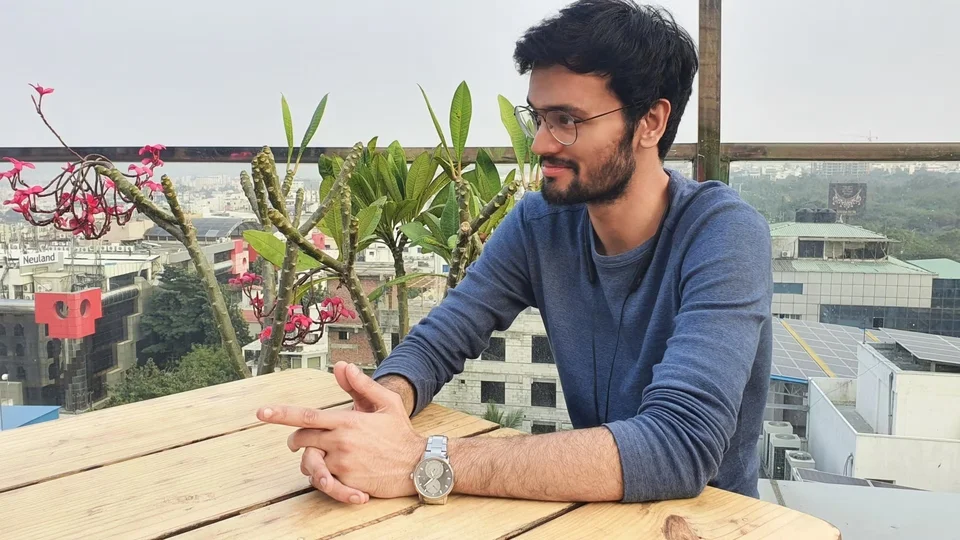
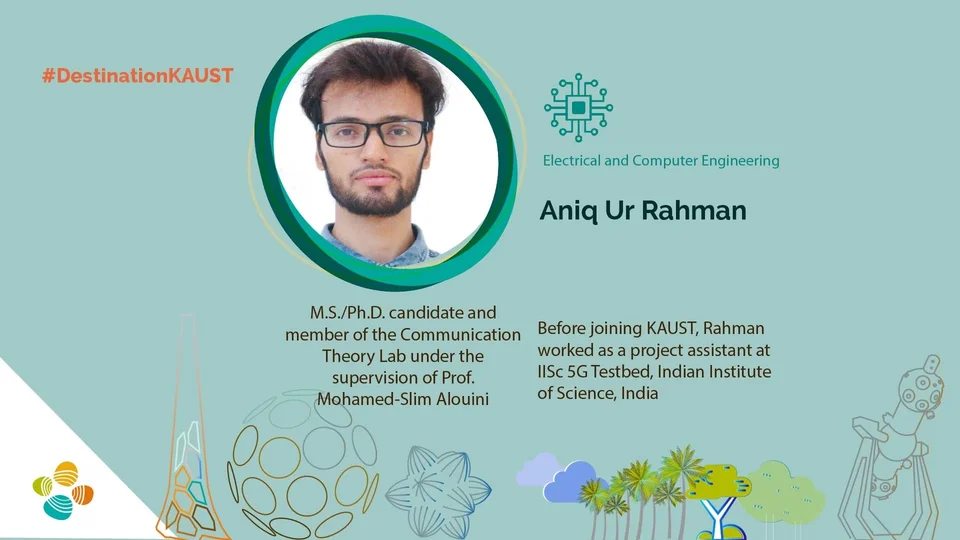
About Aniq Ur Rahman Aniq Ur Rahman M.S., Electrical and Computer Engineering Stochastic Geometry Reinforcement Learning wireless network Aniq is an MS/PhD student under the supervision of Prof. Mohamed-Slim Alouini at the Communication Theory Lab (CTL), KAUST. Education and Early Career Aniq obtained his bachelor’s degree in Electronics and Communication Engineering from National Institute of Technology Durgapur, India in 2019. Upon graduation, he joined Qualcomm as an Associate Systems Engineer. In 2018 summers, he participated in the ALICE experiment as a research intern at the European Organization for Nuclear Research (CERN), Switzerland. Prior to joining KAUST, he worked as a Project Assistant at IISc 5G Testbed, Indian Articles Related News December 2023 A simple solution for frequency sharing 2 min read · Wed, Dec 20 2023 News Spotlight A simple yet elegant solution could improve data rates for multiple communications networks that share a common frequency band. January 2022 KAUST CTL team wins competition at 6G Summit on Connecting the Unconnected 1 min read · Mon, Jan 10 2022 News The Marconi Society organized the second 6G Summit on Connected the Unconnected in partnership with KAUST. The summit was a three-day virtual event that brought together experts from technology and policy-making to discuss ideas that can accelerate the process of connecting the unconnected population to the internet. A competition was part of this summit and was open to students and early career researchers from all over the world who proposed novel solutions for digital inclusion. A team of four students from Communication Theory Lab (CTL) consisting of Aniq Ur Rahman, Fares Fourati, Maurilo July 2021 Grant award set to boost KAUST student’s efforts to close the digital divide 2 min read · Mon, Jul 26 2021 News NDA architecture interconnectivity A research team featuring KAUST M.S./Ph.D. student Aniq Ur Rahman recently received €5,000 in funding from AlumNode, for their project: “Connecting the Unconnected: A Tool for Digital Inclusion.” Rahman—along with his colleagues Dr. Anish Jindal from the University of Essex, U.K., and Dr. Khac-Hoang Ngo from Chalmers University of Technology, Sweden—received the grant for their innovative optimal network deployment architecture (NDA) software aimed at reducing the global digital divide. June 2021 Aniq Ur Rahman receives funding from AlumNode 1 min read · Fri, Jun 18 2021 News KAUST MS/PhD student Aniq Ur Rahman of the Communication Theory Lab, KAUST, received 5000 EUR funding from AlumNode for the project: “Connecting the Unconnected: A Tool for Digital Inclusion”. His team consists of himself, Dr. Anish Jindal from the University of Essex, UK, and Dr. Khac-Hoang Ngo from Chalmers University of Technology, Sweden. All of the team members alumni of Heidelberg Laureate Forum 2019 which made them eligible to apply for the AlumNode funding. AlumNode is a collaboration of Heidelberg Laureate Fourm Foundation (HLFF) and German Scholars Organization (GSO). It is funded by March 2021 Meet KAUST New Student: Aniq Ur Rahman 2 min read · Thu, Mar 18 2021 News Aniq Ur Rahman joined KAUST in January 2021 as an M.S./Ph.D. candidate and member of the Communication Theory Lab under the supervision of Prof. Mohamed-Slim Alouini. He holds a bachelor's degree in electronics and communication engineering from the National Institute of Technology (NIT Durgapur), India.
A simple solution for frequency sharing 2 min read · Wed, Dec 20 2023 News Spotlight A simple yet elegant solution could improve data rates for multiple communications networks that share a common frequency band.
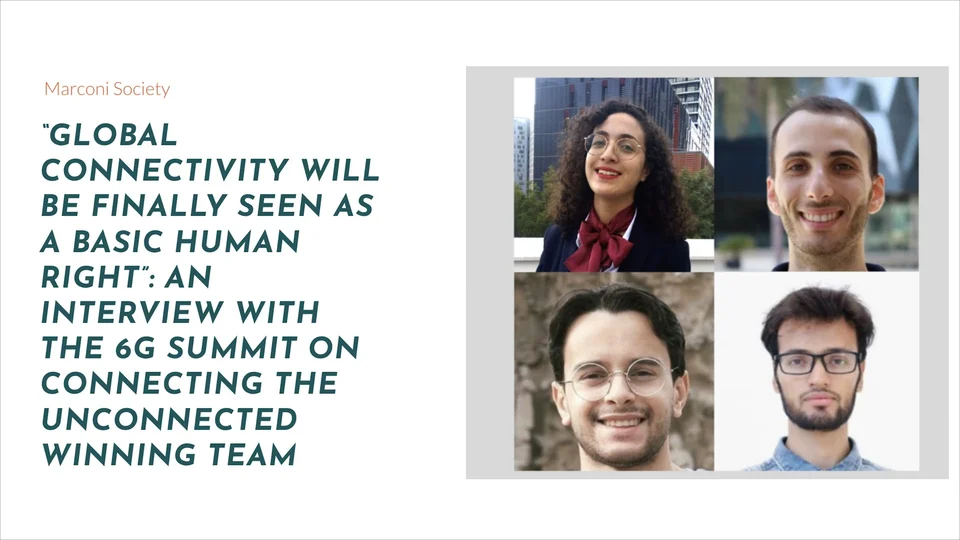
KAUST CTL team wins competition at 6G Summit on Connecting the Unconnected 1 min read · Mon, Jan 10 2022 News The Marconi Society organized the second 6G Summit on Connected the Unconnected in partnership with KAUST. The summit was a three-day virtual event that brought together experts from technology and policy-making to discuss ideas that can accelerate the process of connecting the unconnected population to the internet. A competition was part of this summit and was open to students and early career researchers from all over the world who proposed novel solutions for digital inclusion. A team of four students from Communication Theory Lab (CTL) consisting of Aniq Ur Rahman, Fares Fourati, Maurilo
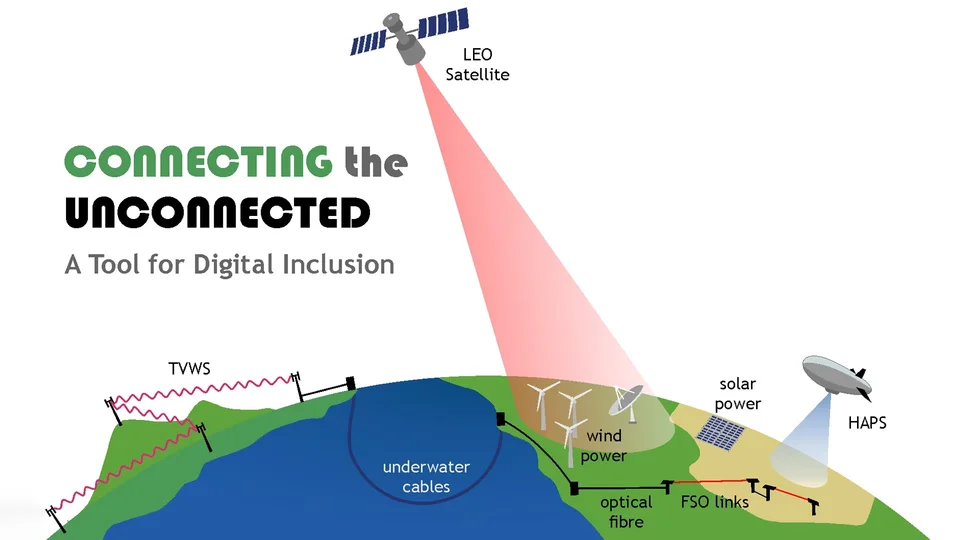
Grant award set to boost KAUST student’s efforts to close the digital divide 2 min read · Mon, Jul 26 2021 News NDA architecture interconnectivity A research team featuring KAUST M.S./Ph.D. student Aniq Ur Rahman recently received €5,000 in funding from AlumNode, for their project: “Connecting the Unconnected: A Tool for Digital Inclusion.” Rahman—along with his colleagues Dr. Anish Jindal from the University of Essex, U.K., and Dr. Khac-Hoang Ngo from Chalmers University of Technology, Sweden—received the grant for their innovative optimal network deployment architecture (NDA) software aimed at reducing the global digital divide.
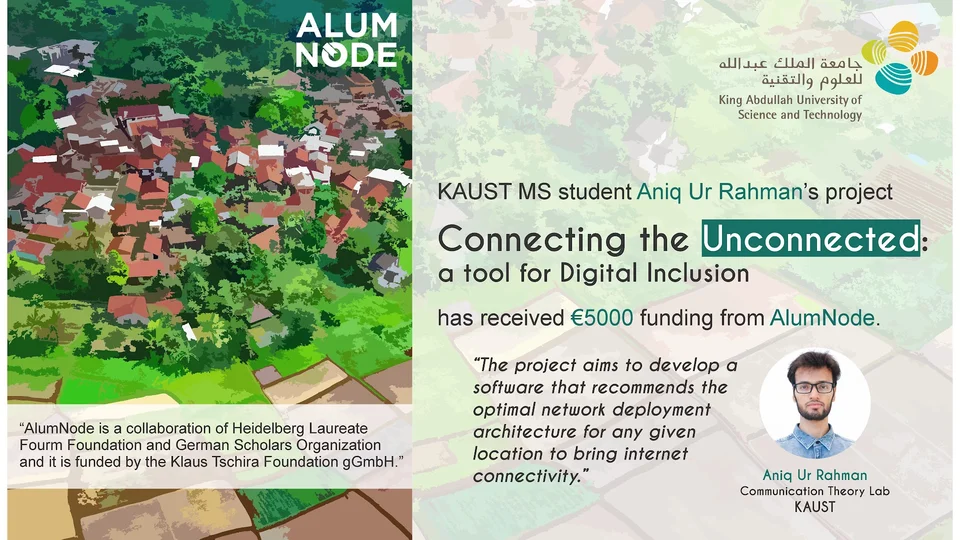
Aniq Ur Rahman receives funding from AlumNode 1 min read · Fri, Jun 18 2021 News KAUST MS/PhD student Aniq Ur Rahman of the Communication Theory Lab, KAUST, received 5000 EUR funding from AlumNode for the project: “Connecting the Unconnected: A Tool for Digital Inclusion”. His team consists of himself, Dr. Anish Jindal from the University of Essex, UK, and Dr. Khac-Hoang Ngo from Chalmers University of Technology, Sweden. All of the team members alumni of Heidelberg Laureate Forum 2019 which made them eligible to apply for the AlumNode funding. AlumNode is a collaboration of Heidelberg Laureate Fourm Foundation (HLFF) and German Scholars Organization (GSO). It is funded by
Meet KAUST New Student: Aniq Ur Rahman 2 min read · Thu, Mar 18 2021 News Aniq Ur Rahman joined KAUST in January 2021 as an M.S./Ph.D. candidate and member of the Communication Theory Lab under the supervision of Prof. Mohamed-Slim Alouini. He holds a bachelor's degree in electronics and communication engineering from the National Institute of Technology (NIT Durgapur), India.
Related Sites Electrical and Computer Engineering (ECE) Communication Theory Lab (CTL) Related Content Articles 5 Related Links LinkedIn Google Scholar dblp Scopus ResearchGate ORCID