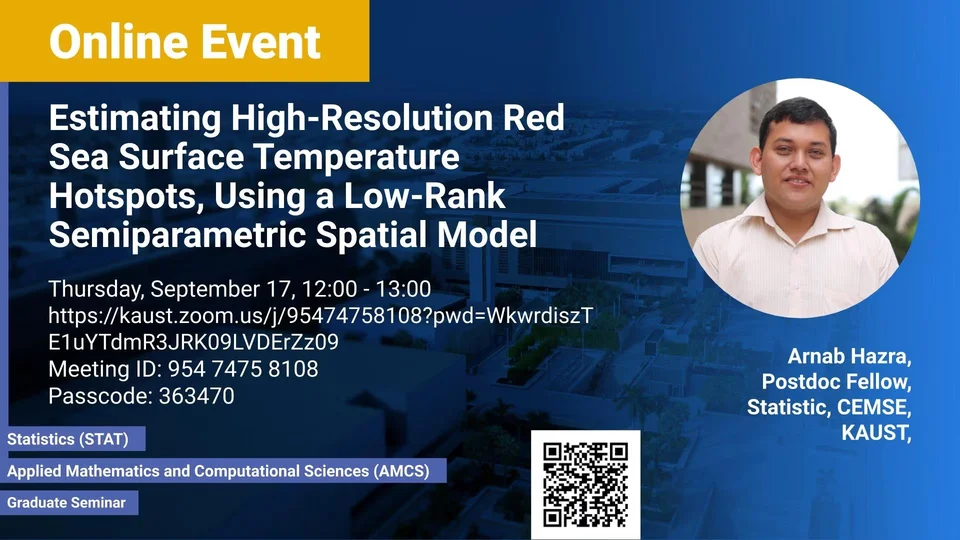
About Arnab Hazra Arnab Hazra Postdoctoral Research Fellow, Statistics Statistics of extremes Environmental Statistics spatial statistics Statistical Modeling computational statistics Dr. Arnab Hazra was a postdoctoral fellow in the Extreme Statistics Research Group of Prof. Raphaël Huser from February 2019 until December 2021, doing research on spatial extremes with environmental applications and bayesian statistics. After his postdoc at KAUST, Arnab moved to the Indian Institute of Technology (IIT), Kanpur, India, where he embraced an academic career by becoming an Assistant Professor of Statistics. See his personal website here. Education and early career Arnab Hazra received his Ph.D. in Statistics from North Carolina State University, United States. His Ph.D. advisors Events Presented Events Sep 13 - Sep 19, 2020 Estimating High-Resolution Red Sea Surface Temperature Hotspots, Using a Low-Rank Semiparametric Spatial Model Arnab Hazra, Postdoctoral Research Fellow, Statistics Sep 17, 12:00 - 13:00 KAUST High Resolution X-ray Diffraction spatial modulation In this work, we estimate extreme sea surface temperature (SST) hotspots, i.e., high threshold exceedance regions, for the Red Sea, a vital region of high biodiversity. We analyze high-resolution satellite-derived SST data comprising daily measurements at 16703 grid cells across the Red Sea over the period 1985–2015. We propose a semiparametric Bayesian spatial mixed-effects linear model with a flexible mean structure to capture spatially-varying trend and seasonality, while the residual spatial variability is modeled through a Dirichlet process mixture (DPM) of low-rank spatial Student-t processes (LTPs). By specifying cluster-specific parameters for each LTP mixture component, the bulk of the SST residuals influence tail inference and hotspot estimation only moderately. Our proposed model has a nonstationary mean, covariance and tail dependence, and posterior inference can be drawn efficiently through Gibbs sampling. In our application, we show that the proposed method outperforms some natural parametric and semiparametric alternatives.
Estimating High-Resolution Red Sea Surface Temperature Hotspots, Using a Low-Rank Semiparametric Spatial Model Arnab Hazra, Postdoctoral Research Fellow, Statistics Sep 17, 12:00 - 13:00 KAUST High Resolution X-ray Diffraction spatial modulation In this work, we estimate extreme sea surface temperature (SST) hotspots, i.e., high threshold exceedance regions, for the Red Sea, a vital region of high biodiversity. We analyze high-resolution satellite-derived SST data comprising daily measurements at 16703 grid cells across the Red Sea over the period 1985–2015. We propose a semiparametric Bayesian spatial mixed-effects linear model with a flexible mean structure to capture spatially-varying trend and seasonality, while the residual spatial variability is modeled through a Dirichlet process mixture (DPM) of low-rank spatial Student-t processes (LTPs). By specifying cluster-specific parameters for each LTP mixture component, the bulk of the SST residuals influence tail inference and hotspot estimation only moderately. Our proposed model has a nonstationary mean, covariance and tail dependence, and posterior inference can be drawn efficiently through Gibbs sampling. In our application, we show that the proposed method outperforms some natural parametric and semiparametric alternatives.
Engage ORCID ShareClipboard Related Sites Extreme Statistics (XSTAT) Statistics (STAT) Related Content Articles 6 Events 1 Related Links ResearchGate Publications Personal