About Atif Shamim Atif Shamim Associate Dean for Special Projects, Computer, Electrical and Mathematical Sciences and Engineering Antennas sensors Microwave circuits additive manufacturing Professor Shamim is an accomplished electrical engineer specializing in wireless communication and sensing components and systems. His work aims to improve the performance of wireless communication and sensing systems through low-cost additive manufacturing techniques. Events Presented Events Aug 30 - Sep 5, 2026 From Nanoparticles to Microwave Systems: Bridging Materials, Inks, and Additive Manufacturing Atif Shamim, Associate Dean for Special Projects, Computer, Electrical and Mathematical Sciences and Engineering Aug 30, 12:00 - 13:00 B9 R2325 additive manufacturing wearable and flexible antennas Sensing Systems This talk introduces additive manufacturing as an emerging technique to realize low-cost, flexible, and wearable wireless communication and sensing systems. Nov 9 - Nov 15, 2025 Enabling Next Generation Wireless Communication through mm-Wave Reconfigurable Intelligent Surface (RIS) Atif Shamim, Associate Dean for Special Projects, Computer, Electrical and Mathematical Sciences and Engineering Nov 9, 12:00 - 13:00 B9, L2, R2325 Next Generation Wireless Communication Systems 5G and beyond Reconfigurable Intelligent Surfaces The mm-wave 5G and beyond communication systems significantly improve the data rate, user capacity, and latency, however, the electromagnetic (EM) wave propagation suffers from high atmospheric attenuation as compared to the sub-6 GHz bands. Therefore, the quality of wireless communication gets severely affected in an environment where multiple obstacles, such as buildings and trees, are present, and thus, communication coverage is typically limited to line of sight (LOS). Aug 27 - Sep 2, 2023 Enabling Next Generation Wireless Communication through mm-Wave Reconfigurable Intelligent Surface (RIS) Atif Shamim, Associate Dean for Special Projects, Computer, Electrical and Mathematical Sciences and Engineering Aug 27, 12:00 - 13:00 B9 L2 H2 5G and beyond electromagnetic waves The mm-wave 5G and beyond communication systems significantly improve the data rate, user capacity, and latency, however, the electromagnetic (EM) wave propagation suffers from high atmospheric attenuation as compared to the sub-6 GHz bands. Sep 18 - Sep 24, 2022 Fully Printed, Flexible and Disposable Wireless Sensors for Internet of Things Applications Atif Shamim, Associate Dean for Special Projects, Computer, Electrical and Mathematical Sciences and Engineering Sep 18, 12:00 - 13:00 B9 L2 R2322 Fully Printed Flexible and Disposable Wireless Sensors With the advent of wearable devices and internet of things (IoT), there is a new focus on sensing systems which can be bent so that they can be worn or mounted on non-planar objects. Apr 3 - Apr 9, 2022 Towards Miniaturized, Flexible and Wearable Wireless Communication and Sensing Systems for IoT Applications Atif Shamim, Associate Dean for Special Projects, Computer, Electrical and Mathematical Sciences and Engineering Apr 3, 14:00 - 16:00 B9 L2 H2 With the advent of wearable sensors and internet of things (IoT) applications, there is a new focus on electronics which can be compact, light-weight and flexible so that these can be worn or mounted on non-planar objects. Due to large volume (billions of devices), it is required that the cost is extremely low, to the extent that they become disposable. In the context of miniaturization and lower cost, concepts such as System-on-chip (SoC) where a complete system is realized on a single chip (integrated circuit (IC)) or System-on-package (SoP) where the package of the chip is made functional are beneficial. The flexible and low-cost aspects can be addressed through additive manufacturing technologies such as inkjet and screen printing. Two important aspects of any IoT system, “Sensing” and “Wireless Communication”, will be the focus of this talk. The SoC part of the talk will focus on integration of the antenna on the chip and ways of enhancing its efficiency despite the lossy Silicon substrate in conventional semiconductor manufacturing processes. Through a SoP design example, it will be shown how smart packaging of a chip can boost the performance without adding any additional components or cost. In the later part of the talk, additive manufacturing will be introduced as an emerging technique to realize low cost and flexible wireless communication and sensing systems. Various novel functional inks, such as conductive, dielectric, phase change and sensing materials will be shown. A multilayer process will be presented where dielectrics are also printed in addition to the metallic parts, thus demonstrating fully printed components. Finally, some printed sensor examples will be shown for remote health and environmental monitoring. The promising results of these designs indicate that the day when electronics can be printed like newspapers and magazines through roll-to-roll printing is not far away. Jan 30 - Feb 5, 2022 On-Chip Antennas: The Last Barrier to True RF System-on-Chip Atif Shamim, Associate Dean for Special Projects, Computer, Electrical and Mathematical Sciences and Engineering Jan 30, 12:00 - 13:00 KAUST Antennas are integral part of wireless communication devices and traditionally have remained off the Integrated Circuits (ICs which are also commonly known as chips) resulting in large sized modules. Sep 6 - Sep 12, 2020 Flexible, Wearable, Disposable Wireless Communication and Sensing Systems Through Additive Manufacturing - 2020 Atif Shamim, Associate Dean for Special Projects, Computer, Electrical and Mathematical Sciences and Engineering Sep 6, 12:00 - 13:00 KAUST flexible Wearable disposable wireless communication Sensing Systems additive manufacturing With the advent of wearable sensors and internet of things (IoT), there is a new focus on electronics which can be bent so that they can be worn or mounted on non-planar objects. Due to large volume (billions of devices), there is a requirement that the cost is extremely low, to the extent that they become disposable. The flexible and low-cost aspects can be addressed through additive manufacturing technologies such as inkjet, screen and 3D printing. This talk introduces additive manufacturing as an emerging technique to realize low cost, flexible and wearable wireless communication and sensing systems. The ability to print electronics on unconventional mediums such as plastics, papers, and textiles has opened up a plethora of new applications. In this talk, various innovative antenna and sensor designs will be shown which have been realized through additive manufacturing. A multilayer process will be presented where dielectrics are also printed in addition to the metallic parts, thus demonstrating fully printed components. Many new functional inks and their use in tunable and reconfigurable components will be shown. In the end, many system level examples of wireless sensing applications will be shown. The promising results of these designs indicate that the day when electronics can be printed like newspapers and magazines through roll-to-roll and reel-to-reel printing is not far away. Sep 1 - Sep 7, 2019 Flexible, Wearable, Disposable Wireless Communication and Sensing Systems Through Additive Manufacturing - 2019 Atif Shamim, Associate Dean for Special Projects, Computer, Electrical and Mathematical Sciences and Engineering Sep 1, 12:00 - 13:00 B9 L2 H1 additive manufacturing sensors electronics With the advent of wearable sensors and internet of things (IoT), there is a new focus on electronics which can be bent so that they can be worn or mounted on non-planar objects. Due to large volume (billions of devices), there is a requirement that the cost is extremely low, to the extent that they become disposable. The flexible and low-cost aspects can be addressed through additive manufacturing technologies such as inkjet, screen and 3D printing. This talk introduces additive manufacturing as an emerging technique to realize low cost, flexible and wearable wireless communication and sensing systems.
From Nanoparticles to Microwave Systems: Bridging Materials, Inks, and Additive Manufacturing Atif Shamim, Associate Dean for Special Projects, Computer, Electrical and Mathematical Sciences and Engineering Aug 30, 12:00 - 13:00 B9 R2325 additive manufacturing wearable and flexible antennas Sensing Systems This talk introduces additive manufacturing as an emerging technique to realize low-cost, flexible, and wearable wireless communication and sensing systems.
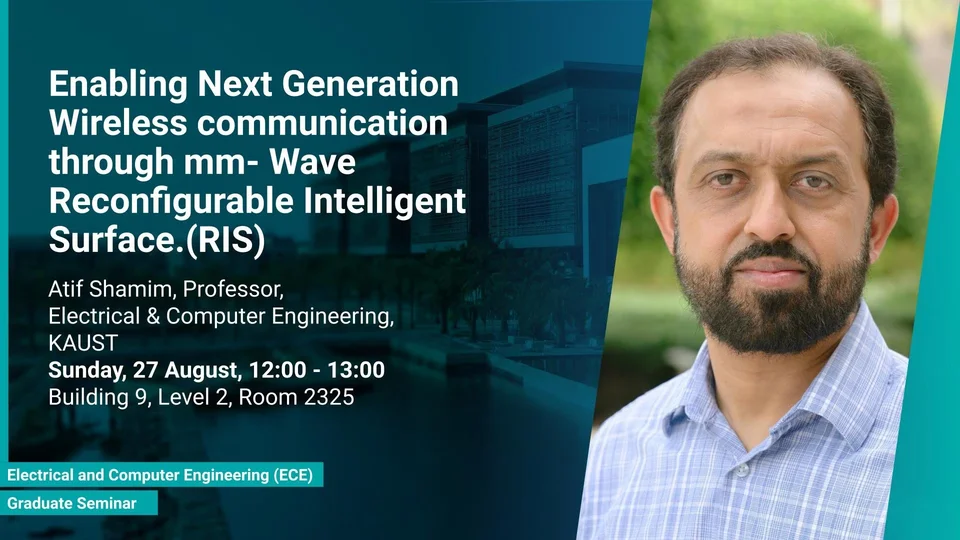
Enabling Next Generation Wireless Communication through mm-Wave Reconfigurable Intelligent Surface (RIS) Atif Shamim, Associate Dean for Special Projects, Computer, Electrical and Mathematical Sciences and Engineering Nov 9, 12:00 - 13:00 B9, L2, R2325 Next Generation Wireless Communication Systems 5G and beyond Reconfigurable Intelligent Surfaces The mm-wave 5G and beyond communication systems significantly improve the data rate, user capacity, and latency, however, the electromagnetic (EM) wave propagation suffers from high atmospheric attenuation as compared to the sub-6 GHz bands. Therefore, the quality of wireless communication gets severely affected in an environment where multiple obstacles, such as buildings and trees, are present, and thus, communication coverage is typically limited to line of sight (LOS).
Enabling Next Generation Wireless Communication through mm-Wave Reconfigurable Intelligent Surface (RIS) Atif Shamim, Associate Dean for Special Projects, Computer, Electrical and Mathematical Sciences and Engineering Aug 27, 12:00 - 13:00 B9 L2 H2 5G and beyond electromagnetic waves The mm-wave 5G and beyond communication systems significantly improve the data rate, user capacity, and latency, however, the electromagnetic (EM) wave propagation suffers from high atmospheric attenuation as compared to the sub-6 GHz bands.
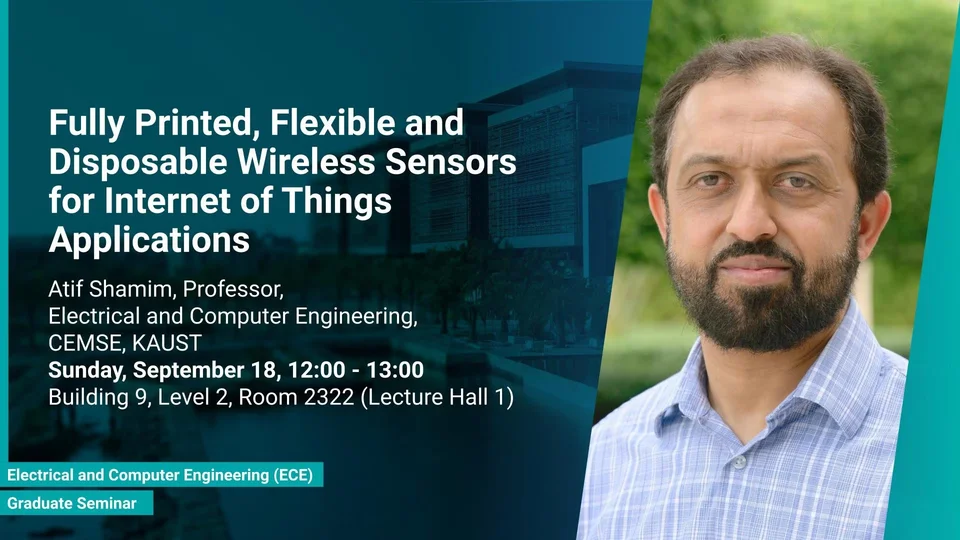
Fully Printed, Flexible and Disposable Wireless Sensors for Internet of Things Applications Atif Shamim, Associate Dean for Special Projects, Computer, Electrical and Mathematical Sciences and Engineering Sep 18, 12:00 - 13:00 B9 L2 R2322 Fully Printed Flexible and Disposable Wireless Sensors With the advent of wearable devices and internet of things (IoT), there is a new focus on sensing systems which can be bent so that they can be worn or mounted on non-planar objects.
Towards Miniaturized, Flexible and Wearable Wireless Communication and Sensing Systems for IoT Applications Atif Shamim, Associate Dean for Special Projects, Computer, Electrical and Mathematical Sciences and Engineering Apr 3, 14:00 - 16:00 B9 L2 H2 With the advent of wearable sensors and internet of things (IoT) applications, there is a new focus on electronics which can be compact, light-weight and flexible so that these can be worn or mounted on non-planar objects. Due to large volume (billions of devices), it is required that the cost is extremely low, to the extent that they become disposable. In the context of miniaturization and lower cost, concepts such as System-on-chip (SoC) where a complete system is realized on a single chip (integrated circuit (IC)) or System-on-package (SoP) where the package of the chip is made functional are beneficial. The flexible and low-cost aspects can be addressed through additive manufacturing technologies such as inkjet and screen printing. Two important aspects of any IoT system, “Sensing” and “Wireless Communication”, will be the focus of this talk. The SoC part of the talk will focus on integration of the antenna on the chip and ways of enhancing its efficiency despite the lossy Silicon substrate in conventional semiconductor manufacturing processes. Through a SoP design example, it will be shown how smart packaging of a chip can boost the performance without adding any additional components or cost. In the later part of the talk, additive manufacturing will be introduced as an emerging technique to realize low cost and flexible wireless communication and sensing systems. Various novel functional inks, such as conductive, dielectric, phase change and sensing materials will be shown. A multilayer process will be presented where dielectrics are also printed in addition to the metallic parts, thus demonstrating fully printed components. Finally, some printed sensor examples will be shown for remote health and environmental monitoring. The promising results of these designs indicate that the day when electronics can be printed like newspapers and magazines through roll-to-roll printing is not far away.
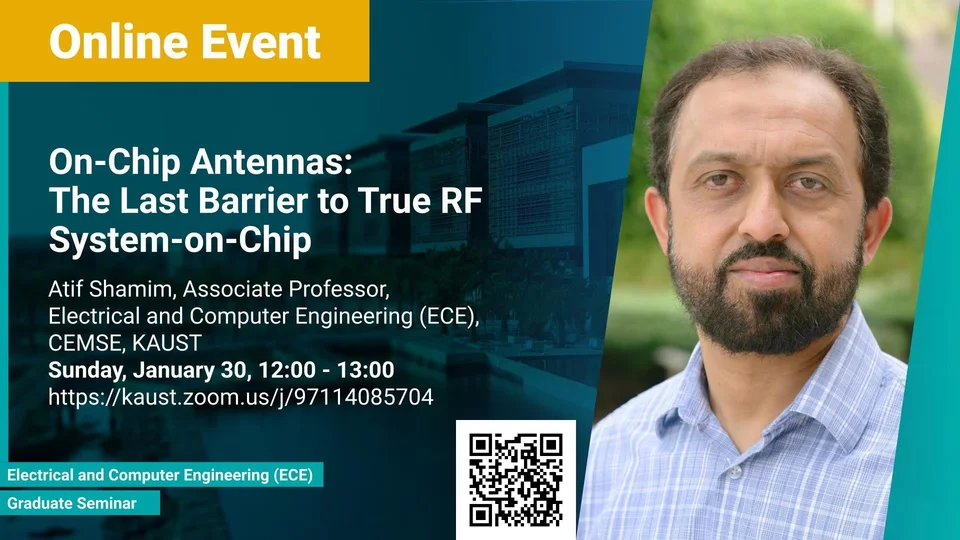
On-Chip Antennas: The Last Barrier to True RF System-on-Chip Atif Shamim, Associate Dean for Special Projects, Computer, Electrical and Mathematical Sciences and Engineering Jan 30, 12:00 - 13:00 KAUST Antennas are integral part of wireless communication devices and traditionally have remained off the Integrated Circuits (ICs which are also commonly known as chips) resulting in large sized modules.
Flexible, Wearable, Disposable Wireless Communication and Sensing Systems Through Additive Manufacturing - 2020 Atif Shamim, Associate Dean for Special Projects, Computer, Electrical and Mathematical Sciences and Engineering Sep 6, 12:00 - 13:00 KAUST flexible Wearable disposable wireless communication Sensing Systems additive manufacturing With the advent of wearable sensors and internet of things (IoT), there is a new focus on electronics which can be bent so that they can be worn or mounted on non-planar objects. Due to large volume (billions of devices), there is a requirement that the cost is extremely low, to the extent that they become disposable. The flexible and low-cost aspects can be addressed through additive manufacturing technologies such as inkjet, screen and 3D printing. This talk introduces additive manufacturing as an emerging technique to realize low cost, flexible and wearable wireless communication and sensing systems. The ability to print electronics on unconventional mediums such as plastics, papers, and textiles has opened up a plethora of new applications. In this talk, various innovative antenna and sensor designs will be shown which have been realized through additive manufacturing. A multilayer process will be presented where dielectrics are also printed in addition to the metallic parts, thus demonstrating fully printed components. Many new functional inks and their use in tunable and reconfigurable components will be shown. In the end, many system level examples of wireless sensing applications will be shown. The promising results of these designs indicate that the day when electronics can be printed like newspapers and magazines through roll-to-roll and reel-to-reel printing is not far away.
Flexible, Wearable, Disposable Wireless Communication and Sensing Systems Through Additive Manufacturing - 2019 Atif Shamim, Associate Dean for Special Projects, Computer, Electrical and Mathematical Sciences and Engineering Sep 1, 12:00 - 13:00 B9 L2 H1 additive manufacturing sensors electronics With the advent of wearable sensors and internet of things (IoT), there is a new focus on electronics which can be bent so that they can be worn or mounted on non-planar objects. Due to large volume (billions of devices), there is a requirement that the cost is extremely low, to the extent that they become disposable. The flexible and low-cost aspects can be addressed through additive manufacturing technologies such as inkjet, screen and 3D printing. This talk introduces additive manufacturing as an emerging technique to realize low cost, flexible and wearable wireless communication and sensing systems.
Engage ORCID KAUST Repository KAUST Academic Portal Scopus LinkedIn ShareClipboard Related Sites Electrical and Computer Engineering (ECE) Extreme Bandwidth Communication (XBCom) Integrated Microwaves Packaging Antennas and Circuits Technology (IMPACTS) Related Content Articles 126 Projects 12 Events 8 Related Links Professor Shamim's Patents Atif Shamim's publications on Google Scholar