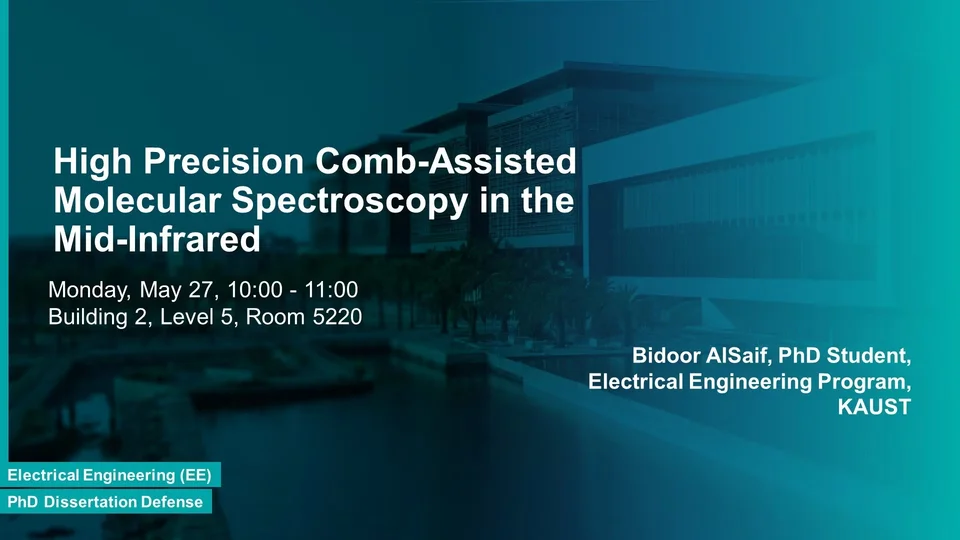
About Bidoor AlSaif Bidoor AlSaif Ph.D. Student, Electrical and Computer Engineering Optical sensors molecular spectroscopy Bidoor AlSaif is a physics graduate from College of Science (Imam Abdulrahman bin Faisal University) in Dammam. Thereafter, she completed her MS degree in Physics from the King Saud University. She joined KAUST Electrical Engineering Program in 2013 in to peruse her PhD degree. Motivated by astonishing world of laser physics and its wide applications, she joined Prof. Aamir Farooq to develop sensors in the mid-IR with quantum-cascade lasers (QCLs) and to perform precise spectroscopic measurements. She achieved highly accurate spectroscopic measurements of one of the most important greenhouse Events Presented Events May 26 - Jun 1, 2019 High Precision Comb-Assisted Molecular Spectroscopy in the Mid-Infrared Bidoor AlSaif, Ph.D. Student, Electrical and Computer Engineering May 27, 10:00 - 11:00 B2 L5 R5220 Optical sensors molecular spectroscopy The design of laser-based optical sensors relies heavily on precise spectroscopic knowledge of atomic and molecular absorption transitions. Accurate spectroscopic information is invaluable in several fields such as biology, chemistry, astronomy, and environmental science. Within the electromagnetic spectrum, the mid-infrared (MIR) region can enable sensors with higher sensitivity due to the stronger absorption cross-sections. Moreover, MIR spectral transitions correspond to the fundamental vibrational motions of the molecules and are thus considered fingerprints of the molecular structure. Vibrational bands contain many rotational transitions, resulting in fine-splitting of spectral bands, particularly in gaseous samples. In order to resolve the fine rotational structure of vibrational bands, high-resolution MIR spectrometers are needed.
High Precision Comb-Assisted Molecular Spectroscopy in the Mid-Infrared Bidoor AlSaif, Ph.D. Student, Electrical and Computer Engineering May 27, 10:00 - 11:00 B2 L5 R5220 Optical sensors molecular spectroscopy The design of laser-based optical sensors relies heavily on precise spectroscopic knowledge of atomic and molecular absorption transitions. Accurate spectroscopic information is invaluable in several fields such as biology, chemistry, astronomy, and environmental science. Within the electromagnetic spectrum, the mid-infrared (MIR) region can enable sensors with higher sensitivity due to the stronger absorption cross-sections. Moreover, MIR spectral transitions correspond to the fundamental vibrational motions of the molecules and are thus considered fingerprints of the molecular structure. Vibrational bands contain many rotational transitions, resulting in fine-splitting of spectral bands, particularly in gaseous samples. In order to resolve the fine rotational structure of vibrational bands, high-resolution MIR spectrometers are needed.
Related Sites Electrical and Computer Engineering (ECE) Physical Science and Engineering (PSE) Mechanical Engineering (ME) Related Content Events 1