About Di Wang Di Wang Assistant Professor, Computer Science machine learning data mining privacy security Professor Wang's research addresses issues and societal concerns arising from machine learning, particularly in the areas of privacy, security, safety, fairness, robustness, interpretability and transparency. He aims to develop provable and practical algorithms to address trustworthiness issues in machine learning. Events Presented Events Sep 27 - Oct 3, 2026 Differentially Private Training in the LLM Era Di Wang, Assistant Professor, Computer Science Sep 28, 12:00 - 13:00 B9 R2325 privacy-preserving AI LLM LLM training systems stochastic gradient descent optimization This seminar explores how to make differentially private training practical and scalable for large language models and new methods that enable stronger privacy guarantees without sacrificing performance. Mar 10 - Mar 16, 2024 Differential Privacy for Modern Deep Learning Models Di Wang, Assistant Professor, Computer Science Mar 11, 11:30 - 12:30 B9 L2 H2 To protect privacy of training data for deep learning models, one line of work proposes to use Differential Privacy (DP). Over recent years, a substantial body of research has emerged, proposing a diverse array of differentially private training algorithms tailored to various deep learning models. Nov 19 - Nov 25, 2023 Improving Interpretation Faithfulness for Transformers Di Wang, Assistant Professor, Computer Science Nov 20, 11:30 - 12:30 B9 L2 H2 H2 transformers nlp interpretation faithfulness Currently, attention mechanism becomes a standard fixture in most state-of-the-art NLP, Vision and GNN models, not only due to outstanding performance it could gain, but also due to plausible innate explanation for the behaviors of neural architectures it provides, which is notoriously difficult to analyze. However, recent studies show that attention is unstable against randomness and perturbations during training or testing, such as random seeds and slight perturbation of input or embedding vectors, which impedes it from becoming a faithful explanation tool. Thus, a natural question is whether we can find some substitute of the current attention which is more stable and could keep the most important characteristics on explanation and prediction of attention. Apr 24 - Apr 30, 2022 Private Learning with Heavy-tailed Data Di Wang, Assistant Professor, Computer Science Apr 25, 12:00 - 13:00 B9 R2322 H1 Differential Privacy (DP) allows for rich statistical and machine learning analysis, and is now becoming a gold standard for private data analysis. Despite the noticeable success of this theory, existing tools from DP are severely limited to regular datasets, e.g., datasets need to be or are assumed to be clean and normalized before performing DP algorithms. Sep 5 - Sep 11, 2021 Empirical Risk Minimization in the Non-interactive LDP Model Di Wang, Assistant Professor, Computer Science Sep 9, 12:00 - 13:00 KAUST As a fundamental problem in both machine learning and privacy, Empirical Risk Minimization in the Differential Privacy Model (DP-ERM) received much attentions. However, most of the previous studies are either in the central DP model or interactive LDP model. In this talk, I will discuss some recent developments of DP-ERM in the non-interactive LDP model. Apr 4 - Apr 10, 2021 Challenges of Differentially Private Empirical Risk Minimization Di Wang, Assistant Professor, Computer Science Apr 5, 12:00 - 13:00 KAUST Recent research showed that most of the existing machine learning algorithms are vulnerable to various privacy attacks. An effective way for defending these attacks is to enforce differential privacy during the learning process. As a rigorous scheme for privacy preserving, Differential Privacy (DP) has now become a standard for private data analysis. Despite its rapid development in theory, DP's adoption to the machine learning community remains slow due to various challenges from the data, the privacy models and the learning tasks. In this talk, I will give a brief introduction on DP and use the Empirical Risk Minimization (ERM) problem as an example and show how to overcome these challenges in DP model. Particularly, I will first talk about how to overcome the high dimensionality challenge from the data for Sparse Linear Regression in the local DP (LDP) model. Then, I will discuss the challenge from the non-interactive LDP model and show a series of results to reduce the exponential sample complexity of ERM. Next, I will present techniques on achieving DP for ERM with non-convex loss functions. Finally, I will discuss some future research along these directions.
Differentially Private Training in the LLM Era Di Wang, Assistant Professor, Computer Science Sep 28, 12:00 - 13:00 B9 R2325 privacy-preserving AI LLM LLM training systems stochastic gradient descent optimization This seminar explores how to make differentially private training practical and scalable for large language models and new methods that enable stronger privacy guarantees without sacrificing performance.
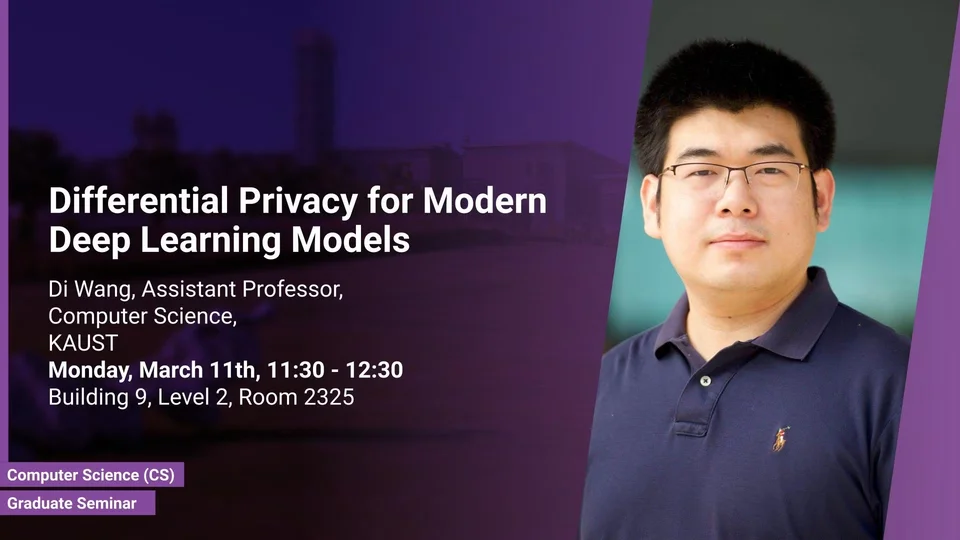
Differential Privacy for Modern Deep Learning Models Di Wang, Assistant Professor, Computer Science Mar 11, 11:30 - 12:30 B9 L2 H2 To protect privacy of training data for deep learning models, one line of work proposes to use Differential Privacy (DP). Over recent years, a substantial body of research has emerged, proposing a diverse array of differentially private training algorithms tailored to various deep learning models.
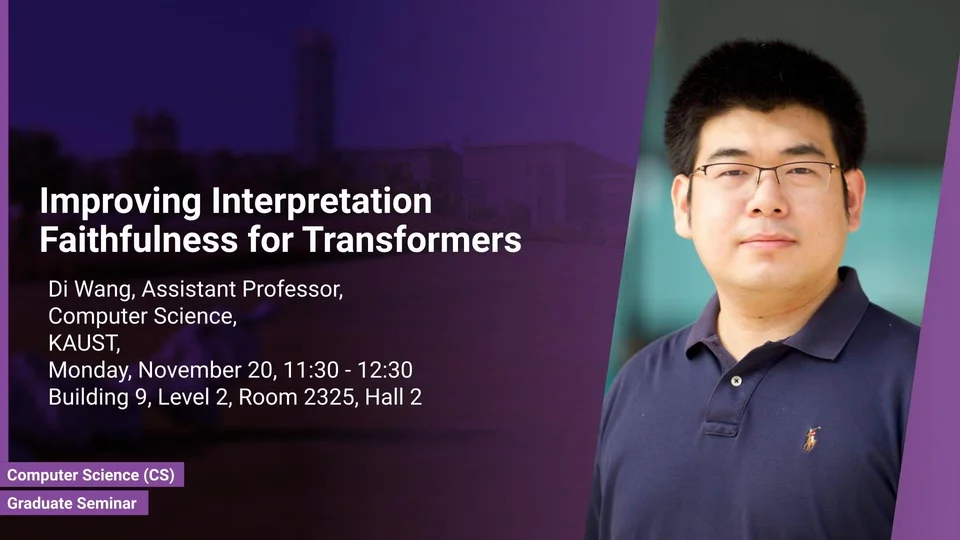
Improving Interpretation Faithfulness for Transformers Di Wang, Assistant Professor, Computer Science Nov 20, 11:30 - 12:30 B9 L2 H2 H2 transformers nlp interpretation faithfulness Currently, attention mechanism becomes a standard fixture in most state-of-the-art NLP, Vision and GNN models, not only due to outstanding performance it could gain, but also due to plausible innate explanation for the behaviors of neural architectures it provides, which is notoriously difficult to analyze. However, recent studies show that attention is unstable against randomness and perturbations during training or testing, such as random seeds and slight perturbation of input or embedding vectors, which impedes it from becoming a faithful explanation tool. Thus, a natural question is whether we can find some substitute of the current attention which is more stable and could keep the most important characteristics on explanation and prediction of attention.
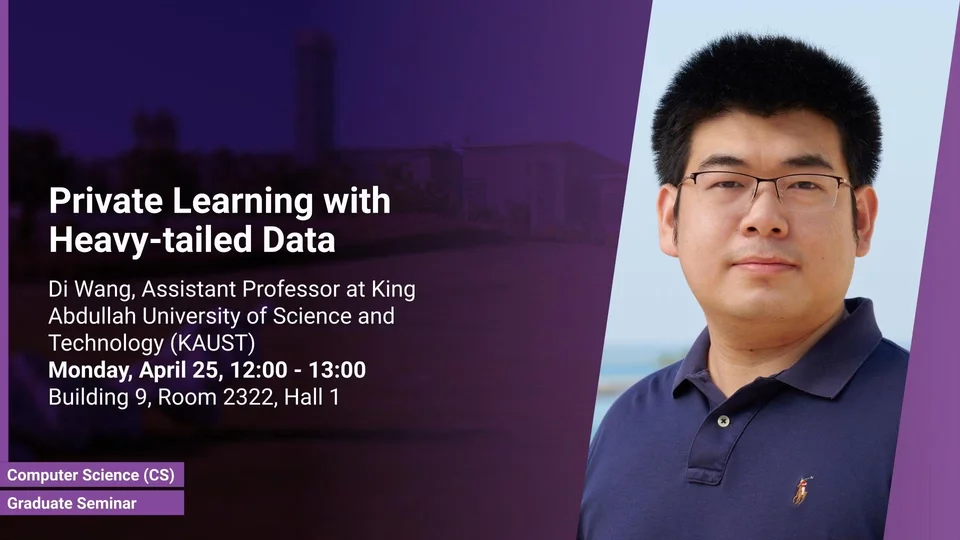
Private Learning with Heavy-tailed Data Di Wang, Assistant Professor, Computer Science Apr 25, 12:00 - 13:00 B9 R2322 H1 Differential Privacy (DP) allows for rich statistical and machine learning analysis, and is now becoming a gold standard for private data analysis. Despite the noticeable success of this theory, existing tools from DP are severely limited to regular datasets, e.g., datasets need to be or are assumed to be clean and normalized before performing DP algorithms.
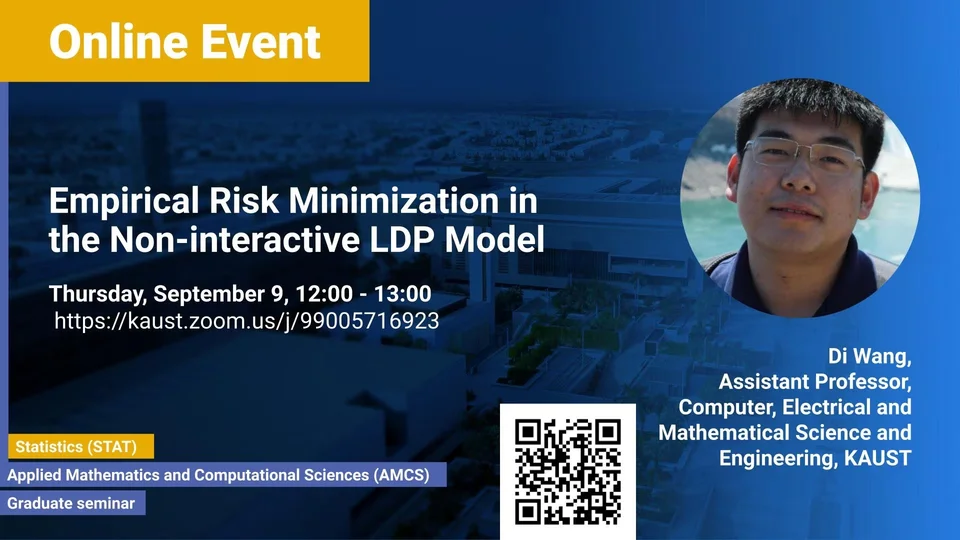
Empirical Risk Minimization in the Non-interactive LDP Model Di Wang, Assistant Professor, Computer Science Sep 9, 12:00 - 13:00 KAUST As a fundamental problem in both machine learning and privacy, Empirical Risk Minimization in the Differential Privacy Model (DP-ERM) received much attentions. However, most of the previous studies are either in the central DP model or interactive LDP model. In this talk, I will discuss some recent developments of DP-ERM in the non-interactive LDP model.
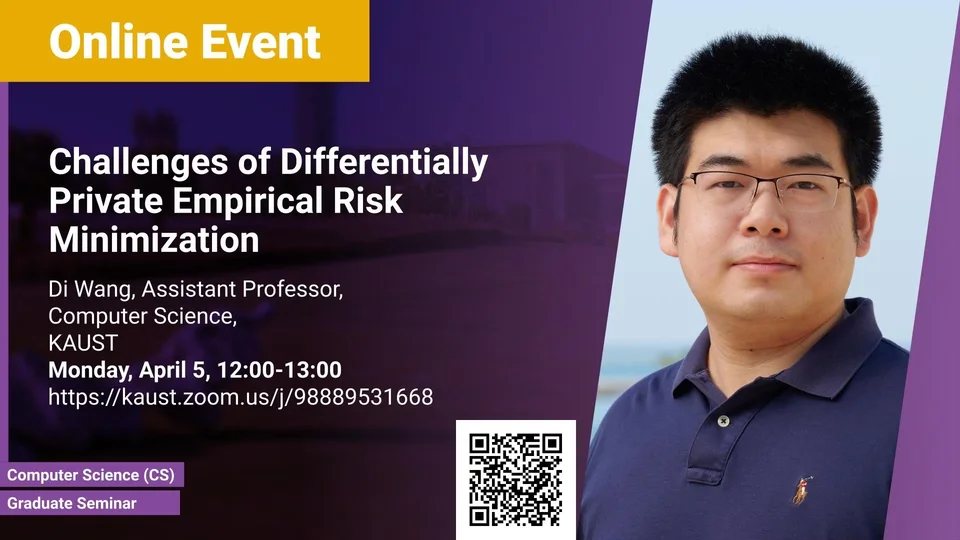
Challenges of Differentially Private Empirical Risk Minimization Di Wang, Assistant Professor, Computer Science Apr 5, 12:00 - 13:00 KAUST Recent research showed that most of the existing machine learning algorithms are vulnerable to various privacy attacks. An effective way for defending these attacks is to enforce differential privacy during the learning process. As a rigorous scheme for privacy preserving, Differential Privacy (DP) has now become a standard for private data analysis. Despite its rapid development in theory, DP's adoption to the machine learning community remains slow due to various challenges from the data, the privacy models and the learning tasks. In this talk, I will give a brief introduction on DP and use the Empirical Risk Minimization (ERM) problem as an example and show how to overcome these challenges in DP model. Particularly, I will first talk about how to overcome the high dimensionality challenge from the data for Sparse Linear Regression in the local DP (LDP) model. Then, I will discuss the challenge from the non-interactive LDP model and show a series of results to reduce the exponential sample complexity of ERM. Next, I will present techniques on achieving DP for ERM with non-convex loss functions. Finally, I will discuss some future research along these directions.
Engage ORCID ShareClipboard Related Sites Computer Science (CS) Center of Excellence for Generative AI (GenAI) Privacy Awareness, Responsibility and Trustworthy Lab (PART) Statistics (STAT) Related Content Articles 1 Events 6 Related Links Publications on Google Scholar LinkedIn Profile Personal website