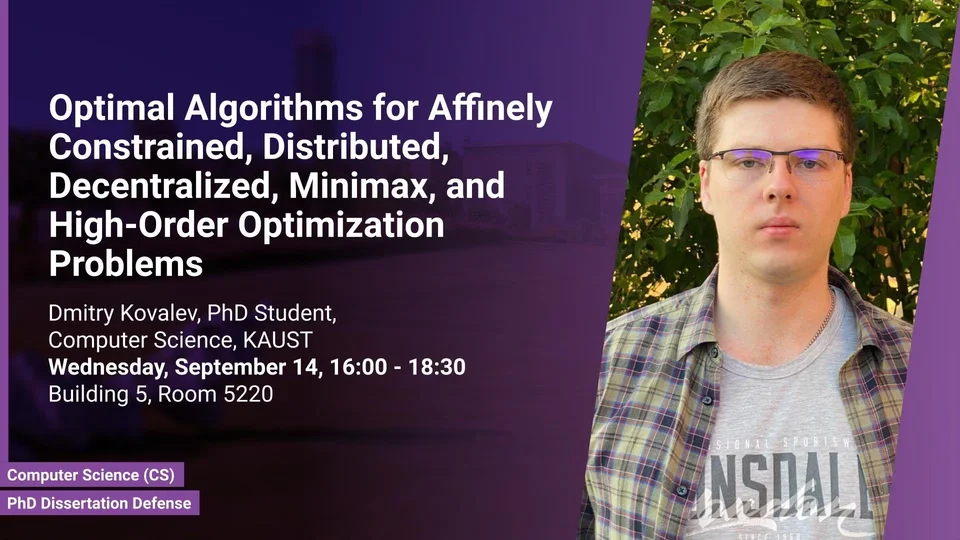
About Dmitry Kovalev Dmitry Kovalev Ph.D. Student, Computer Science optimization machine learning Education Dmitry obtained a B.S. degree from Moscow Institute of Physics and Technology, Moscow, Russia, in 2018. He is an M.S. in the Computer Science program at the King Abdullah University of Science and Technology as of Fall 2018. Publications Dmitry Kovalev, Samuel Horvath and Peter Richtárik. Don't Jump Through Hoops and Remove Those Loops: SVRG and Katyusha are Better Without the Outer Loop, arXiv preprint arXiv:1901.08689, 2019. Dmitry Kovalev, Peter Richtárik, Eduard Gorbunov, Elnur Gasanov. Stochastic Spectral and Conjugate Descent Methods . Advances in Neural Information Processing Events Presented Events Sep 11 - Sep 17, 2022 Optimal Algorithms for Affinely Constrained, Distributed, Decentralized, Minimax, and High-Order Optimization Problems Dmitry Kovalev, Ph.D. Student, Computer Science Sep 14, 16:00 - 18:30 B5 R5220 optimization machine learning In this thesis, we discuss a few fundamental and well-studied optimization problem classes: decentralized distributed optimization (Chapters 2 to 4), distributed optimization under similarity (Chapter 5), affinely constrained optimization (Chapter 6), minimax optimization (Chapter 7), and high-order optimization (Chapter 8). For each problem class, we develop the first provably optimal algorithm: the complexity of such an algorithm cannot be improved for the problem class given. The proposed algorithms show state-of-the-art performance in practical applications, which makes them highly attractive for potential generalizations and extensions in the future.
Optimal Algorithms for Affinely Constrained, Distributed, Decentralized, Minimax, and High-Order Optimization Problems Dmitry Kovalev, Ph.D. Student, Computer Science Sep 14, 16:00 - 18:30 B5 R5220 optimization machine learning In this thesis, we discuss a few fundamental and well-studied optimization problem classes: decentralized distributed optimization (Chapters 2 to 4), distributed optimization under similarity (Chapter 5), affinely constrained optimization (Chapter 6), minimax optimization (Chapter 7), and high-order optimization (Chapter 8). For each problem class, we develop the first provably optimal algorithm: the complexity of such an algorithm cannot be improved for the problem class given. The proposed algorithms show state-of-the-art performance in practical applications, which makes them highly attractive for potential generalizations and extensions in the future.
Related Sites Optimization and Machine Learning (OML) Computer Science (CS) Related Content Articles 1 Events 1 Related Links Google Scholar Personal Website