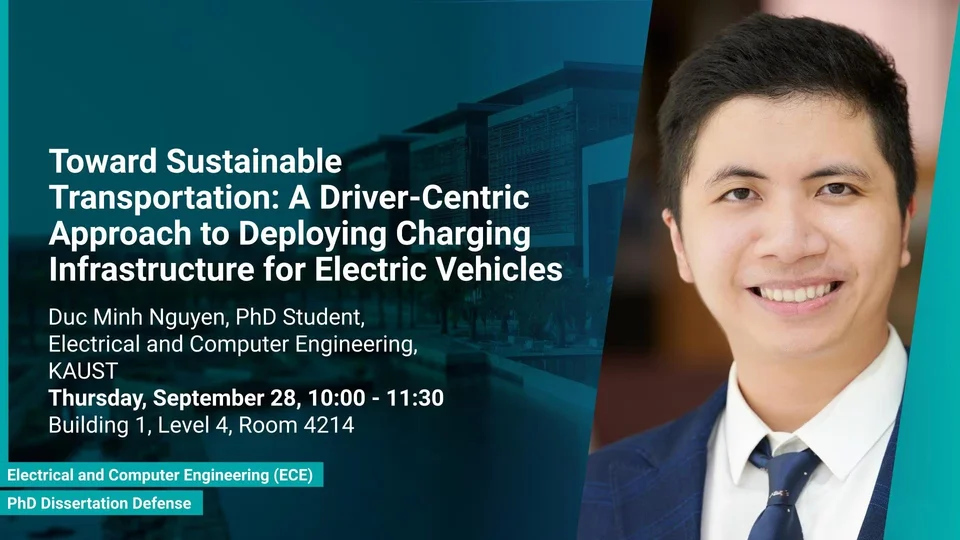
About Duc Minh Nguyen Duc Minh Nguyen Ph.D., Electrical and Computer Engineering Deep learning Mathematical modeling Duc Minh Nguyen is a Ph.D. student under the supervision of Professor Mohamed-Slim Alouini at the Computer, Electrical and Mathematical Science and Engineering (CEMSE) Division in King Abdullah University of Science and Technology (KAUST). Education and Early Career Minh is a graduate from Dankook University, Republic of Korea (2018) where he received a B.Eng. Degree in Mobile Systems Engineering, with a minor in International Business Administration. During his time at Dankook University, Minh worked on Social Networks Analysis. He developed an accurate spatial clustering algorithm based on Events Presented Events Sep 24 - Sep 30, 2023 Toward Sustainable Transportation: A Driver-Centric Approach to Deploying Charging Infrastructure for Electric Vehicles Duc Minh Nguyen, Ph.D., Electrical and Computer Engineering Sep 28, 10:00 - 11:30 B1 L4 R4214 Whether the future of transportation is going to be electric or not is no longer a question. Electric vehicles (EVs) offer several benefits toward global sustainability. However, without a variety of charging infrastructures that cover diverse forthcoming charging needs, the speed of vehicle electrification may be slow and limited. In the coming years, we project that charging stations will still likely meet most personal demands. However, novel charging alternatives such as dynamic charging systems, i.e., electrified roads that wirelessly charge EVs on the go, will fit into various public and commercial scenarios. In this thesis, we present a driver-centric approach to planning these infrastructures.
Toward Sustainable Transportation: A Driver-Centric Approach to Deploying Charging Infrastructure for Electric Vehicles Duc Minh Nguyen, Ph.D., Electrical and Computer Engineering Sep 28, 10:00 - 11:30 B1 L4 R4214 Whether the future of transportation is going to be electric or not is no longer a question. Electric vehicles (EVs) offer several benefits toward global sustainability. However, without a variety of charging infrastructures that cover diverse forthcoming charging needs, the speed of vehicle electrification may be slow and limited. In the coming years, we project that charging stations will still likely meet most personal demands. However, novel charging alternatives such as dynamic charging systems, i.e., electrified roads that wirelessly charge EVs on the go, will fit into various public and commercial scenarios. In this thesis, we present a driver-centric approach to planning these infrastructures.
Related Sites Electrical and Computer Engineering (ECE) Communication Theory Lab (CTL) Related Content Articles 3 Events 1 Related Links LinkedIn Google Scholar ORCID