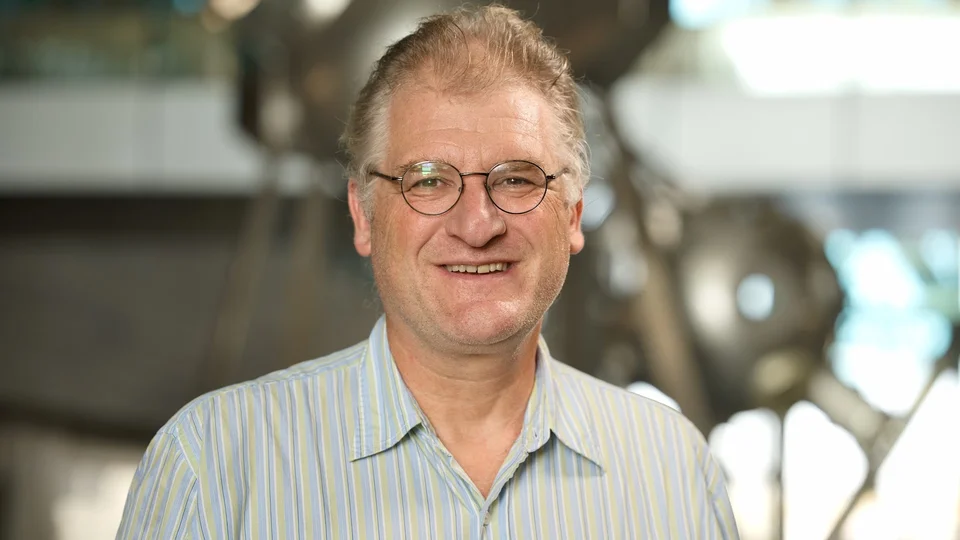
About Eric Feron Eric Feron Professor, Electrical and Computer Engineering control systems aerospace software system optimization robotics With 31 years of teaching and research experience, Professor Feron’s work utilizes elementary concepts of control systems, optimization and computer science to address critical issues in modern aerospace engineering and robotics. Events Presented Events Sep 28 - Oct 4, 2025 Robotics at KAUST Eric Feron, Professor, Electrical and Computer Engineering Sep 29, 12:00 - 13:00 B9 L2 R2325 robotics Robotics at KAUST is a system integration activity that relies on inputs from Computer Science, Software Engineering, Mechanical Engineering, and Electrical Engineering. A few examples of completed and ongoing robotics research at KAUST will be introduced and discussed. In addition, KAUST's new and large robotics bay will be described in detail. Sep 21 - Sep 27, 2025 Forays into modular drones: Sierpinsky tetrahedra, dodecahedra, and Alexander Graham Bell Eric Feron, Professor, Electrical and Computer Engineering Sep 21, 12:00 - 13:00 B9 L2 R2325 modular drons Modular drones offer attractive options for addressing demanding mission requirements without having to build monolithic and large machines. Several such drones have been designed, built, and flown at Georgia Tech's Decision and Control (DCL) laboratory and KAUST's Robotics, Intelligent Systems, and Control (RISC) laboratory. These drones attempt to address some of the perceived weaknesses of prior industrial and academic designs, including lack of structural integrity and possible identity confusion among the modules. Coincidentally, some of the designs echo the fractal kites designed by Alexander Graham Bell more than a century ago and still built and flown today. Mar 26 - Apr 1, 2023 Thoughts on software and systems engineering - 2023-03-27 Eric Feron, Professor, Electrical and Computer Engineering Mar 27, 12:00 - 13:00 B9 L2 H2 H2 Complex systems and software engineering, and associated challenges become increasingly important for the well-being and safety of our society of humans. Motivated by this push towards ever more complex systems and software of all sizes, spectacular failures, and decades of questioning in a variety of contexts and endeavors, this talk presents a theory of complex systems engineering, that is, a scientific theory in which an engineered system or software can be seen as a validated scientific hypothesis arising from a convergent mix of mathematical and validated experimental constructs. In its simplest form, a complex engineered system is a manufactured, validated scientific hypothesis arising from a mathematical theorem similar to those found in theoretical physics. This observation provides suggestions for improving system design, especially system architecture, by leveraging advanced mathematical and / or scientific concepts. In return, mathematicians and computer scientists can benefit from this bridge to engineering by bringing to bear many of their automated and manual theorem proving techniques to help with the design of complex systems. Thoughts on software and systems engineering - 2023-03-26 Eric Feron, Professor, Electrical and Computer Engineering Mar 26, 12:00 - 13:00 B9 L2 H2 Complex systems and software engineering, and associated challenges become increasingly important for the well-being and safety of our society of humans. Feb 27 - Mar 5, 2022 The KAUST Research Conference on Robotics and Autonomy 2022 Eric Feron, Professor, Electrical and Computer Engineering Feb 28, 08:00 - Mar 2, 20:00 B19 H1 robotics KAUST Robotics, Intelligent Systems and Control Lab (RISC Lab) will host the KAUST Research Conference on Robotics and Autonomy 2022 (#RobotoKAUST) from February 28 until March 2, 2022. The conference will address the most recent trends of robotics application in a range of disciplines. To attend RobotoKAUST Gala, please, read more about the event and follow the event registration instructions. Nov 7 - Nov 13, 2021 Lyapunov equations that go beyond Lyapunov equations for system stability and performance Eric Feron, Professor, Electrical and Computer Engineering Nov 7, 12:00 - 13:00 KAUST Lyapunov equations Lyapunov's stability theory, which was formulated around 1892, presents itself as a watershed event in the study of dynamical systems. Feb 7 - Feb 13, 2021 Ariadne: Building safe autonomy with unproven algorithms Eric Feron, Professor, Electrical and Computer Engineering Feb 7, 12:00 - 13:00 KAUST Ariadne safe autonomy unproven algorithms With the advent of increasingly intelligent algorithms, robots are capable of planning and performing increasingly challenging and creative tasks. Safety, however, remains an essential requirement on robotic behaviors. It is also a property that is hard or impossible to prove for virtually all intelligent algorithms of practical value. Ariadne is a model-based paradigm that enables the safe operation of many robotic systems, even though the algorithms involved with the operation may not be verifiable. Ariadne, or "plan B" engineering, will be illustrated in various current Robotics contexts derived from Ariadne's own Greek mythology, railroad systems, nuclear energy production, air transportation, and others. Nov 22 - Nov 28, 2020 The Tetracopter: A modular, self-similar flying robot Eric Feron, Professor, Electrical and Computer Engineering Nov 26, 12:00 - 13:00 KAUST Modular robotics deals with robots that are an assemblage of smaller sized and often identical robots. The benefits of modular robots are many, chief among them being how easily they can be transported from one location to another. Moreover, their size can be adjusted according to the task at hand without requiring extensive redesign or specialization, therefore making them the object of significant research efforts. Oct 18 - Oct 24, 2020 Aerospace Systems Research at KAUST, an uplifting experience Eric Feron, Professor, Electrical and Computer Engineering Oct 21, 12:00 - 13:00 KAUST Aerospace Systems research KAUST Aerospace Engineering is the source of much dreaming and worrying in most people's imagination. As such, it constitutes a marvelous support for the development and application of numerous disciplines, chief among them are aerodynamics, structures, flight and orbital mechanics. With time however, information technologies are progressively becoming the costliest activity within the aerospace engineering systems design phase. Indeed, they stand as the core elements of avionics systems, airline operations, air traffic control, spacecraft engineering, and planetary exploration, among others. Such subjects have been bringing much joy and teaching many lessons to your speaker for the past 30 years and will keep doing so, hopefully, for the next three decades. Nov 10 - Nov 16, 2019 Eric Feron's world: A short introduction Eric Feron, Professor, Electrical and Computer Engineering Nov 14, 12:00 - 13:00 B3 L5 R5209 aerospace information systems aerospace software engineering drones Lyapunov functions Over the past 30 years, my research has focused on problems involving aerospace information systems, give or take a couple of exceptions - I also seem to like things with wheels-. In the talk, I will introduce and discuss a few research topics that, I believe, best describe the kind of research I like to perform. The topics will include things as diverse as drones, airports, and the hunt for Lyapunov functions. I will also introduce an educational initiative focusing on systematically restoring "the sense of touch" in all Engineering disciplines, and which I would like to experiment with as part of the courses I will be in charge of at KAUST.
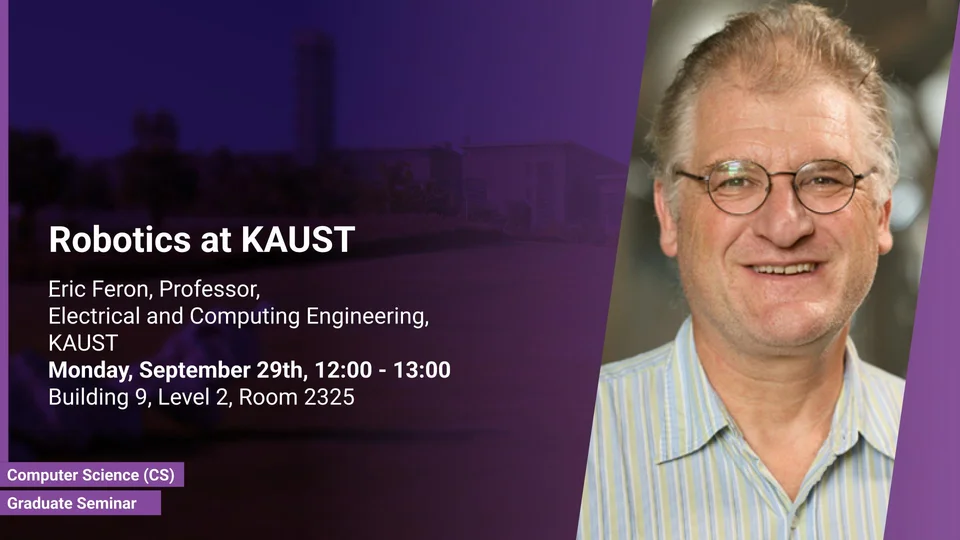
Robotics at KAUST Eric Feron, Professor, Electrical and Computer Engineering Sep 29, 12:00 - 13:00 B9 L2 R2325 robotics Robotics at KAUST is a system integration activity that relies on inputs from Computer Science, Software Engineering, Mechanical Engineering, and Electrical Engineering. A few examples of completed and ongoing robotics research at KAUST will be introduced and discussed. In addition, KAUST's new and large robotics bay will be described in detail.
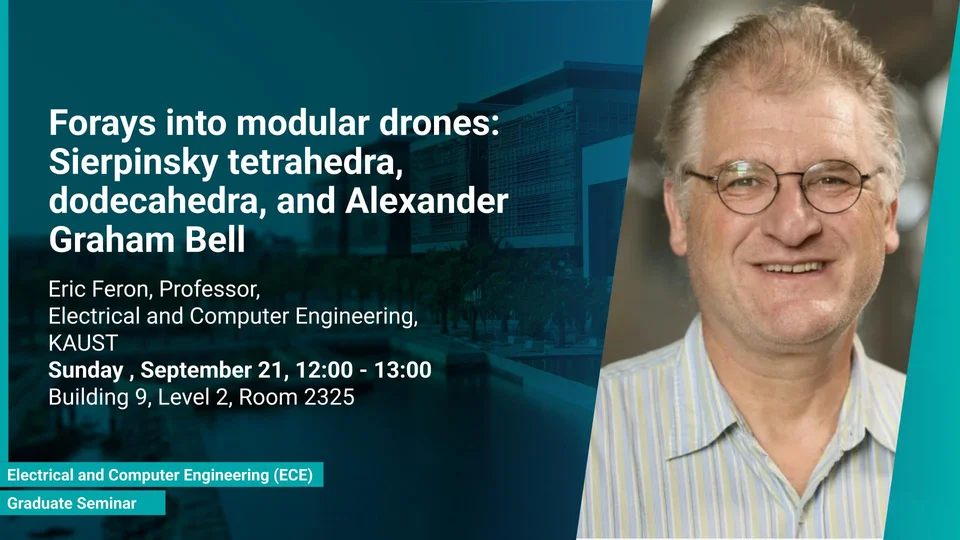
Forays into modular drones: Sierpinsky tetrahedra, dodecahedra, and Alexander Graham Bell Eric Feron, Professor, Electrical and Computer Engineering Sep 21, 12:00 - 13:00 B9 L2 R2325 modular drons Modular drones offer attractive options for addressing demanding mission requirements without having to build monolithic and large machines. Several such drones have been designed, built, and flown at Georgia Tech's Decision and Control (DCL) laboratory and KAUST's Robotics, Intelligent Systems, and Control (RISC) laboratory. These drones attempt to address some of the perceived weaknesses of prior industrial and academic designs, including lack of structural integrity and possible identity confusion among the modules. Coincidentally, some of the designs echo the fractal kites designed by Alexander Graham Bell more than a century ago and still built and flown today.
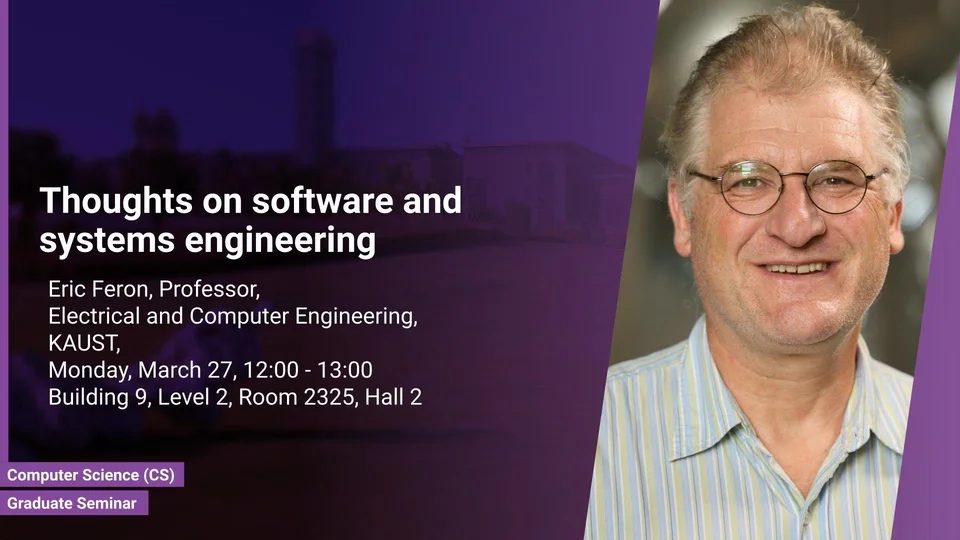
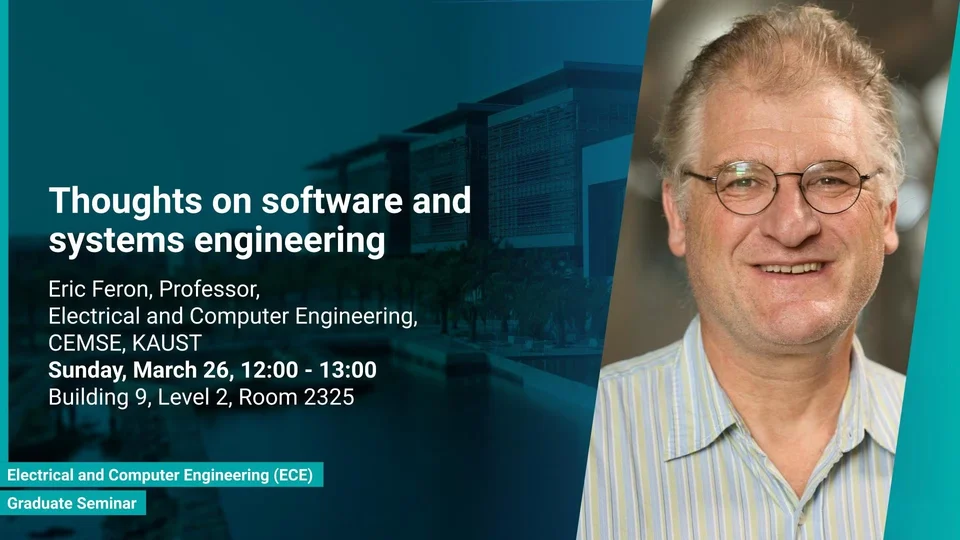
Thoughts on software and systems engineering - 2023-03-27 Eric Feron, Professor, Electrical and Computer Engineering Mar 27, 12:00 - 13:00 B9 L2 H2 H2 Complex systems and software engineering, and associated challenges become increasingly important for the well-being and safety of our society of humans. Motivated by this push towards ever more complex systems and software of all sizes, spectacular failures, and decades of questioning in a variety of contexts and endeavors, this talk presents a theory of complex systems engineering, that is, a scientific theory in which an engineered system or software can be seen as a validated scientific hypothesis arising from a convergent mix of mathematical and validated experimental constructs. In its simplest form, a complex engineered system is a manufactured, validated scientific hypothesis arising from a mathematical theorem similar to those found in theoretical physics. This observation provides suggestions for improving system design, especially system architecture, by leveraging advanced mathematical and / or scientific concepts. In return, mathematicians and computer scientists can benefit from this bridge to engineering by bringing to bear many of their automated and manual theorem proving techniques to help with the design of complex systems.
Thoughts on software and systems engineering - 2023-03-26 Eric Feron, Professor, Electrical and Computer Engineering Mar 26, 12:00 - 13:00 B9 L2 H2 Complex systems and software engineering, and associated challenges become increasingly important for the well-being and safety of our society of humans.
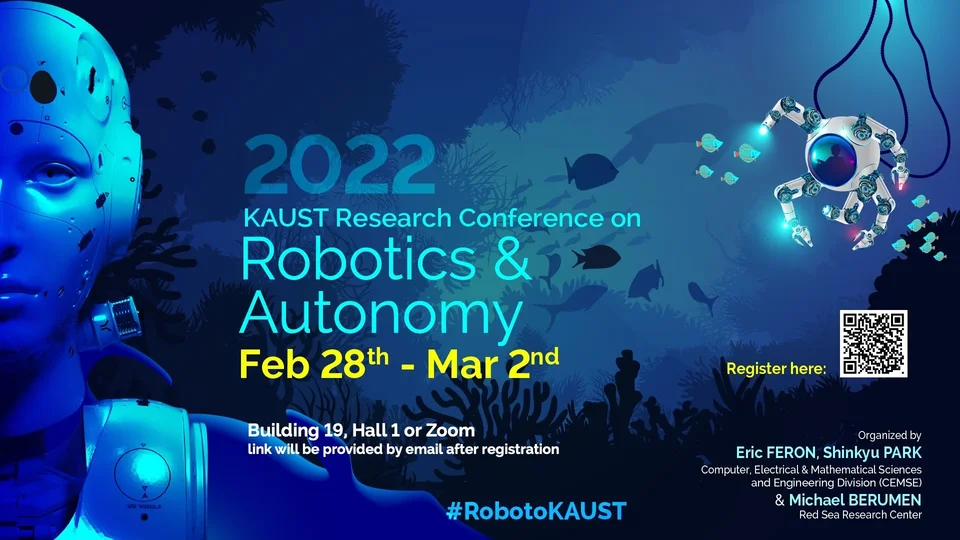
The KAUST Research Conference on Robotics and Autonomy 2022 Eric Feron, Professor, Electrical and Computer Engineering Feb 28, 08:00 - Mar 2, 20:00 B19 H1 robotics KAUST Robotics, Intelligent Systems and Control Lab (RISC Lab) will host the KAUST Research Conference on Robotics and Autonomy 2022 (#RobotoKAUST) from February 28 until March 2, 2022. The conference will address the most recent trends of robotics application in a range of disciplines. To attend RobotoKAUST Gala, please, read more about the event and follow the event registration instructions.
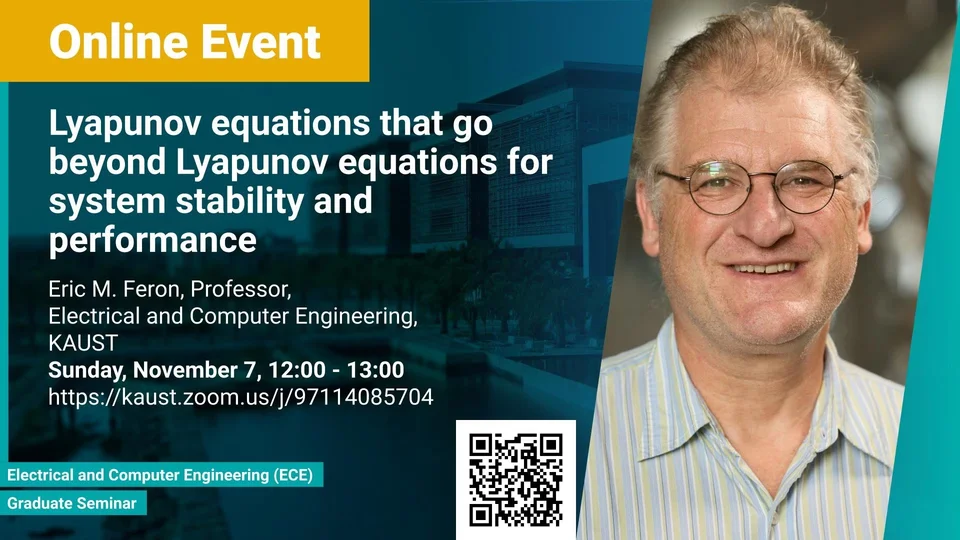
Lyapunov equations that go beyond Lyapunov equations for system stability and performance Eric Feron, Professor, Electrical and Computer Engineering Nov 7, 12:00 - 13:00 KAUST Lyapunov equations Lyapunov's stability theory, which was formulated around 1892, presents itself as a watershed event in the study of dynamical systems.
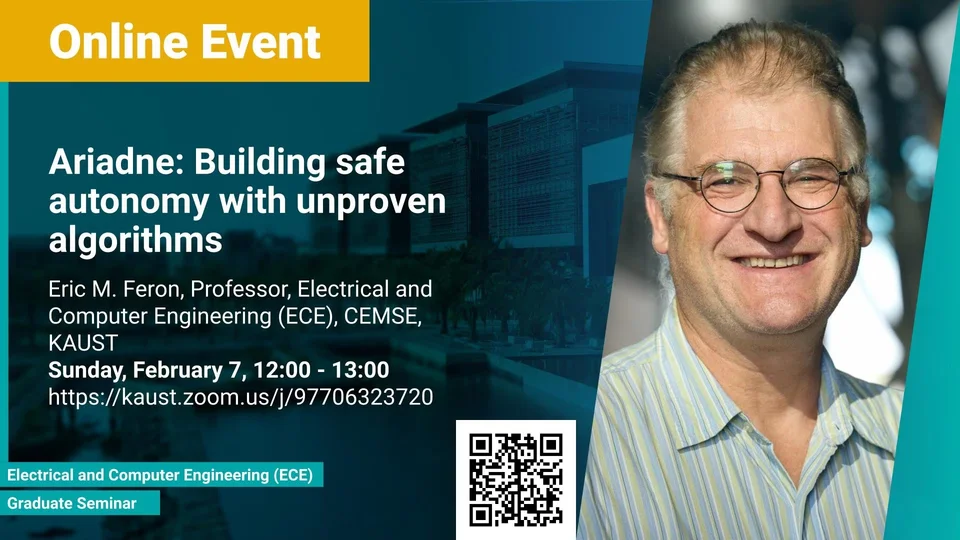
Ariadne: Building safe autonomy with unproven algorithms Eric Feron, Professor, Electrical and Computer Engineering Feb 7, 12:00 - 13:00 KAUST Ariadne safe autonomy unproven algorithms With the advent of increasingly intelligent algorithms, robots are capable of planning and performing increasingly challenging and creative tasks. Safety, however, remains an essential requirement on robotic behaviors. It is also a property that is hard or impossible to prove for virtually all intelligent algorithms of practical value. Ariadne is a model-based paradigm that enables the safe operation of many robotic systems, even though the algorithms involved with the operation may not be verifiable. Ariadne, or "plan B" engineering, will be illustrated in various current Robotics contexts derived from Ariadne's own Greek mythology, railroad systems, nuclear energy production, air transportation, and others.
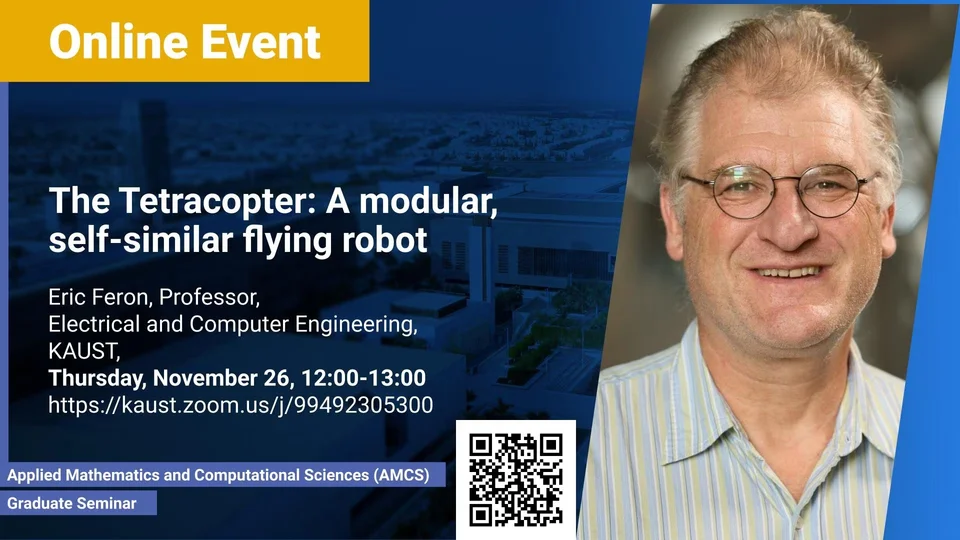
The Tetracopter: A modular, self-similar flying robot Eric Feron, Professor, Electrical and Computer Engineering Nov 26, 12:00 - 13:00 KAUST Modular robotics deals with robots that are an assemblage of smaller sized and often identical robots. The benefits of modular robots are many, chief among them being how easily they can be transported from one location to another. Moreover, their size can be adjusted according to the task at hand without requiring extensive redesign or specialization, therefore making them the object of significant research efforts.
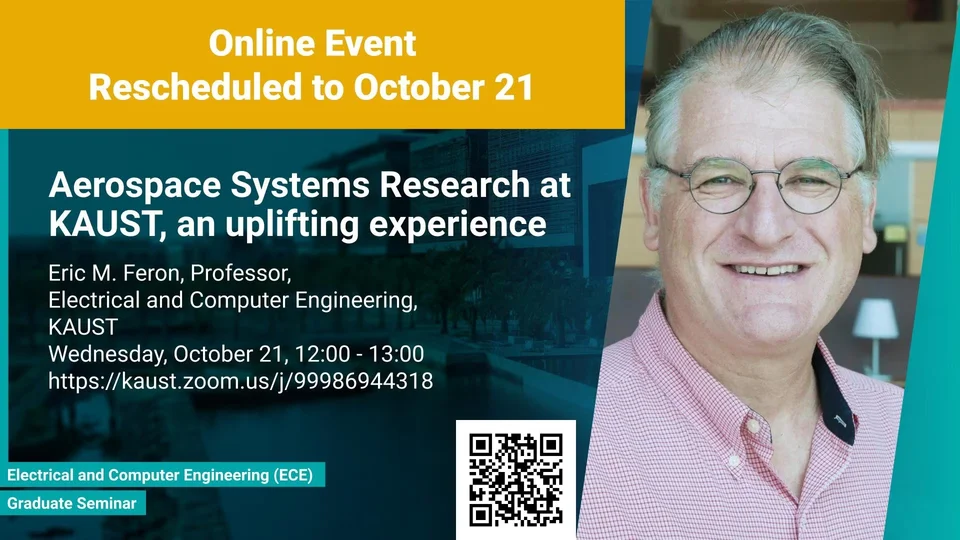
Aerospace Systems Research at KAUST, an uplifting experience Eric Feron, Professor, Electrical and Computer Engineering Oct 21, 12:00 - 13:00 KAUST Aerospace Systems research KAUST Aerospace Engineering is the source of much dreaming and worrying in most people's imagination. As such, it constitutes a marvelous support for the development and application of numerous disciplines, chief among them are aerodynamics, structures, flight and orbital mechanics. With time however, information technologies are progressively becoming the costliest activity within the aerospace engineering systems design phase. Indeed, they stand as the core elements of avionics systems, airline operations, air traffic control, spacecraft engineering, and planetary exploration, among others. Such subjects have been bringing much joy and teaching many lessons to your speaker for the past 30 years and will keep doing so, hopefully, for the next three decades.
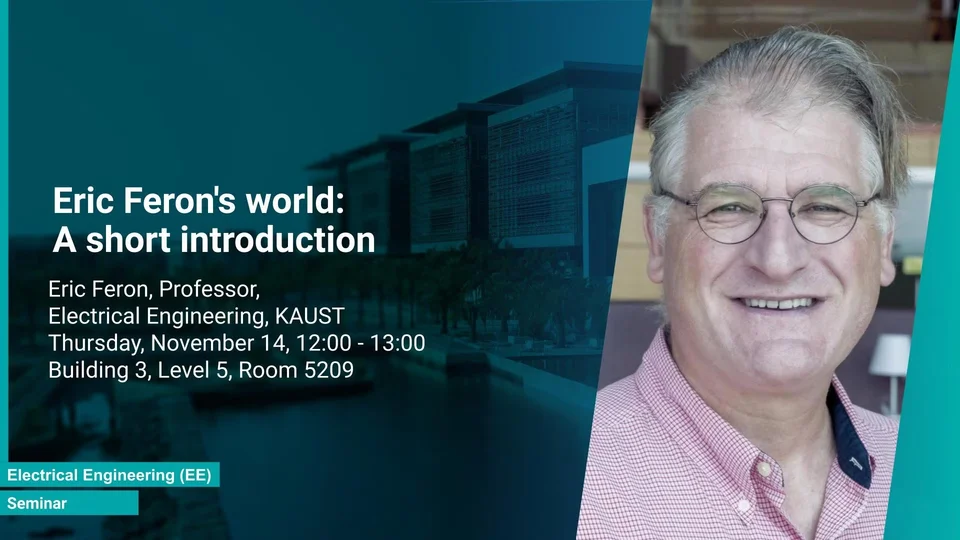
Eric Feron's world: A short introduction Eric Feron, Professor, Electrical and Computer Engineering Nov 14, 12:00 - 13:00 B3 L5 R5209 aerospace information systems aerospace software engineering drones Lyapunov functions Over the past 30 years, my research has focused on problems involving aerospace information systems, give or take a couple of exceptions - I also seem to like things with wheels-. In the talk, I will introduce and discuss a few research topics that, I believe, best describe the kind of research I like to perform. The topics will include things as diverse as drones, airports, and the hunt for Lyapunov functions. I will also introduce an educational initiative focusing on systematically restoring "the sense of touch" in all Engineering disciplines, and which I would like to experiment with as part of the courses I will be in charge of at KAUST.
Engage LinkedIn ORCID KAUST Repository KAUST Academic Portal Google Scholar ShareClipboard Related Sites Electrical and Computer Engineering (ECE) Computer Science (CS) Mechanical Engineering (ME) KAUST Research Conference on Robotics and Autonomy (RobotoKAUST) Aerospace and Transportation Systems (ATS) Related Content Articles 25 Events 10