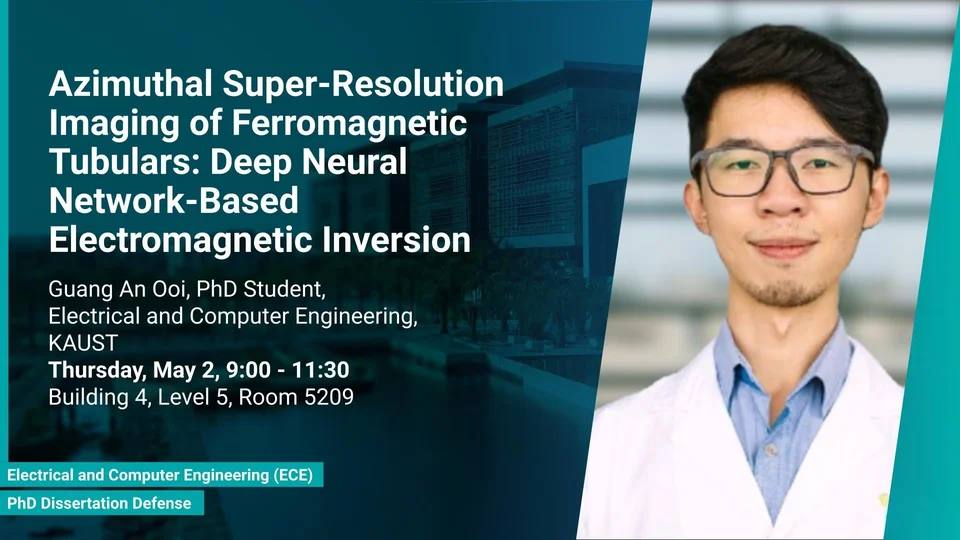
About Guang An Ooi Guang An Ooi Ph.D. Student, Electrical and Computer Engineering machine learning software development Computer simulations Research Interests Guang develops systems for real-time wellbore casing inspection and 3D visualization. He constructs novel neural networks for electromagnetic inspection tools developed in conjunction with the MERGE team, which generates casing cross-sectional images from spatio-temporal data. In addition, Guang is interested in programming drilling simulators in Java and Python. Education Profile B.Sc., Aeronautics and Astronautics Engineering, National Cheng Kung University, Taiwan, 2017 M.Sc., Electrical Engineering, King Abdullah University of Science and Technology, Saudi Arabia, 2019 Events Presented Events Apr 28 - May 4, 2024 Azimuthal Super-Resolution Imaging of Ferromagnetic Tubulars: Deep Neural Network-Based Electromagnetic Inversion Guang An Ooi, Ph.D. Student, Electrical and Computer Engineering May 2, 09:00 - 11:30 B4 L5 R5209 The structural integrity of wellbore casings and transportation pipelines is a critical aspect in the oil and gas industry for operational efficiency and environmental safety. Traditional non-destructive testing methods, while effective, face significant challenges in accurately assessing and monitoring these crucial infrastructural components, especially under harsh operating environments. Furthermore, the inner volume of these tubular structures and the flow speed of transported liquids pose additional difficulties upon the performance of devices designed to inspect their structures for defects and deformations.
Azimuthal Super-Resolution Imaging of Ferromagnetic Tubulars: Deep Neural Network-Based Electromagnetic Inversion Guang An Ooi, Ph.D. Student, Electrical and Computer Engineering May 2, 09:00 - 11:30 B4 L5 R5209 The structural integrity of wellbore casings and transportation pipelines is a critical aspect in the oil and gas industry for operational efficiency and environmental safety. Traditional non-destructive testing methods, while effective, face significant challenges in accurately assessing and monitoring these crucial infrastructural components, especially under harsh operating environments. Furthermore, the inner volume of these tubular structures and the flow speed of transported liquids pose additional difficulties upon the performance of devices designed to inspect their structures for defects and deformations.
Related Sites Electrical and Computer Engineering (ECE) Mechatronics and Energy Systems (MERGE) Related Content Articles 7 Events 1 Related Links linkedin