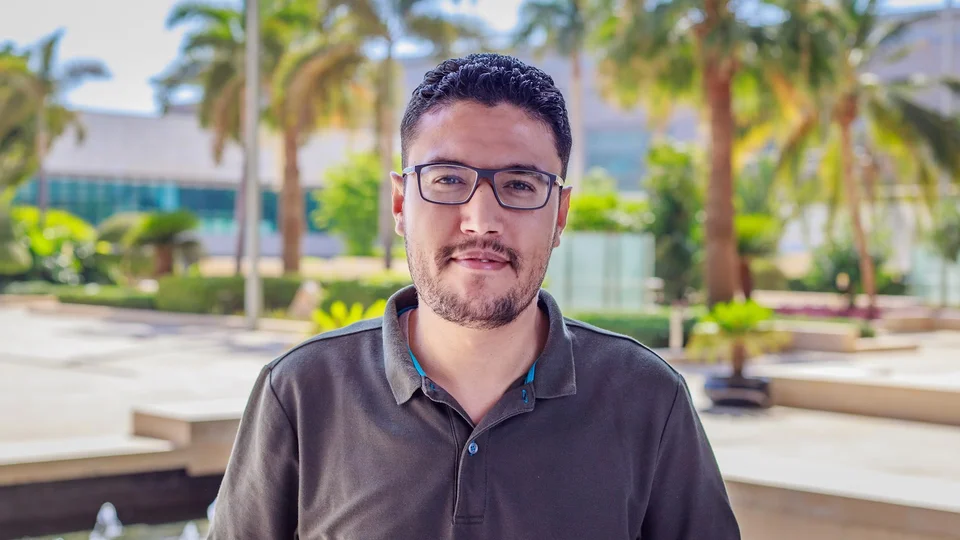
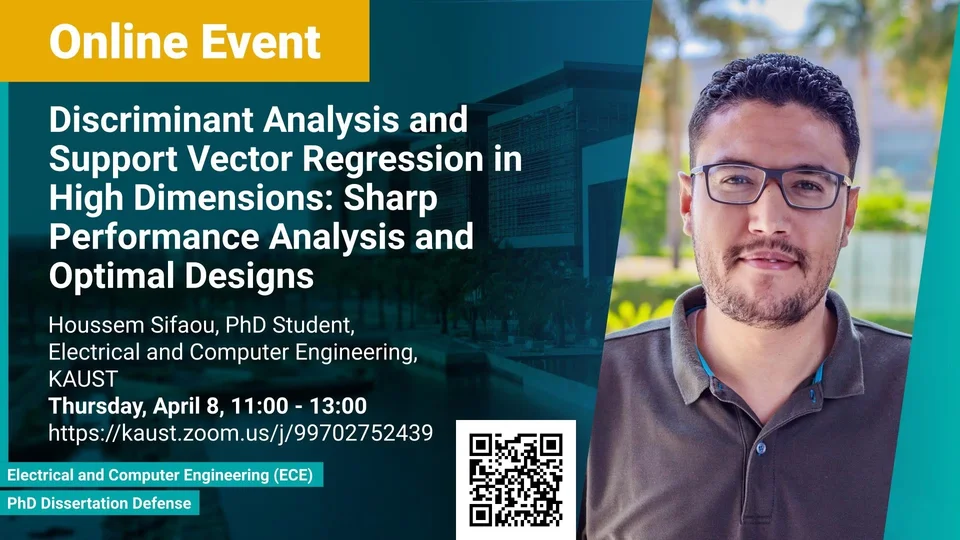
About Houssem Sifaou Houssem Sifaou Ph.D., Electrical and Computer Engineering Visible light communications Random Matrix Theory Wireless Communications machine learning Asymptotic Performance Analysis Ultra-Massive MIMO Houssem Sifaou is a Ph.D. candidate in Electrical Engineering, King Abdullah University of Science and Technology (KAUST), working with Professor Mohamed-Slim Alouini in the Communication Theory Laboratory (CTL). Education and Early Career Houssem Sifaou received the Engineering Degree (Hons.) in Signal and Systems from Tunisia Polytechnic School, La Marsa, Tunisia, in 2014 and the M.S. degree in Electrical Engineering from King Abdullah University of Science and Technology (KAUST), Thuwal, Saudi Arabia, in 2016. Scientific Interest Houssem Sifaou is interested in Random Matrix Theory Events Presented Events Apr 4 - Apr 10, 2021 Discriminant Analysis and Support Vector Regression in High Dimensions: Sharp Performance Analysis and Optimal Designs Houssem Sifaou, Ph.D., Electrical and Computer Engineering Apr 8, 11:00 - 13:00 KAUST Machine learning is emerging as a powerful tool to data science and is being applied in almost all subjects. In many applications, the number of features is comparable or even larger than the number of samples, and both grow large. This setting is usually named the high-dimensional regime. In this regime, new challenges and questions arise when it comes to the application of machine learning. In this work, we conduct a high-dimensional performance analysis of some popular classification and regression techniques. In a first part, discriminant analysis classifiers are considered. A major challenge towards the use of these classifiers in practice is that they depend on the inverse of covariance matrices that need to be estimated from training data. Several estimators for the inverse of the covariance matrices can be used. The most common ones are estimators based on the regularization approach. The main advantage of such estimators is their resilience to the sampling noise, making them suitable to high-dimensional settings. In this thesis, we propose new estimators that are shown to yield better performance.
Discriminant Analysis and Support Vector Regression in High Dimensions: Sharp Performance Analysis and Optimal Designs Houssem Sifaou, Ph.D., Electrical and Computer Engineering Apr 8, 11:00 - 13:00 KAUST Machine learning is emerging as a powerful tool to data science and is being applied in almost all subjects. In many applications, the number of features is comparable or even larger than the number of samples, and both grow large. This setting is usually named the high-dimensional regime. In this regime, new challenges and questions arise when it comes to the application of machine learning. In this work, we conduct a high-dimensional performance analysis of some popular classification and regression techniques. In a first part, discriminant analysis classifiers are considered. A major challenge towards the use of these classifiers in practice is that they depend on the inverse of covariance matrices that need to be estimated from training data. Several estimators for the inverse of the covariance matrices can be used. The most common ones are estimators based on the regularization approach. The main advantage of such estimators is their resilience to the sampling noise, making them suitable to high-dimensional settings. In this thesis, we propose new estimators that are shown to yield better performance.
Related Sites Electrical and Computer Engineering (ECE) Communication Theory Lab (CTL) Related Content Events 1 Related Links LinkedIn Google Scholar ORCID