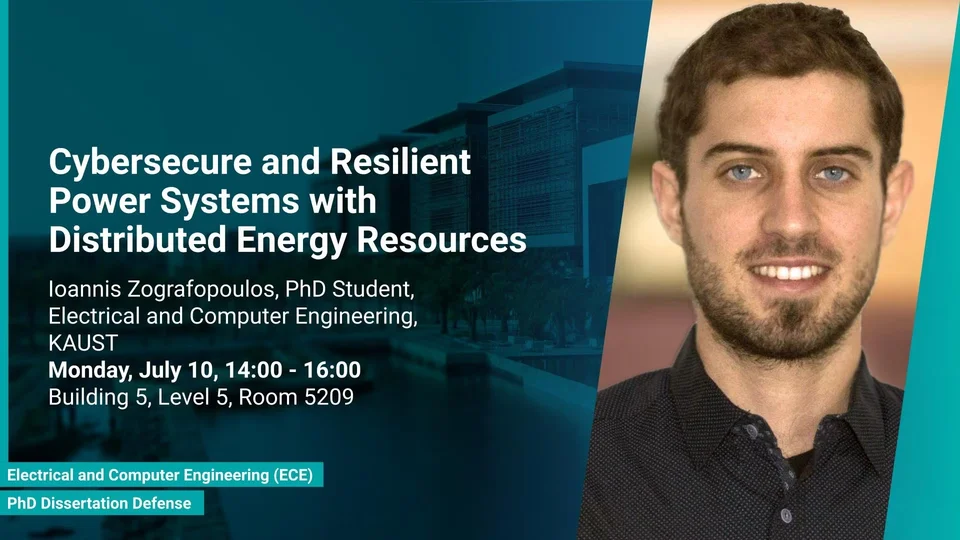
About Ioannis (Yannis) Zografopoulos Ioannis (Yannis) Zografopoulos Ph.D. Student, Electrical and Computer Engineering cybersecurity cyber-physical systems embedded systems internet of things security industrial control systems Ioannis Zografopoulos received his Ph.D. at the Computer, Electrical, and Mathematical Sciences and Engineering Division (CEMSE) of King Abdullah University of Science and Technology (KAUST) in 2023. Prior, he graduated with a B.Eng. and M.Eng. degrees in Computer, Communications, and Network Engineering, and an M.Sc. degree in Electrical and Computer Engineering from the University of Thessaly, Volos, Greece, in 2014 and 2015, respectively. His research interests include cyber-physical systems security, with an emphasis on embedded systems for industrial, distributed energy, and power grid Events Presented Events Jul 9 - Jul 15, 2023 Cybersecure and Resilient Power Systems with Distributed Energy Resources Ioannis (Yannis) Zografopoulos, Ph.D. Student, Electrical and Computer Engineering Jul 10, 14:00 - 16:00 B5 L5 R5209 Power systems constitute a pillar of the critical infrastructure, and, as a result, their cybersecurity is paramount. Traditional power system architectures are moving from their original centralized nature to a distributed paradigm. This transition has been propelled by the rapid penetration of distributed energy resources (DERs) such as rooftop solar panels, battery storage, etc. However, with the introduction of new DER devices, the threat surface of power systems is inadvertently expanding.
Cybersecure and Resilient Power Systems with Distributed Energy Resources Ioannis (Yannis) Zografopoulos, Ph.D. Student, Electrical and Computer Engineering Jul 10, 14:00 - 16:00 B5 L5 R5209 Power systems constitute a pillar of the critical infrastructure, and, as a result, their cybersecurity is paramount. Traditional power system architectures are moving from their original centralized nature to a distributed paradigm. This transition has been propelled by the rapid penetration of distributed energy resources (DERs) such as rooftop solar panels, battery storage, etc. However, with the introduction of new DER devices, the threat surface of power systems is inadvertently expanding.
Engage ORCID ShareClipboard Related Sites Electrical and Computer Engineering (ECE) Secure Next Generation Resilient Systems Lab (SENTRY) Related Content Articles 8 Events 1