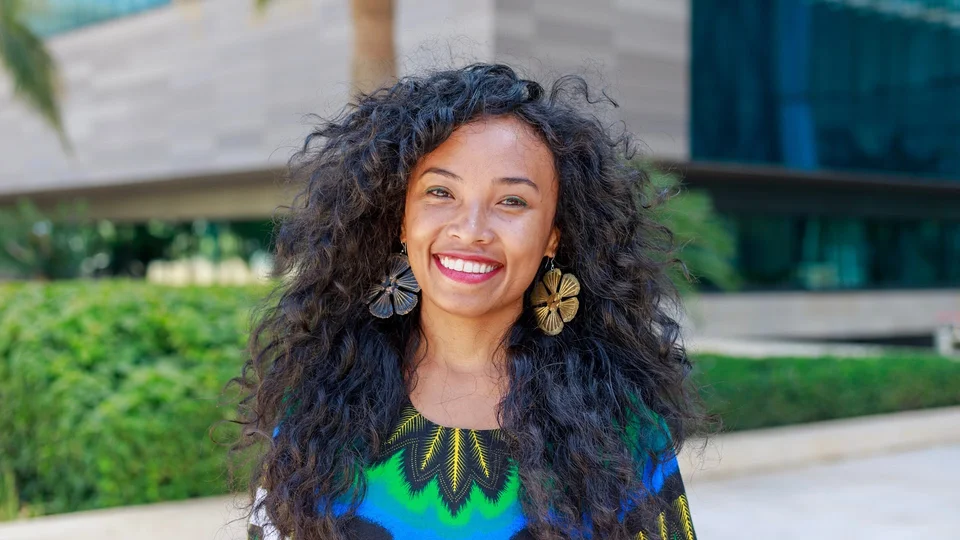
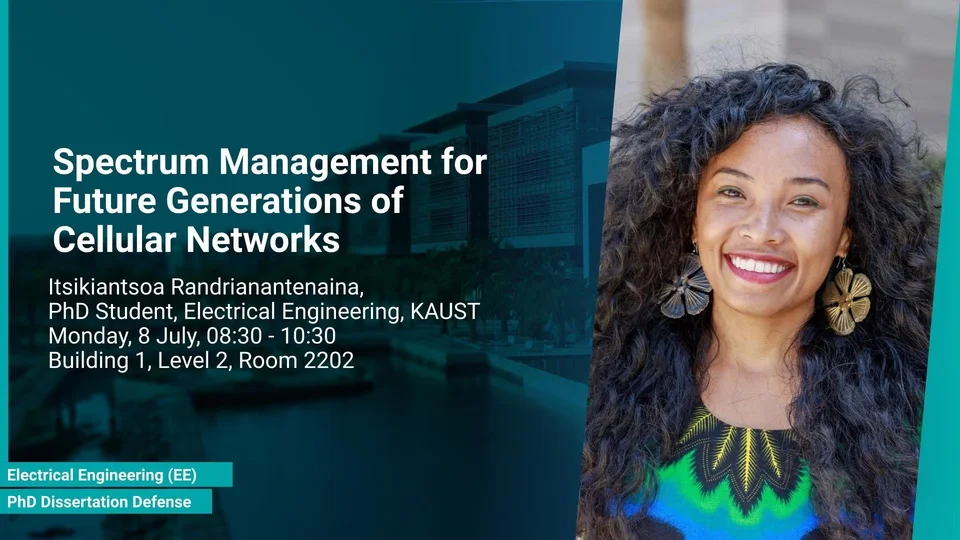
About Itsikiantsoa Randrianantenaina Itsikiantsoa Randrianantenaina Ph.D., Electrical and Computer Engineering Cooperative communications Wireless Communications optimization Cellular Networks Itsikiantsoa Randrianantenaina received the Engineering Diploma degree from the Institut National des Postes et Telecommunications, Rabat, Morocco, in 2013, and the M.S. degree in electrical engineering from the King Abdullah University of Science and Technology (KAUST), Thuwal, Saudi Arabia, from June 2015- June 2019, where she earned the Ph.D. degree and Joined NEOM, Saudi Arabia, as a Research Engineer after graduation. Her research interests include full-duplex and NOMA systems, interference management, FogRAN architecture, stochastic geometry, and optimization. Education Profile Ph.D Events Presented Events Jul 7 - Jul 13, 2019 Spectrum Management for Future Generations of Cellular Networks Itsikiantsoa Randrianantenaina, Ph.D., Electrical and Computer Engineering Jul 8, 08:30 - 10:30 B1 L2 R2202 Wireless Communications Stochastic Geometry optimization Cellular Networks The demand for wireless communication is ceaselessly increasing in terms of the number of subscribers and services. Future generations of cellular networks are expected to allow not only humans but also machines to be immersively connected. However, the radio frequency spectrum is already fully allocated. Therefore, developing techniques to increase spectrum efficiency has become necessary. In that context, this dissertation analyzes two spectrum sharing techniques that enable efficient utilization of the available radio resources in cellular networks. The first technique, called full-duplex (FD) communication, uses the same spectrum to transmit and receive simultaneously. The second spectrum sharing technique, called non-orthogonal multiple access (NOMA), allows a transmitter to communicate with multiple receivers through the same frequency-time resource unit.
Spectrum Management for Future Generations of Cellular Networks Itsikiantsoa Randrianantenaina, Ph.D., Electrical and Computer Engineering Jul 8, 08:30 - 10:30 B1 L2 R2202 Wireless Communications Stochastic Geometry optimization Cellular Networks The demand for wireless communication is ceaselessly increasing in terms of the number of subscribers and services. Future generations of cellular networks are expected to allow not only humans but also machines to be immersively connected. However, the radio frequency spectrum is already fully allocated. Therefore, developing techniques to increase spectrum efficiency has become necessary. In that context, this dissertation analyzes two spectrum sharing techniques that enable efficient utilization of the available radio resources in cellular networks. The first technique, called full-duplex (FD) communication, uses the same spectrum to transmit and receive simultaneously. The second spectrum sharing technique, called non-orthogonal multiple access (NOMA), allows a transmitter to communicate with multiple receivers through the same frequency-time resource unit.
Engage ORCID ShareClipboard Related Sites Electrical and Computer Engineering (ECE) Communication Theory Lab (CTL) Related Content Articles 1 Events 1 Related Links LinkedIn dblp Scopus Convocation Speech KAUST 2016