About Jesper Tegnér Jesper Tegnér Professor, Bioscience living systems machine learning machine intelligence systems medicine genomics artificial intelligence brain-inspired computation Systems neuroscience algorithmic information theory Dynamical Systems spatial transcriptomics single cell biology Jasper Tegnér is an M.D./Ph.D., innovator and professor with over 350 publications, dedicated to exploring the interconnected mechanisms underlying life, intelligence and the mind. His research aims to advance fundamental progress in artificial intelligence by moving beyond engineering to understand the intrinsic modes of operation within cells, between cells and within the brain. Articles Related News August 2024 Adapting AI to identify Arabic dialects 1 min read · Thu, Aug 29 2024 News Clip News KAUST researchers, led by intern Srijith Radhakrishnan, have developed an innovative model for Arabic dialect identification using a parameter-efficient approach that fine-tunes the Whisper speech recognition model, achieving high accuracy with minimal resources and paving the way for broader applications in fields like healthcare and multimodal communication. May 2021 Neural Visiolingual Editor 1 min read · Mon, May 31 2021 News Learning to Edit 3D Structural variations with Language Guidance with Neural Networks Goal: Starting from a blank slate or an initial 3D model loaded from disk, a user can iteratively refine the model by issuing commands in the form of natural language. We consider and exploit synergies between two geometric 3D application domains: furniture and whole-cell modeling Investigator: Mohamed Elhoseiny Peter Wonka Ivan Viola Jesper Tengner
Adapting AI to identify Arabic dialects 1 min read · Thu, Aug 29 2024 News Clip News KAUST researchers, led by intern Srijith Radhakrishnan, have developed an innovative model for Arabic dialect identification using a parameter-efficient approach that fine-tunes the Whisper speech recognition model, achieving high accuracy with minimal resources and paving the way for broader applications in fields like healthcare and multimodal communication.
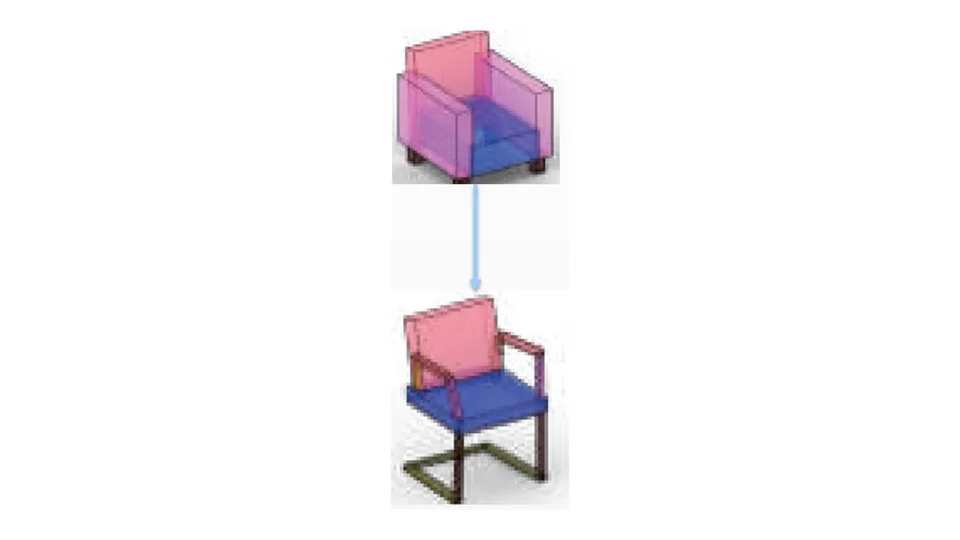
Neural Visiolingual Editor 1 min read · Mon, May 31 2021 News Learning to Edit 3D Structural variations with Language Guidance with Neural Networks Goal: Starting from a blank slate or an initial 3D model loaded from disk, a user can iteratively refine the model by issuing commands in the form of natural language. We consider and exploit synergies between two geometric 3D application domains: furniture and whole-cell modeling Investigator: Mohamed Elhoseiny Peter Wonka Ivan Viola Jesper Tengner
Engage LinkedIn KAUST Repository KAUST Academic Portal ORCID Scopus ShareClipboard Related Sites Biological and Environmental Science and Engineering (BESE) Bioscience (B) Bioengineering (BioE) Statistics (STAT) Computer Science (CS) Living Systems Laboratory (LivingSystems) Related Content Articles 2 Related Links Publications on Google Scholar Living Systems Laboratory